Narrative Magic: Effective Techniques for Compelling Stories

Effective narrative techniques can transform a simple tale into a gripping journey. These techniques are not just for budding novelists; they are essential tools for anyone crafting a story with the power to engage, inspire, and create impact. If you're looking for a quick list of what makes a story compelling, here are the key techniques:
- Narrative Hook: Capture attention right from the start.
- Rich Setting: Make your readers feel the place and time.
- Character Development: Create memorable and relatable characters.
- Dialogue: Use conversations to reveal personality and plot.
- Imagery: Engage the senses with vivid descriptions.
- Pace and Timing: Keep the story moving with a balanced flow.
- Point of View: Choose the right perspective to tell your story.
These methods can help non-profits, social impact organizations, and story-driven brands to better connect with their audiences by ensuring their messages are memorable and impactful.
Stories are not just about recounting events; they are about creating experiences. By using effective storytelling methods and narrative devices, you can amplify your mission and resonate deeply with your audience, fostering both awareness and action.

Effective narrative techniques word roundup:
Understanding Effective Narrative Techniques
Narrative techniques are the tools that bring stories to life. They help shape how a story is told, making it memorable and engaging. Effective narrative techniques are crucial, whether you're writing a novel, crafting a speech, or telling a tale for a non-profit cause.
Storytelling Methods
Storytelling methods are the strategies used to convey a story. These methods focus on how the narrative unfolds and how the audience experiences it. Think of them as the blueprint for your storytelling.
- Chronological: Events unfold in the order they happen. This is straightforward and easy for audiences to follow.
- Non-linear: Events are presented out of order. This can create mystery and suspense.
- Circular: The story ends where it began, creating a sense of completion and reflection.
- Quest-based: The protagonist starts on a journey, facing challenges and growing along the way.
Each method has its strengths. Choosing the right one depends on the story you want to tell and the impact you wish to achieve.
Narrative Modes
Narrative modes are the ways in which a story is presented. They include:
- First-person: The story is told from the perspective of a character within the story. This creates intimacy and immediacy.
- Second-person: The story addresses the reader as "you," making them part of the narrative.
- Third-person: The story is told by an outside narrator. This can be limited to one character's perspective or omniscient, where the narrator knows everything about all characters.
The mode you choose affects the reader's connection to the story. First-person can make it personal, while third-person can provide a broader view.
Narrative Devices
Narrative devices are the elements that enrich your story. They include:
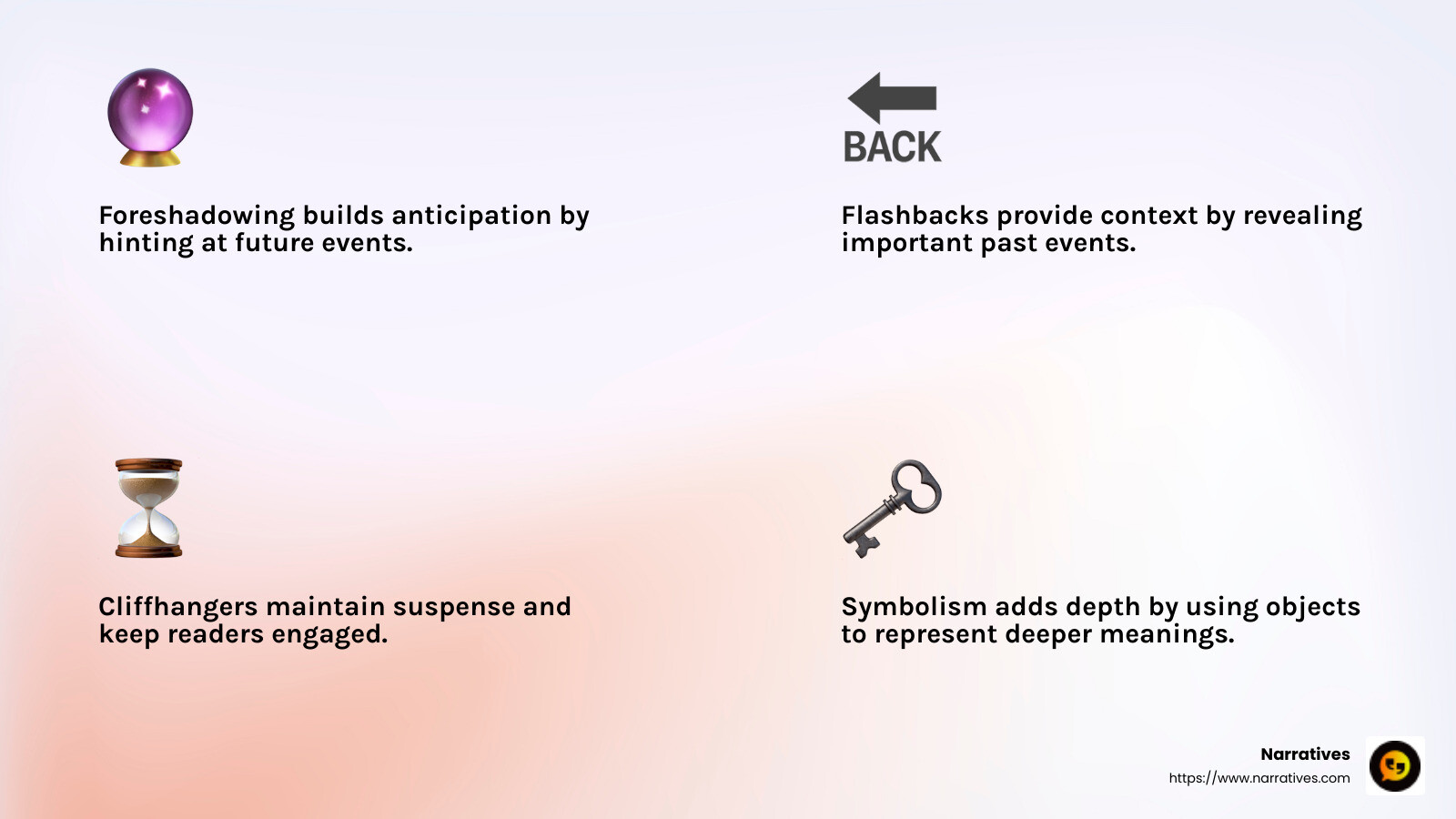
- Foreshadowing: Hinting at events to come, building anticipation.
- Flashbacks: Providing background by showing past events.
- Cliffhangers: Ending a scene or chapter with suspense, keeping readers eager for more.
- Symbolism: Using objects or actions to represent deeper meanings.
By mastering these effective narrative techniques, you can craft stories that captivate and resonate. Whether you're aiming to entertain, inform, or inspire, these tools help make your message unforgettable.
Top 10 Narrative Techniques for Engaging Stories
Crafting an engaging story isn't just about what happens, but how it's told. Let's explore ten effective narrative techniques that can transform your storytelling.
1. Foreshadowing
Foreshadowing involves dropping subtle hints about what's to come. This builds anticipation and keeps readers hooked. Think of it as planting seeds that will bloom later. In Romeo and Juliet, Romeo's ominous line about preferring death over living without love hints at the tragic ending.
2. Stream of Consciousness
This technique captures a character's thoughts in real-time, creating a raw and intimate experience. It’s like eavesdropping on someone’s mind. James Joyce’s Ulysses is a classic example, immersing readers in the protagonist’s inner world.
3. Unreliable Narrators
An unreliable narrator keeps readers guessing by presenting a skewed version of events. This technique adds layers of intrigue and complexity. In The Catcher in the Rye, Holden Caulfield’s biased perspective makes readers question what’s real.
4. Cliffhangers
Cliffhangers leave a story unresolved, urging readers to find out what happens next. Charles Dickens was a master at this, using it in serialized stories like The Pickwick Papers to keep audiences coming back.
5. Setting
The setting defines the time and place, but it can also influence mood and character behavior. A vivid setting immerses readers in the story. In Wuthering Heights, the moody landscape mirrors the characters' emotional turmoil.
6. Backstory
Backstory provides context by revealing events that happened before the main narrative. It adds depth and helps readers understand characters’ motivations. The Lord of the Rings uses glimpses of past ages to enrich its epic tale.
7. Flashback
Flashbacks break the chronological flow to reveal past events. This technique adds depth and context. In A Christmas Carol, Scrooge’s visits to his past Christmases show how he became the man he is.
8. Flashforward
Flashforwards offer glimpses of the future, creating suspense. They can foreshadow events and build anticipation. A Christmas Carol also uses this technique when Scrooge sees his lonely future.
9. Plot Twist
A plot twist is an unexpected turn of events that changes the story's direction. It keeps readers on their toes. Think of the shocking revelation in The Sixth Sense that redefines the entire narrative.
10. Dialogue
Dialogue reveals character traits, advances the plot, and makes interactions realistic. Authentic dialogue can bring characters to life. It’s not just about what’s said, but how it’s said. In To Kill a Mockingbird, the conversations between Scout and Atticus Finch reveal their relationship and values.
These effective narrative techniques are the tools that lift a story from good to unforgettable. By weaving them into your storytelling, you can engage your audience and leave a lasting impact.
Next, we'll dig into how setting and atmosphere play a crucial role in storytelling.
Mastering the Art of Setting and Atmosphere
Setting and atmosphere are more than just the backdrop for your story—they're powerful tools that can transform a narrative. Let's explore how symbolism, allegory, and mood creation can improve your storytelling.
Symbolism
Symbolism uses objects, characters, or settings to represent larger ideas. This technique adds layers of meaning and can make your story resonate on a deeper level.
- Example: In The Great Gatsby, the green light at the end of Daisy’s dock isn't just a light. It symbolizes Gatsby's unreachable dreams and the promise of a future that always seems just out of reach.
Allegory
An allegory is a narrative that uses symbolic figures and actions to convey truths or generalizations about human existence. It's a powerful way to explore complex ideas through simple stories.
- Example: C.S. Lewis's The Lion, the Witch, and the Wardrobe is more than a fantasy tale. Aslan represents Christ, and the story reflects themes of sacrifice and redemption.
Mood Creation
Creating the right mood can draw readers into your world and make them feel what your characters are experiencing. This involves using descriptive language and setting details to evoke emotions.
- Example: In Wuthering Heights, the stormy moors and the wild, untamed landscape mirror the passionate and turbulent emotions of the characters. The setting isn't just a place; it's an integral part of the story's emotional impact.
Tips for Creating Atmosphere:
- Use sensory details: Engage readers by describing sights, sounds, smells, tastes, and textures.
- Match the setting to the story’s tone: A bright, sunny day can set a hopeful mood, while a dark, stormy night might signal danger or despair.
- Incorporate weather and time of day: These elements can subtly influence the mood and symbolize internal states of characters.
By mastering these techniques, you can use setting and atmosphere to not only ground your story but also to improve its emotional depth and complexity.
Next, we'll explore how to develop compelling characters that captivate readers and drive your narrative forward.
Developing Compelling Characters
Characters are the heartbeat of any story. They captivate readers, drive the narrative, and make the plot feel alive. Let's explore the essentials of character development, focusing on direct and indirect characterization and character motivations.
Character Development
Character development is the process of building a fully-realized, complex character. It's about giving characters depth, making them relatable, and ensuring they evolve throughout the story.
Key Aspects of Character Development:
- Background: Provide a backstory that explains who your character is and why they behave the way they do.
- Growth: Show how characters change over time. This can be through personal growth, learning from mistakes, or shifting perspectives.
- Complexity: Avoid one-dimensional characters. Give them conflicting desires, weaknesses, and strengths.
Direct and Indirect Characterization
Direct characterization involves explicitly describing a character's traits. This might include their appearance, personality, or background. It's straightforward and informative.
- Example: "John was a tall man with a commanding presence and an unyielding determination."
Indirect characterization, on the other hand, reveals character traits through actions, dialogue, thoughts, and interactions with other characters. This method allows readers to infer details about the character.
- Example: Instead of saying a character is kind, show them helping a stranger in need.
Using a mix of both techniques can create a richer, more engaging character.
Character Motivations
Understanding what drives your characters is crucial. Character motivations are the reasons behind their actions and decisions. They are the "why" of your character's journey.
Types of Motivations:
- External Motivations: These are outside forces or objectives that push a character forward, like a quest for treasure or the need to save a loved one.
Internal Motivations: These are personal desires or fears, such as the need for acceptance, love, or overcoming a personal flaw.
Example: In Frankenstein, Dr. Frankenstein's motivation to create life stems from a desire for scientific achievement but also from a deeper fear of mortality and loss.
By understanding and clearly defining your characters' motivations, you ensure their actions are believable and their journeys compelling.
Tips for Developing Compelling Characters:
- Create detailed character profiles: Include their history, personality traits, and motivations.
- Show growth and change: Let characters evolve in response to the story’s events.
- Use dialogue effectively: Let their words reveal personality and motivations.
Next, we'll explore how to use dialogue authentically and purposefully to improve your narrative.
Using Dialogue Authentically and Purposefully
Dialogue is a powerful tool in storytelling. It can reveal a character's voice, unveil conflict, and propel the story forward. Let's explore how to use dialogue effectively in your narratives.
Character Voice
Character voice is about how a character speaks and what they say. It reflects their personality, background, and emotions. A well-crafted voice makes characters feel real and distinct.
- Example: A young, energetic character might use slang and speak quickly, while an older, more reserved character might choose words carefully and speak slowly.
Crafting unique voices for each character helps readers differentiate them and adds depth to your story.
Reveal Conflict
Dialogue is an excellent way to reveal conflict. Through conversations, characters can express disagreements, desires, and tensions. This can be more dynamic than simply describing the conflict.
- Example: A heated argument between two friends about a betrayal can show the depth of their conflict more vividly than a narrative description.
Conflict is the engine of a story. Using dialogue to display it makes the narrative more engaging and immediate.
Move the Story Forward
Dialogue should always have a purpose. It should move the story forward by advancing the plot or deepening the reader's understanding of the characters and their situations.
- Example: A conversation that reveals a secret plan or a character’s hidden motivation can change the direction of the story.
While dialogue is important, use it sparingly and meaningfully.
Tips for Using Dialogue Effectively:
- Keep it natural: Avoid overly formal or stilted language unless it suits the character.
- Show, don’t tell: Use dialogue to reveal character traits and plot points rather than explaining them outright.
- Balance dialogue with action: Ensure conversations are interspersed with actions and descriptions to maintain a dynamic pace.
Next, we'll dig into incorporating imagery and sensory language to create vivid, engaging storytelling.
Incorporating Imagery and Sensory Language
To create a vivid and immersive narrative, imagery and sensory language are essential. They transform simple descriptions into experiences that readers can see, hear, taste, touch, and smell. This approach, often referred to as show, not tell, brings stories to life.
Show, Not Tell
"Show, not tell" is about painting a picture with words. Instead of telling the reader that a character is nervous, show it through their actions and surroundings.
- Example: Instead of saying, "She was nervous," describe how "her hands trembled as she reached for the doorknob, her breath shallow and quick."
This technique allows readers to infer emotions and states of mind, making them active participants in the story.
Sensory Engagement
Engaging the reader's senses creates a richer reading experience. By tapping into sight, sound, taste, touch, and smell, you can craft scenes that are both memorable and immersive.
- Example: In Padma Venkatraman's The Bridge Home, an orange is described with sensory detail: its "citrus scent," the "leathery peel," and the "burst" of juice. This description engages multiple senses, making the scene vivid and real.
By focusing on sensory details, you invite readers into the world you're creating.
Vivid Descriptions
Vivid descriptions are the backbone of engaging storytelling. They provide clarity and depth, allowing readers to visualize scenes and understand characters on a deeper level.
- Example: Describing a character’s home as "a cluttered haven of mismatched furniture and faded photographs" gives insight into their personality and history.
To craft vivid descriptions, use specific, concrete details rather than vague generalities. This precision brings clarity and color to your narrative.
Tips for Incorporating Imagery and Sensory Language:
- Use all five senses: Incorporate elements of sight, sound, taste, touch, and smell to create a full-bodied experience.
- Be specific: Choose precise details that convey the mood and tone of your scene.
- Balance detail with pacing: While vivid descriptions are important, be mindful of pacing. Too much detail can slow the story down.
By mastering imagery and sensory language, you can create narratives that resonate deeply with readers, making your stories unforgettable.
Next, we'll explore how playing with perspective and point of view can add layers to your storytelling.
Playing with Perspective and Point of View
Perspective and point of view are powerful tools in storytelling. They shape how readers experience a story, influencing their understanding and emotional connection. Let's explore how different narrative perspectives can be used effectively.
First-Person Narration
First-person narration uses "I" or "we," providing an intimate glimpse into a character's thoughts and feelings. This perspective creates a personal connection between the narrator and the reader.
- Example: In Jane Eyre, the protagonist's reflective voice invites readers into her innermost thoughts and emotions, creating a sense of intimacy and immediacy.
Benefits:
- Deep emotional connection.
- Allows for a personal lens into the story.
Second-Person Narration
Second-person narration speaks directly to the reader using "you." This perspective is less common but can be highly engaging, making the reader an active participant in the story.
- Example: Jay McInerney's Bright Lights, Big City uses second-person narration to create a unique and immersive experience.
Benefits:
- Creates a direct connection with the reader.
- Engages readers by placing them in the story.
Third-Person Narration
Third-person narration uses "he," "she," or "they" and can be omniscient or limited. It offers flexibility in storytelling, allowing the narrator to provide insights into multiple characters and events.
- Example: A Song of Ice and Fire by George R.R. Martin uses multiple limited third-person narrators to weave a complex and engaging tale.
Benefits:
- Offers a broad perspective on the story.
- Can switch focus between different characters and events.
Multiperspectivity
Multiperspectivity involves telling a story from multiple viewpoints, providing a richer and more nuanced narrative. This technique allows for diverse perspectives and can reveal different facets of the same event.
- Example: 2666 by Roberto Bolaño features multiple narrators, each offering their unique perspective on the story's events.
Benefits:
- Provides a comprehensive view of the story.
- Highlights contrasts between characters' perceptions and experiences.
Tips for Playing with Perspective and Point of View:
- Choose the right perspective: Consider which point of view best serves your story's needs and themes.
- Maintain consistency: Ensure that the chosen perspective remains consistent throughout the narrative, unless a shift is intentional and clear.
- Use perspective to reveal character: Let the chosen point of view improve character development and plot progression.
By experimenting with perspective and point of view, you can add depth and complexity to your storytelling, creating engaging and multifaceted narratives.
Next, we'll dive into frequently asked questions about effective narrative techniques.
Frequently Asked Questions about Effective Narrative Techniques
What are narrative techniques?
Narrative techniques are the tools and methods that writers use to tell their stories effectively. These techniques help shape the story, evoke emotions, and guide readers through the narrative journey. They include devices like foreshadowing, flashbacks, and dialogue, each adding depth and intrigue to the storytelling process.
Think of narrative techniques as the building blocks of a story. While the narrative structure is the skeleton, these techniques are the muscles and skin that bring the story to life. They can vary widely based on the writer's goals and the type of story being told.
How can narrative techniques improve storytelling?
Using effective narrative techniques can transform a simple story into a compelling masterpiece. Here’s how:
Engagement: Techniques like cliffhangers and plot twists keep readers on the edge of their seats, eager to know what happens next.
Emotional Impact: Tools such as foreshadowing and backstory help build emotional connections, making readers care deeply about characters and outcomes.
Complexity and Depth: Flashbacks and unreliable narrators can add layers to the narrative, offering new perspectives and insights.
Atmosphere and Mood: Setting and sensory language create vivid images and feelings, immersing readers in the story's world.
By skillfully applying these techniques, writers can craft stories that resonate with readers, leaving a lasting impression.
What is the role of setting in narrative techniques?
Setting plays a crucial role in storytelling, acting as more than just a backdrop for the action. It can be a powerful narrative technique in itself:
Symbolism and Allegory: Settings can symbolize larger themes or mirror characters' emotions. For example, the moody landscapes in Wuthering Heights reflect the inner turmoil of its characters.
Mood Creation: The choice of setting can set the tone for the entire story. A dark, stormy night might create suspense, while a sunny meadow could evoke peace and happiness.
Influence on Plot: Settings can drive the plot forward, presenting challenges or opportunities for characters. The isolation of a deserted island, for instance, can intensify a survival story.

By thoughtfully considering the setting, writers can improve their storytelling, making the narrative more engaging and meaningful.
In the next section, we'll explore how to develop compelling characters, a key aspect of any great story.
Conclusion
At Narratives, we believe in the power of storytelling to drive meaningful change. As a dedicated storytelling partner for non-profits and purpose-driven organizations, we focus on elevating underrepresented voices through effective narrative techniques. Our mission is to create high-quality, emotionally resonant content that not only shares impactful stories but also inspires action and builds trust.
Storytelling is more than just telling tales; it's about making connections and creating a social impact. By using techniques like foreshadowing, dialogue, and character development, we help non-profits convey their missions in ways that captivate and engage their audiences. These techniques are not just tools; they are the heart of what makes stories resonate and leave a lasting impression.
Our work with non-profits goes beyond content creation. We aim to amplify their stories to increase visibility and foster a deeper understanding of the causes they champion. By focusing on community-driven storytelling, we help organizations highlight the real-world impact of their work, encouraging support and involvement from the public.
When digital noise is overwhelming, Narratives stands out by crafting stories that matter. We are committed to helping non-profits harness the full potential of narrative magic to further their missions and create a better world.
To learn more about how we can help your organization tell its story, find our services here.


.avif)