Non-Profit SEO: Elevate Your Online Presence

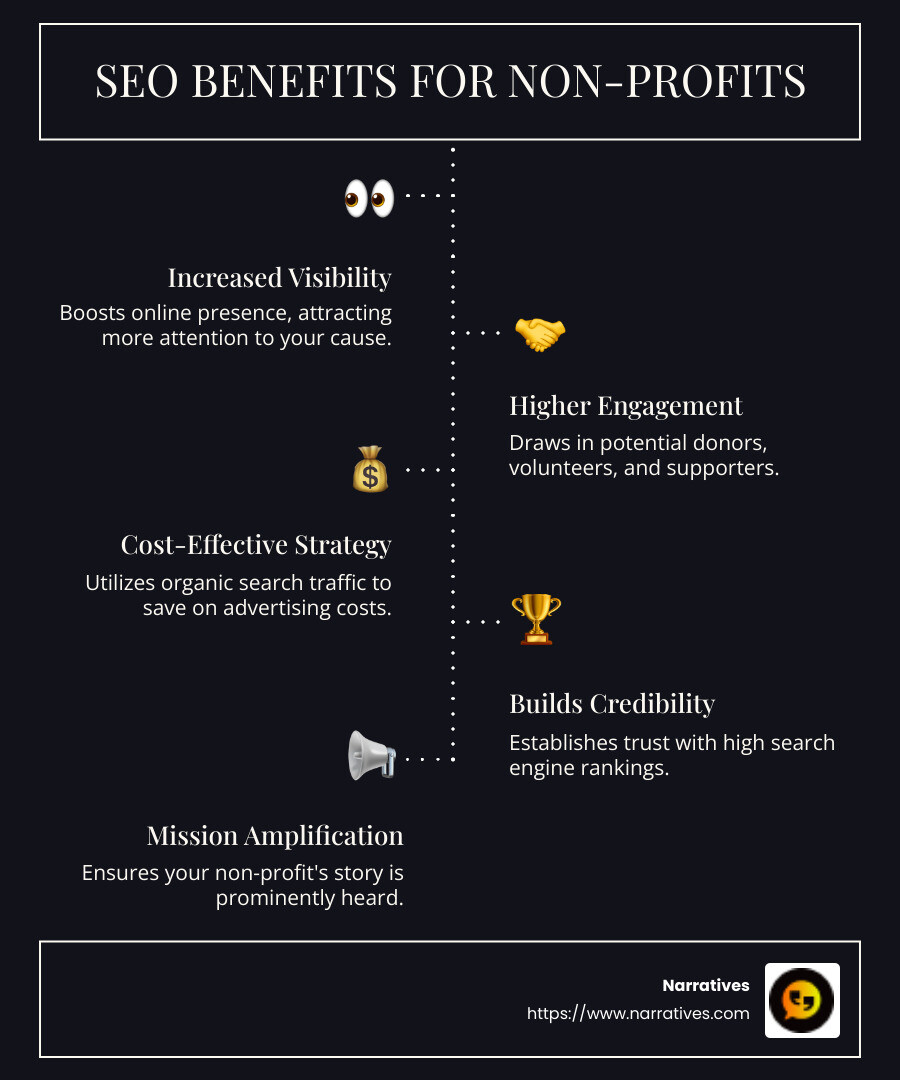
SEO for non-profits is crucial in today's digital age, where online visibility can make a substantial difference in an organization's reach and impact. High search rankings can mean the difference between being found or lost in the digital ether. Here’s a snapshot of why SEO matters for non-profits:
- Increased Visibility: Improves your online presence, bringing more eyes to your cause.
- Higher Engagement: Attracts potential donors, volunteers, and supporters.
- Cost-Effective Strategy: Organic search traffic saves money compared to paid ads.
- Builds Credibility: A high rank on search engines fosters trust with your audience.
When search engines are the go-to source for information, being easy to find online is essential. Imagine potential donors searching for causes like yours—they need to find you quickly to learn about your mission and impact.
In fact, nine out of ten clicks from Google Search go to the results on the first page, underscoring the value of SEO in ensuring your non-profit's story is heard.
Staying ahead requires more than just storytelling; it requires strategic digital visibility to truly amplify your mission.
Quick SEO for non-profits definitions:
Understanding SEO for Non-Profits
SEO basics for non-profits revolve around making your website more visible on search engines like Google. It's about ensuring that when someone searches for topics related to your mission, your organization appears prominently in the search engine results pages (SERPs).
At the heart of SEO is organic traffic. This refers to visitors who find your website naturally through search engines, without the need for paid advertisements. For non-profits, this kind of traffic is invaluable. It brings in people who are genuinely interested in your cause, whether they are potential donors, volunteers, or supporters.
The Role of Search Engine Results
When people use search engines, they typically don't look beyond the first page of results. This is why it's crucial for non-profits to aim for high rankings. The higher your site appears, the more likely people are to click on it.
Organic traffic not only helps in spreading awareness about your services but also plays a significant role in fundraising. By appearing in the top search results, your non-profit can attract more donations and support. This is because users often perceive high-ranking sites as more credible and trustworthy.
Here's why SEO for non-profits is a game-changer:
Cost-Effectiveness: Unlike expensive ad campaigns, SEO focuses on building a sustainable online presence, reducing long-term costs.
Trust and Authority: High search rankings build authority. People trust Google to show them the best results, and being among those results can improve your organization's reputation.
Engagement and Support: By optimizing your site for relevant keywords, you attract visitors who are actively searching for the services or support you offer.
SEO is about aligning your non-profit's goals with the search behaviors of your target audience. By understanding and implementing effective SEO strategies, your organization can significantly improve its online footprint and, ultimately, its impact.
Next, we'll dive into key strategies to lift your non-profit's search engine presence.
Key SEO Strategies for Non-Profits
When it comes to SEO for non-profits, there are several key strategies that can significantly boost your organization's online presence. Let's explore these essential tactics:
Local SEO
Local SEO is crucial for non-profits with a physical presence. It helps you connect with people in your geographic area who are looking for services like yours. Think of it as putting your organization on the local map.
To start, sign up for a Google Business Profile, which ensures your non-profit appears in local search results and Google Maps. Make sure your profile is complete with accurate information, including your address, phone number, and operating hours. Consistency in this information across all platforms is key.
Search Intent
Understanding search intent is about knowing what your audience is looking for when they type in a query. Are they searching for information, looking to make a donation, or wanting to volunteer? Tailor your content to meet these needs. For instance, if someone searches "volunteer opportunities near me," your site should provide clear, actionable information on how they can get involved.
Page Speed
Page speed is a critical factor in retaining visitors. Slow websites can frustrate users, leading to higher bounce rates. Use tools like Google's PageSpeed Insights to identify areas for improvement. Optimize images, leverage browser caching, and minimize code to ensure your site loads quickly.
Mobile Usability
With more people accessing the web via smartphones, ensuring mobile usability is non-negotiable. Your website should be responsive, meaning it adjusts seamlessly to different screen sizes. This not only improves user experience but also boosts your search rankings, as Google prioritizes mobile-friendly sites.
Backlinks
Backlinks are links from other websites to yours, and they are a vote of confidence in your content. High-quality backlinks can significantly improve your search engine rankings. Engage in outreach to relevant blogs and websites, offer to write guest posts, or collaborate on projects that can naturally lead to backlinks.
By focusing on these strategies, your non-profit can improve its visibility and effectiveness online. SEO is not a one-time task but an ongoing process. Stay informed about changes in search engine algorithms and continuously refine your strategies to maintain and improve your search presence.
Next, we'll explore on-page SEO optimization to further improve your website's search engine performance.
On-Page SEO Optimization
On-page SEO is all about making your website's pages search-friendly. Let's explore some key elements: keyword research, content quality, meta descriptions, and internal linking.
Keyword Research
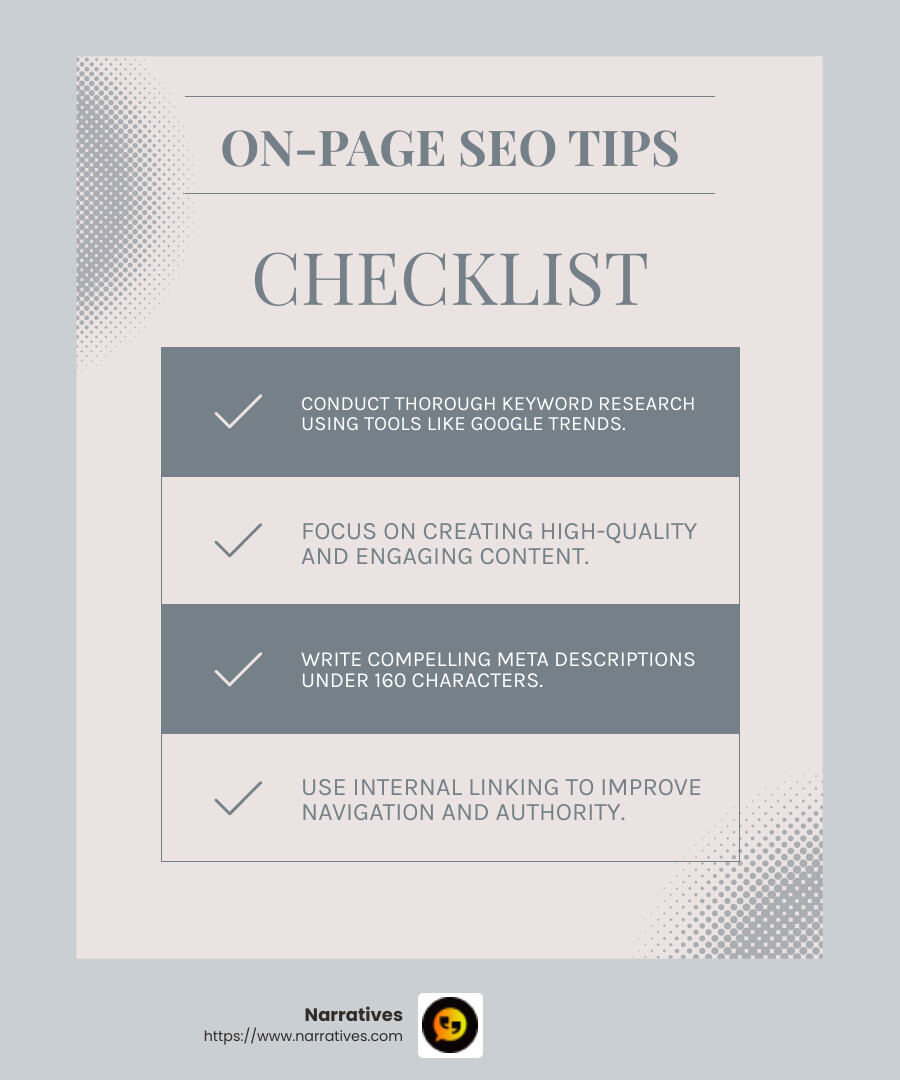
Keywords are the foundation of SEO for non-profits. They help search engines understand your content and how it relates to users' queries. Start by identifying keywords relevant to your mission and services. Use tools like Google Trends to see what people are searching for in your niche. Focus on long-tail keywords, which are more specific and less competitive. For example, instead of just "donations," try "how to donate to non-profit organizations."
Content Quality
Content is king. High-quality content answers your audience's questions and solves their problems. For non-profits, this might mean sharing stories about your impact, showcasing testimonials from beneficiaries, or providing detailed guides on how to get involved. Make sure your content is engaging, informative, and relevant. Well-crafted content is more likely to attract backlinks and keep visitors on your site longer.
Meta Descriptions
Meta descriptions are short summaries of your page content that appear in search results. They don't directly impact rankings but can influence click-through rates. Keep them under 160 characters and include your target keyword. A compelling meta description might look like this: "Find volunteer opportunities with Narratives. Make a difference in your community today!"
Internal Linking
Internal linking helps users steer your site and distributes page authority. Link related pages together using descriptive anchor text. For instance, if you have a blog post about a recent event, link it to your volunteer sign-up page. This not only improves user experience but also helps search engines crawl your site more effectively.
By optimizing these on-page elements, your non-profit can improve its search visibility and connect with more potential supporters. Up next, we'll dig into off-page SEO techniques to further expand your reach.
Off-Page SEO Techniques
Off-page SEO is all about building your nonprofit's reputation and authority outside your website. Let's explore three key areas: link building, content marketing, and social signals.
Link Building
Link building is the process of getting other websites to link back to your site. These links, known as backlinks, are like votes of confidence. They tell search engines that your content is valuable and trustworthy.
Here are some effective link building strategies for non-profits:
Outreach: Reach out to websites related to your mission and ask them to link to your content. For example, if you run a nonprofit focused on environmental conservation, connect with eco-friendly blogs and offer them a guest post.
Broken Link Building: Find broken links on other sites and suggest your content as a replacement. This is a win-win: the website fixes its broken link, and you earn a backlink.
Unlinked Brand Mentions: Look for mentions of your nonprofit that don't include a link. Kindly ask those sites to add a link to your website.
Content Marketing
Content marketing involves creating and sharing valuable content to attract and engage your audience. For non-profits, this could mean blog posts, videos, or infographics that highlight your mission and impact.
Why is content marketing important for SEO for non-profits? Because high-quality content naturally attracts backlinks. When other sites see the value in your content, they're more likely to link to it.
Blog Posts: Write about your success stories, upcoming events, or interviews with beneficiaries. Make sure your content answers common questions or provides useful insights.
Videos: Create short videos showcasing your work or explaining how people can get involved. Videos are highly shareable and can boost your visibility on social media platforms.
Infographics: Design eye-catching infographics that present data or tell a story. These are often shared widely and can lead to more backlinks.
Social Signals
Social signals refer to the likes, shares, and comments your content receives on social media platforms. While they don't directly impact search rankings, they can increase your content's visibility and drive traffic to your site.
Engage on Social Media: Share your content on platforms like Facebook, Twitter, and LinkedIn. Encourage your followers to share it with their networks.
Collaborate with Influencers: Partner with influencers who align with your mission. Their endorsement can introduce your nonprofit to a wider audience.
Host Online Events: Organize webinars or live Q&A sessions to engage your audience and promote your cause.
By focusing on these off-page SEO techniques, your nonprofit can build credibility and reach a larger audience. Next, we'll explore the technical aspects of SEO to ensure your website performs at its best.
Technical SEO for Non-Profits
Technical SEO helps your nonprofit's website perform better in search results. Let's explore the key areas: site speed, mobile responsiveness, site structure, and sitemaps.
Site Speed
Site speed is crucial. A fast-loading website keeps visitors happy and improves your ranking on search engines.
Compress Images and Videos: Large files slow down your site. Use tools to compress them without losing quality.
Leverage Caching: Caching stores parts of your website, so they load faster for returning visitors.
Remove Unnecessary Plugins: Too many plugins can slow your site. Keep only the essentials.
Google's PageSpeed Insights tool can help you check your site's speed and offer tips to improve it.
Mobile Responsiveness
With more people using smartphones, your site must be mobile-friendly. Google's ranking algorithms consider mobile usability.
Responsive Design: Ensure your website adapts to different screen sizes. This improves user experience and boosts your SEO.
Test with Tools: Use tools like Semrush's Site Audit to check your mobile page experience.
A mobile-responsive site keeps visitors engaged and increases your chances of ranking higher in search results.
Site Structure
A well-organized site structure makes it easy for both visitors and search engines to steer your content.
Logical Hierarchy: Arrange your pages in a way that makes sense. Use categories and subcategories to organize information.
Internal Linking: Connect related pages within your site. This helps search engines understand your content and improves user navigation.
Avoid Orphan Pages: Ensure every page is linked from somewhere else on your site to prevent them from being overlooked.
Good site structure improves user experience and helps search engines index your pages effectively.
Sitemaps
A sitemap is a file that lists your site's important pages. It guides search engines to your content.
Create a Sitemap: Include all the pages you want search engines to crawl and index.
Submit to Google Search Console: This helps Google understand your site structure and find your content more easily.
A well-maintained sitemap ensures that search engines can access and index your content efficiently.
By focusing on these technical SEO elements, you can improve your nonprofit's online presence and make sure your website is easy to find and use. Up next, we'll address some frequently asked questions to further clarify how SEO for non-profits can benefit your organization.
Frequently Asked Questions about SEO for Non-Profits
How does SEO benefit non-profits?
SEO for non-profits is a powerful tool for boosting online reach and attracting donors. When your nonprofit's website ranks higher in search engine results, more people find your cause. This increased visibility can lead to more volunteers, donors, and supporters.
A study by Search Engine Journal found that 70% of users prefer organic search results over paid ads. This means that by focusing on SEO, nonprofits can gain trust and credibility with their audience without the high costs of paid advertising.
What are the top SEO keywords for non-profits?
Choosing the right keywords is essential for non-profits to connect with their target audience. Start with keyword research to identify search phrases that potential supporters use. Long-tail keywords like "non-profit donations" and "local charities near me" are often effective because they're specific and have lower competition.
For instance, according to Moz, long-tail keywords account for 70% of all web searches. This makes them crucial for non-profits aiming to improve their digital visibility and attract relevant traffic.
How can non-profits improve their local SEO?
Improving local SEO is vital for non-profits that serve specific communities. One key step is to create and optimize a Google Business Profile. This helps your organization appear in local search results and on Google Maps, making it easier for local supporters to find you.
Additionally, listing your nonprofit in local directories can boost your local SEO efforts. Ensure your contact information is consistent across all platforms. This consistency strengthens your presence in local search results.
By focusing on these areas, non-profits can improve their online presence, reaching more people and making a greater impact in their communities.
In the next section, we'll explore how Narratives can help you tell your story and connect with your audience through digital storytelling.
Conclusion
In today's digital landscape, SEO for non-profits is more than just a tool—it's a bridge to connect with communities and amplify impact. At Narratives, we believe in the power of digital storytelling to lift underrepresented voices and inspire action.
Through our partnership with non-profits, we focus on crafting high-quality, emotionally resonant content. This approach not only improves visibility but also builds trust and fosters genuine connections.
Community impact is at the heart of our mission. By sharing compelling stories and highlighting the real-life struggles and triumphs of those we serve, we help non-profits resonate with their audience on a deeper level. This connection is crucial for driving engagement and support.
Our strategy includes using SEO to rank for storytelling-related keywords, ensuring that our partners' stories reach the right audience. By focusing on long-tail, high-intent keywords, we help non-profits attract organic traffic that supports their goals of raising awareness, attracting donors, and mobilizing volunteers.
Digital storytelling is more than a marketing tool—it's a way to humanize your cause and build a community around it. We invite you to explore how Narratives can be your partner in this journey. Together, we can create content that not only tells your story but also inspires change and fosters a lasting impact in the communities you serve.


.avif)