Storytelling for Social Change: Techniques to Engage Donors and Communities
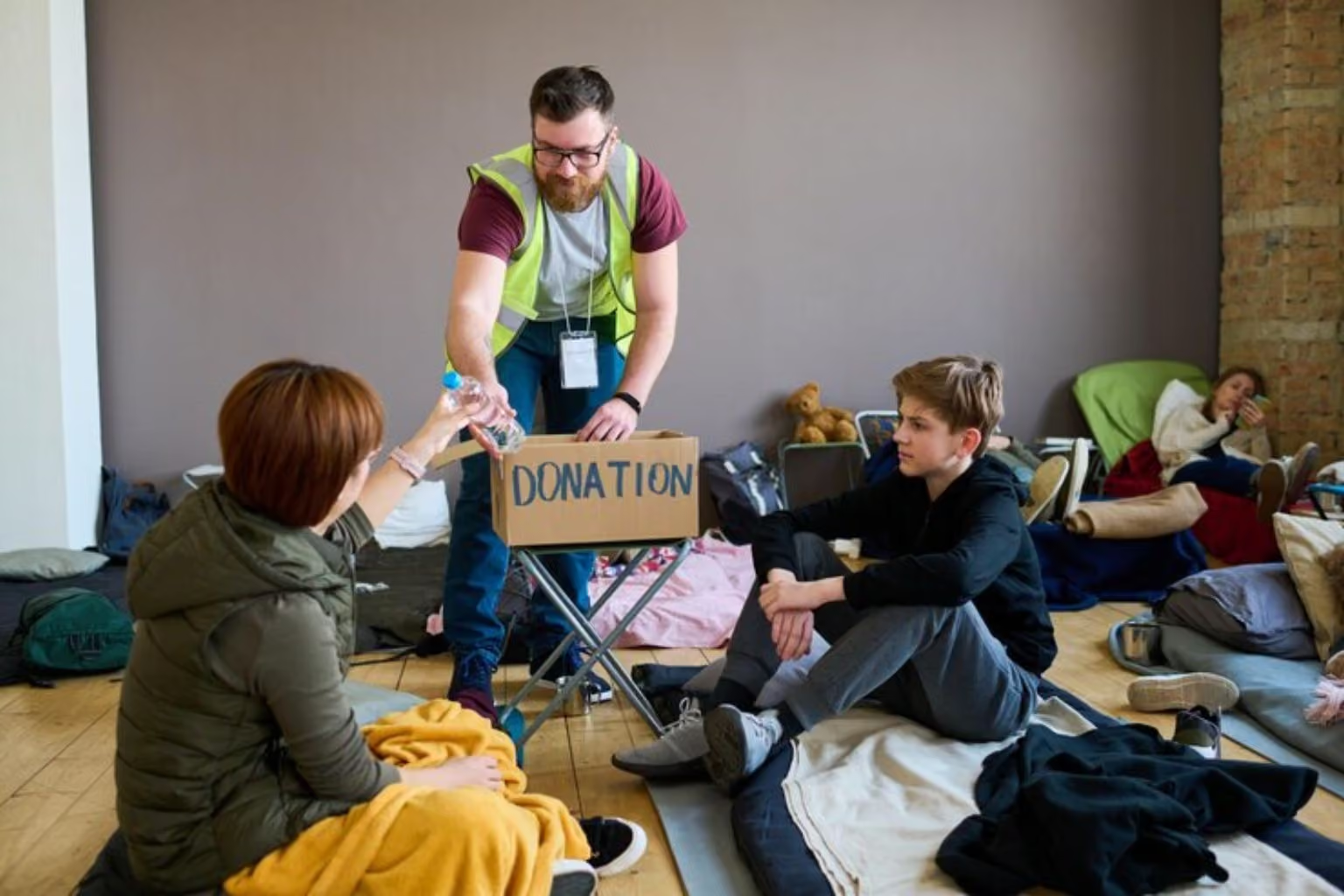
A conversation often begins long before a word leaves someone’s mouth. That emotional shift is where storytelling for social change begins, and many organizations seem to overlook the subtlety of it. They rush toward facts, charts, proof. Donors and communities respond to something more textured. Something that feels lived in.
Non-profits that understand this typically see deeper engagement, not just higher fundraising totals. Social impact work depends on people recognizing themselves, even slightly, in the stories being shared. That recognition creates involvement. It also creates responsibility.
Some teams learn this lesson the hard way. They share updates, project summaries, or technical explanations, then wonder why the message vanishes into the digital noise. Social impact storytelling only resonates when the layers beneath a statistic come into focus.
The question is how to do it in a way that respects dignity, invites empathy, and avoids the oversimplification trap. The techniques below appear to help organizations walk that line.
Why Human-Centered Narratives Keep Audiences From Turning Away
The internet’s pace creates an odd duality. People scroll for hours, yet attention vanishes instantly. Against that backdrop, storytelling for social change works because it slows the reader down. Even for a moment.
A single voice tends to hold attention. One person’s conflict, not a generalized overview of a community. It may be unfair, but it is true. When donors meet one person with a specific struggle, they begin to form an emotional anchor. From that anchor, broader impact becomes easier to understand.
Many fundraisers now rely on this pattern. Some cautiously, since oversimplification can distort the complexity of a community’s reality. Still, the approach is effective when handled with care. It turns abstract missions into something relatable.
The Core Principles Behind Impact Storytelling That Actually Moves People
A story that feels genuine usually contains three quiet elements. None of them requires polished scripts.
- Tension that has not been fully resolved
Donors rarely engage when everything appears perfect. They want honesty, even if it feels slightly uncomfortable. - A sense of proximity
Not literal distance, but emotional closeness. Readers want to feel near enough to understand someone’s circumstances without intruding. - A glimpse of possibility
Not exaggerated hope. Just a believable next step that signals progress.
These elements appear repeatedly in strong community storytelling campaigns. They shape the emotional landscape without manipulating it.
How Donors Interpret Stories When Deciding Whether to Support
What donors look for is not always what organizations expect. Many believe people want inspiration. Some do. Others want clarity. A few simply want to understand whether their involvement matters at all.
It appears that donors typically read social impact storytelling with three questions in mind:
Is the challenge real and specific?
Overly general descriptions tend to disappear in memory.
Does the story respect the person being featured?
Dignity matters. People notice if storytelling becomes exploitative.
Will my contribution meaningfully shift this person’s situation?
A clear path gives donors a sense of agency.
When these questions remain unanswered, fundraising stalls. When they are addressed with nuance, storytelling fundraising often strengthens the donor’s sense of partnership.
Crafting Atmosphere: The Often Ignored Emotional Architecture of Nonprofit Narratives
Some stories read like press releases. Others feel like someone opened a window into a real room. Readers sense the difference.
Atmosphere emerges from detail. Not decorative detail, but the right detail. A chipped coffee mug on a table. A hallway where voices echo. The way someone avoids eye contact for a moment. Sensory cues like these provide texture, giving the story weight without overwhelming it.
Impact storytelling benefits from this careful layering. It shifts the narrative from informational to experiential. It does not rely on melodrama. Instead, it builds presence. Readers feel as though they are standing nearby.
What emerges is a kind of respectful intimacy, one that motivates action.
Avoiding Common Pitfalls That Quietly Harm Your Message
Even experienced teams fall into predictable patterns. Repetition. Excessive data. Overconfident language. These issues reduce engagement because they make stories feel prepackaged.
A few pitfalls often stand out:
• Over-framing the storyteller as a victim.
Communities are rarely defined only by struggle. Strength needs equal attention.
• Using jargon that distances readers.
Terms that feel clinical weaken emotional resonance.
• Telling donors what to feel.
Guiding emotion works. Dictating emotion rarely does.
Most organizations improve outcomes by stepping back. They let the story breathe. They allow nuance. This slight restraint tends to deepen trust.
When Storytelling Shapes Community Identity
Communities often mirror the stories told about them. Positive identity forms when narratives highlight capability, not just need. This idea sounds simple, but in practice, it requires restraint.
Organizations that rely too heavily on suffering risk reinforce negative stereotypes. Community storytelling strengthens local engagement when it presents complexity. People want to see resilience. Humor. Contradiction. The everyday details that make a community feel complete.
A story becomes more than communication. It becomes a mirror. Sometimes, even a call to reimagine what is possible.
Transform Stories into Lasting Impact with Empathy and Accuracy
If you reach a point where the responsibility of capturing stories feels overwhelming, it may be worth considering outside support. Some teams have limited time. Others lack the training required for sensitive interviews or documentary-style work.
Narratives collaborates with nonprofits that want to present their communities with accuracy and empathy. They document experiences, preserve dignity, and bring audiences closer to the human realities behind social issues. The work is subtle, but the impact often reaches beyond a single campaign.
Partner with Narratives Today – Share Your Community’s Story with Care and Authenticity
The Future: Stories That Invite Participation Instead of Passive Sympathy
Trends shift, but one pattern seems stable. People want to participate. Not just donate. They want to feel included in the story’s forward motion. Storytelling for social change will likely continue evolving toward collaboration, where communities shape their own narratives.
This shift already appears in youth-led projects, participatory filmmaking, and community research initiatives. The audience becomes part of the voice. That shared authorship creates a stronger sense of belonging.
The path ahead remains open, and perhaps that openness is the point.
FAQs
1. What makes storytelling for social change effective?
It connects specific human experiences to broader issues in a relatable way.
2. How can nonprofits avoid exploitative storytelling?
Focus on dignity, agency, and the individual’s own voice rather than framing them as passive subjects.
3. Is data still important in impact storytelling?
Yes, though it works best when paired with a personal narrative rather than presented alone.
4. Why does community storytelling matter for fundraising?
It builds trust and shows how local experiences reflect larger systemic challenges.
5. How often should nonprofits share stories?
Consistency helps, but quality matters more than frequency. Aim for thoughtful, well-rounded narratives.
Conclusion
Every story contains a doorway. Some remain closed. Others invite someone in, offering a moment of recognition that can reshape how a person sees their place in a community. When used with care, storytelling for social change can transform passive audiences into active supporters. The work is delicate, but the results ripple outward.


.avif)