360-Degree Documentary Films: The Future of Impact Storytelling
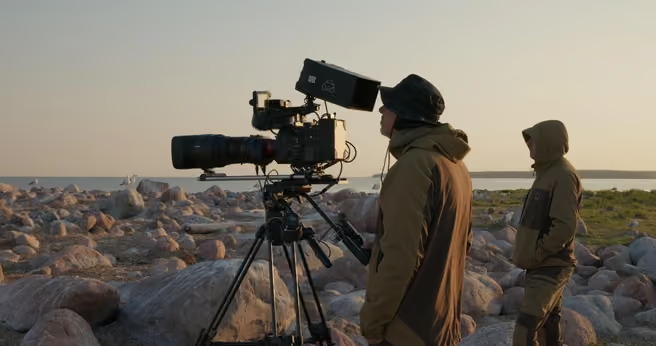
A viewer stands still, headset on, turning slowly. Not watching a story unfold on a screen, but inside it. The subject speaks, and the environment responds in all directions. That subtle shift is changing how stories are understood, especially those tied to human experience and social issues.
360 documentary films are beginning to sit at the intersection of technology and empathy. Not as a novelty, but as a serious evolution in documentary storytelling.
What Are 360-Degree Documentaries?
Definition of 360 Documentary Films
At a basic level, 360 documentary films are immersive visual experiences captured using omnidirectional cameras. Instead of framing a scene, they record everything around the lens. The viewer decides where to look.
It sounds simple, but in practice, it changes narrative control.
Difference vs Traditional Films
Traditional documentaries guide attention. Framing, cuts, and angles tell the viewer what matters.
With 360 documentary films, the control softens. The director still shapes the story, but the audience participates in how it’s experienced. A conversation in the background may become the focal point. A quiet detail, easily missed in standard film, becomes central.
Some argue this weakens narrative clarity. That concern isn’t unfounded, especially in complex narratives. Yet in the right context, it creates something closer to lived experience.
Why 360° Storytelling Creates Deeper Emotional Impact
Immersion Psychology
There’s a growing body of thought suggesting immersion alters emotional response when viewers feel physically present, even if virtually, their reactions tend to be less detached.
In 360 documentary films, distance collapses. A refugee camp, a hospital ward, a classroom in a remote region, all feel immediate.
Not identical to reality, of course. But closer than a flat frame allows.
Viewer Empathy
Empathy in social impact storytelling often relies on proximity. The more someone feels “there,” the harder it becomes to disengage.
That said, immersion alone doesn’t guarantee connection. Poor storytelling still feels hollow, even in 360 degrees. The craft remains essential.
Still, when done well, 360 documentary films can shift perception in ways standard formats struggle to achieve.
How Nonprofits and Brands Are Using 360 Films
Social Causes
Nonprofits are using immersive formats to convey complex issues like incarceration, displacement, and mental health. 360° documentaries let audiences explore environments directly, offering a sense of honesty while requiring careful ethical consideration.
Crisis Storytelling
In crisis communication, immediacy matters. In flood zones, conflict areas, and recovery sites, context is crucial. A 360° view reveals scale and nuance, showing what lies beyond the main focus—often carrying its own significance.
Awareness Campaigns
Brands aligned with social missions are exploring immersive storytelling as part of broader multimedia content production strategies.
Not all attempts land well. Some feel like technology-first experiments without narrative depth. But when integrated thoughtfully, 360 documentary films can strengthen campaign credibility.
Creating a 360 Documentary: What Actually Matters
Story Selection
Not every story benefits from a 360 format. Scenes with spatial relevance tend to work best. Environments where context adds meaning.
A conversation at a kitchen table might not need immersion. A community gathering or a public space often does.
Choosing the wrong story can dilute the impact.
Equipment Setup
360° cameras are more accessible, but quality varies. Common issues include stitching errors, poor audio, and uneven lighting. Professionals use multi-lens rigs and spatial audio to maintain immersion, as technical flaws can quickly disrupt the experience.
Filming Techniques
Directing in 360° focuses on guiding attention through movement, sound, and subject placement rather than traditional framing. Cuts alone aren’t enough, as viewers choose where to look—an unpredictability that is both a challenge and an advantage.
Editing Tools
Post-production in 360 documentary films involves stitching, stabilization, and spatial editing. It’s more technical than standard workflows.
There’s also a creative decision to make. How much guidance should be added? Too much, and the experience feels controlled. Too little, and the narrative may drift.
Distribution Channels
Publishing immersive content requires platform awareness. File formats, resolution, and interactivity all vary.
Ignoring these details often results in poor playback, which undermines the entire effort.
If you're planning to develop a 360 documentary, consider aligning the production process early with distribution goals. It saves time later.
Best Platforms to Publish 360 Content
YouTube VR
Widely accessible and relatively easy to use. It supports 360 playback across devices, including mobile and headsets.
However, content discovery on the platform can be inconsistent.
Meta Platforms
Immersive content performs differently here. Engagement depends heavily on audience familiarity with VR environments.
Not every audience demographic is equally comfortable navigating 360 environments.
Website Integration
Embedding 360 documentary films directly on a website allows for controlled presentation. It also supports broader content strategies, combining video with written context.
This approach often works well for organizations focused on documentary storytelling and long-form engagement.
SEO Strategy for 360 Documentary Content
Video Metadata Optimization
Titles and descriptions still matter. Perhaps more than expected.
Using the term 360 documentary films naturally within metadata helps search engines understand context. Overuse, though, becomes counterproductive.
Balance tends to perform better.
Blog and Video Integration
Combining video with supporting written content improves visibility. A well-structured blog can provide context, answer related queries, and strengthen authority signals.
This is where many creators fall short—the film exists, but the supporting content does not.
Keyword Targeting
Primary and secondary keywords should appear organically. Not forced into every sentence.
Terms like documentary storytelling, purposeful films, and social impact storytelling fit naturally when discussing process and intent.
If you’re producing immersive content regularly, it may be worth reviewing how your multimedia content production aligns with search behavior. Small adjustments can influence reach more than expected.
Where Purpose Meets Production
There’s a noticeable shift among organizations focused on impact. Storytelling is no longer treated as a side function. It’s becoming central.
Narratives Inc., for instance, approaches documentary storytelling with a clear emphasis on human perspective. Their work leans into first-person experiences, often placing individuals at the center rather than the issue itself.
In that context, 360 documentary films don’t feel like an add-on. They seem like a natural extension of their mission to deepen understanding.
For nonprofits or mission-driven teams considering immersive formats, it might be worth exploring how your current storytelling approach translates into spatial experiences. Not every story needs it. Some clearly benefit.
Bring your stories to life—explore how 360 documentaries can turn perspective into a powerful, immersive impact.
Challenges of 360 Storytelling
Cost Considerations
Equipment and post-production costs can add up quickly. While entry-level tools exist, achieving consistent quality often requires investment.
That said, costs have been decreasing gradually.
Accessibility Limitations
Not all audiences have access to VR headsets or compatible devices. Mobile viewing helps, but the experience isn’t identical.
This creates a trade-off between innovation and reach.
Technical Constraints
File sizes, bandwidth, and playback issues still pose challenges. Even well-produced 360-degree documentary films can suffer from buffering or resolution drops.
It’s improving, though not entirely solved.
Future Trends: AI, VR, and AR Convergence
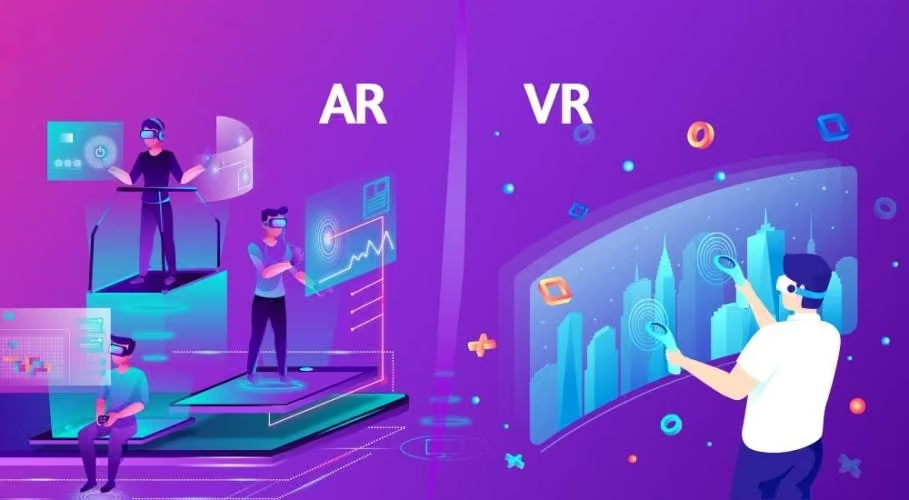
The line between immersive formats is beginning to blur. Virtual reality, augmented reality, and AI-driven content are converging in ways that weren’t fully anticipated a few years ago.
AI may assist in editing or scene enhancement. AR could layer additional context onto real-world environments. VR continues to push deeper immersion.
Where 360 documentary films fit within this evolving landscape remains an open question. They may serve as a bridge format, or something more foundational.
It is difficult to say with certainty.
Conclusion
Storytelling has always adapted to its medium. Print a shaped narrative structure. Film introduced visual language. Digital platforms altered pacing and distribution.
360 documentary films are part of that progression. Not a replacement, but an expansion.
They ask more from creators. They ask more from audiences, too.
And perhaps that’s the point.
If you’re considering immersive storytelling for your next project, start with the story itself. The format should follow, not lead.
FAQs
1. What are 360 documentary films used for?
They are used to create immersive storytelling experiences, often for social impact, education, and awareness campaigns.
2. Do viewers need special equipment to watch them?
Not always. They can be viewed on mobile devices or desktops, though VR headsets enhance the experience.
3. Are 360 films more effective than traditional documentaries?
It depends on the story. Some benefit from immersion, others work better with structured framing.
4. How expensive is it to produce a 360 documentary?
Costs vary widely based on equipment, crew, and post-production complexity.
5. Can 360 documentaries rank on Google?
Yes, especially when supported by optimized blog content and proper metadata strategies.
.avif)