How Augmented Reality is Transforming Nonprofit Campaigns
A printed flyer rarely stops anyone mid-scroll anymore. Even well-produced videos compete with a constant stream of content that feels urgent for about three seconds. This challenge has pushed many organizations to rethink how they present their work, especially those relying on emotional connection to drive action.
That’s where augmented reality nonprofit campaigns begin to stand out. Not as a novelty, but as a shift in how stories are experienced rather than simply viewed.
It isn’t just about adding a digital layer. It’s about placing someone inside a moment they would otherwise never encounter.
What is Augmented Reality in Nonprofit Marketing?
A practical definition
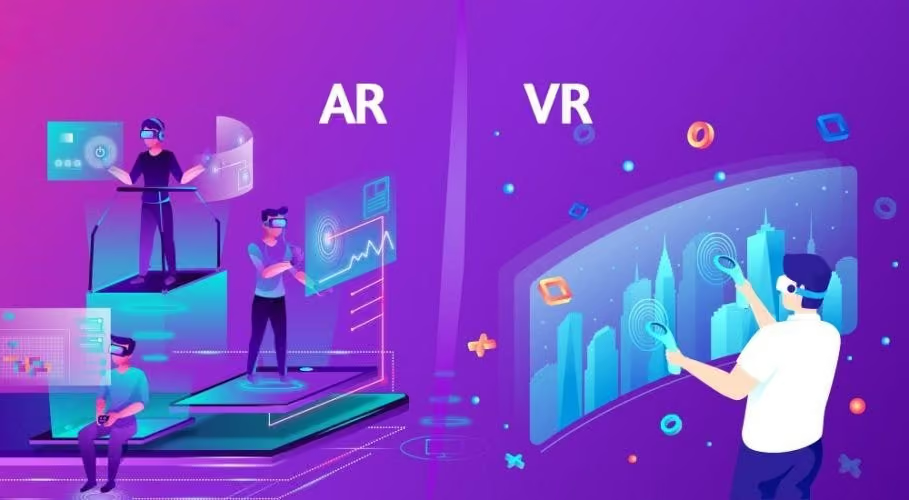
Augmented reality, in this context, blends digital visuals with a real-world environment using a phone or tablet. A mural becomes interactive. A poster comes alive. A simple QR code opens a layered narrative.
For nonprofits, that shift matters. It moves storytelling from passive to participatory.
Why nonprofits are adopting it
There’s a pattern emerging. Campaigns that allow people to experience a cause tend to hold attention longer. Not always dramatically longer, but enough to change behavior in some cases.
That’s why augmented reality nonprofit campaigns are gaining traction. They offer something traditional formats struggle with. They offer something traditional formats struggle with: presence.
Still, it’s not a universal solution. Some organizations invest heavily in the tech and see limited returns. Usually, the issue isn’t the medium. It’s the message behind it.
Why AR Campaigns Drive Deeper Engagement
Emotional immersion changes perception
Reading about a crisis creates awareness. Seeing it can create concern. Experiencing even a simulated version of it tends to shift perspective more noticeably.
When someone points their phone at a space and watches it transform into a flooded street or a shrinking forest, the abstract becomes immediate. That’s where nonprofit storytelling becomes more than narrative. It becomes context.
Interaction builds memory
There’s something subtle happening when users tap, swipe, or move within an experience. They aren’t just consuming content. They’re participating in it.
This kind of participation tends to stick.
That’s why augmented reality nonprofit campaigns often see higher engagement rates compared to static formats. While not always ten times higher as some reports suggest, engagement is consistently stronger in terms of time spent and recall.
Data tells part of the story
Engagement metrics in AR campaigns often include dwell time, interaction points, and completion rates. These offer a more layered view than impressions alone.
Still, data can be misleading if taken at face value. High interaction doesn’t always translate into donations. That gap is important to consider.
Real-World Examples of AR in Action
Healthcare awareness campaigns
The NHS blood donation initiative allowed users to scan a poster and watch a patient’s journey unfold in real space. The goal wasn’t just awareness. It was urgent.
The campaign reportedly increased registrations, although the long-term impact remains difficult to measure.
Environmental storytelling
WWF experimented with AR experiences that placed endangered animals into urban environments. A tiger in a subway station tends to get attention.
The strength here wasn’t just visual impact. It reinforced social awareness campaigns with a sense of proximity. Wildlife no longer felt distant.
Climate-focused activations
Greenpeace has used AR to simulate rising sea levels in major cities. The visual disruption often triggers conversation, which can be more valuable than immediate conversion.
Still, these campaigns require careful framing. Without context, they risk being dismissed as spectacle.
A Practical Framework to Launch an AR Campaign
Start with the emotional core
Before choosing tools or platforms, clarify the story. What moment matters most? What should the audience feel?
Without that clarity, even the most advanced AR layer falls flat.
Choose the right format
Not every campaign needs a custom app. In fact, most don’t.
QR-based AR experiences, social media filters, or web-based overlays often provide enough functionality with fewer barriers.
Build a narrative journey
Think beyond a single interaction. What happens after the first moment?
Strong storytelling for nonprofits often unfolds in layers. An initial experience, followed by deeper content, then a clear next step.
Integrate a clear action
This is where many augmented reality nonprofit campaigns lose momentum. The experience ends, and the user… does nothing.
A donation prompt, a sign-up, even a simple share option should feel like a natural continuation, not an afterthought.
Measure what matters
Track engagement, yes. But also track outcomes.
Are people taking action? Are they returning? Are they sharing?
Those signals matter more than raw interaction numbers.
Where Most Nonprofits Struggle with AR
Too much focus on the technology
It’s easy to get caught up in what AR can do. Less attention is given to what it should do.
When the experience becomes the focus instead of the message, the campaign often feels hollow.
Weak or missing calls to action
An immersive experience without direction tends to fade quickly. People need a clear next step.
The call to action should not be aggressive—just clear and obvious.
Limited distribution planning
Even the most thoughtful augmented reality nonprofit campaigns won’t gain traction without visibility.
AR does not replace marketing; it depends on it.
Promoting AR Campaigns for Maximum Reach
Social amplification still matters
Short clips of the AR experience can travel far on platforms like Instagram or TikTok. They act as previews rather than replacements.
Influencer and partner collaboration
When aligned voices share the experience, it extends reach beyond the organization’s existing audience.
However, alignment matters. Forced partnerships often feel unnatural.
Content and SEO integration
This is often overlooked. Campaigns live on social media but lack supporting content that captures search traffic.
Organizations working with storytelling platforms like Narratives Inc. tend to approach this differently. Their focus on human-centered media means AR experiences are often supported by written narratives, video content, and deeper context. That combination strengthens both visibility and emotional impact.
If you’re planning a campaign, consider how your story will live beyond the AR moment. Build content around it. Document it. Let it evolve.
AR and AI: Where Things May Be Heading
Smarter personalization
AI-driven narratives could adapt AR experiences in real time based on user behavior. It’s still early, but the direction seems clear.
More relevant stories. Fewer generic ones.
Scalable storytelling fundraising
Combining AR with AI-generated content might allow nonprofits to scale storytelling fundraising without losing emotional depth. That balance is difficult, though.
Automation can dilute authenticity if not handled carefully.
Ethical considerations
As experiences become more immersive, questions around manipulation and emotional impact become harder to ignore.
There’s a line between engagement and exploitation. It isn’t always obvious.
The Role of Storytelling in AR Campaigns
At its core, this isn’t about technology.
It’s about how stories are told, who gets to tell them, and how they’re experienced.
Organizations that already invest in nonprofit storytelling tend to adapt to AR more naturally. They understand pacing, emotion, and narrative structure.
Technology simply becomes a tool. Not the strategy.
Conclusion
Augmented reality isn’t replacing traditional campaigns. It’s reshaping expectations around engagement.
Some campaigns will overinvest and underperform. Others will find a balance that feels almost intuitive.
The difference usually comes down to one thing. Story before technology.
If you’re considering augmented reality nonprofit campaigns, take a step back first. What does your audience need to feel, understand, or question?
Answer that, and the rest becomes easier to design.
Curious how your organization’s stories could translate into immersive experiences? It might be worth testing a small concept before committing to something larger.
Not every story needs AR, but some were always meant for it.
FAQs
1. Are augmented reality nonprofit campaigns expensive to create?
Costs vary widely. Simple QR-based experiences can be relatively affordable, while custom applications require more investment.
2. Do AR campaigns actually increase donations?
They can, but not always directly. They tend to improve engagement first, which may lead to donations over time.
3. What platforms work best for AR nonprofit campaigns?
Web-based AR and social media filters are often the most accessible starting points.
4. How does AR improve storytelling for nonprofits?
It allows users to interact with a story, making the experience more personal and memorable.
5. Is AR suitable for all social awareness campaigns?
Not necessarily. Some messages are better delivered through simpler formats, depending on the audience and context.

.avif)