Eaton Fire Survivors Lose Their “Forever” Home
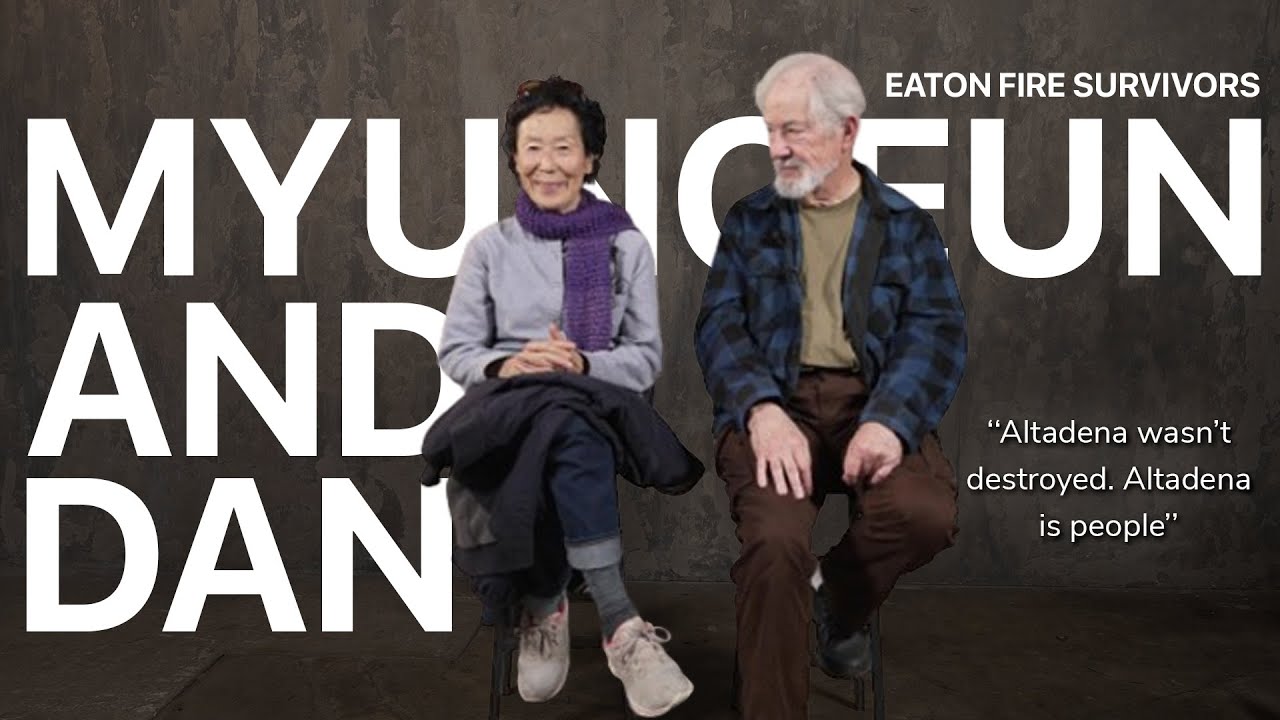
This story is the transcript of a Narratives video interview, lightly edited for clarity.
The night of the fire
I figured we would start by talking about the night the fire started. Can you talk about how that night began for you both, and what the rest of that evening was like?
Dan Strickland: To some degree, it's like a quote from an old musical: you wonder how these things begin. We'd been listening to the local weather guy, Edgar McGregor, and the previous week, Thursday, Friday, he was predicting Santa Ana winds would happen Tuesday. As far as I was concerned, I've been through Santa Ana winds every year. They're annoying. I don't like them, but I sit them out, and that's that.
Edgar was saying, though, it had been raining so much the previous year that there was a lot of vegetation that had now dried up, and so he was really worried about it. And he was even narrowing it down: Tuesday morning there will be a level two Santa Ana. That'll be nasty, but you won't need to get out at that point. And then he said Tuesday about 7:00 there would be a level three to four Santa Ana, and you probably want to get out for that, because it's probably going to produce a fire. So, well, okay, we'll sit it out and see what happens.
Both of us have been through Santa Anas every year. We were living up there in 2009 when the Station Fire happened, and that was really close to our house. The difference was that there was no wind with that, so we could sort of sightsee the fire. We could smell it, like ancient locker room socks that have not been washed in a century or two, kind of smell. And we were not feeling quite as urgent as we should have been.
But I went to bed Tuesday evening. Myungeun stayed up. We have very different sleep patterns. And Edison turned off the lights around 5:30. It was already dark.
Myungeun Strickland: Yeah, around 5:30.
Dan: So we had no electricity. The only communication was our phones. And so I went to bed, and the wind was howling. It was unpleasant, you know how Santa Anas are. But I was zoned out, and about 10:30 Myungeun came in.
Myungeun: No, it was before. We left 10:30, but it was before 10:30. I began to really worry and watch the back mountain, and I didn't see any sign of flame or anything, so hopefully the wind dies down a little bit. But I was awake, watching outside, people's movement, cars, things like that, and it wasn't very different from usual. And I saw our neighbors. Our neighbor opposite from us was leaving toward La Cañada. He has his parents living there. But other houses were still in the house.
I think when I get really worried and saw some flame far away, I said, oh, oh, that will get into our neighbor any minute with this kind of crazy wind. Wind had no direction. I saw it's going every direction. So I woke Dan up and start finding the cat first. I said, "We have to get out, we have to get out." And then start finding the cat, and in this darkness, and our house is big and I have a lot of my stuff, so I couldn't find him. So it took about 15 minutes to find him under the bed, hunkering down. And so we hurry up. And what he did, I don't remember.
Dan: I grabbed the laptop.
Myungeun: And I grabbed not even my purse, just a little wallet or something, because it has my driver's license, and since we have to drive, we needed that. That's all I got. Grab the cat.
How long did you think you would be gone?
Dan: A couple of days.
Myungeun: I wasn't thinking. Yeah, if I think I'd be gone, I'll maybe spend more time to grab my photos and important documents and things like that.
Dan: I had a little pack with medications, and it had a two-day supply in it, so that's kind of the thing.
Myungeun: I get my medication. When I was leaving, I wasn't thinking anything, but hopefully the wind will die down. I didn't have any expectation of anything like that. So we left about 10:30.
Dan: Yes. And noticed everybody coming down from Mewing Avenue and onto Palm Street. It wasn't jammed. It was just, not even half a dozen cars, but it was several cars from neighbors on Ying Street who had decided it was time to go.
And on the news, had you seen the other fires? Had they started yet, or was this one of the first fires? Had homes burned down yet?
Dan: I'm not sure what you mean by other fires.
You were impacted by the Eaton Fire, right? The Palisades fires?
Dan: We had no idea. We were out of communication with pretty much the rest of the world.
Oh, right, because you were completely offline.
Dan: Oh, yeah, because the power is off. And we were taking care of ourselves, to be quite honest.
Shelter at the meeting house
So then where did you head to next?
Dan: Our meeting house, our Quaker meeting house. We went there because I have a key, the combination.
Myungeun: Our second home. We spent 22 years there.
Dan: There's a kitchen, there's a restroom, there's pads on the benches that you can sleep on, and it's a familiar place. So we just, without thinking, went there.
Myungeun: And we know the combination, so we're in there. So we were safe. Nobody else was there.
Dan: There's a guy who lives on the campus. It's four buildings on campus, including the actual meeting house itself. But the guy who is the caretaker, what we call the resident friend, his lungs were bothering him, so he had headed out of Dodge. He'd gone way up north somewhere, and he wasn't there, and the gates were just open. And that's where we went in. I turned on the heat, but Myungeun stayed in the library, which isn't particularly well heated, with the cat, to make sure he was okay. She said she was really cold that first night. I suspect it was really upset as much as cold.
We have a school on campus called Friends Western School, and a couple of people from that group came and started cleaning up the debris on Wednesday.
Myungeun: On the campus, anyway. It was Wednesday or Thursday.
Dan: They learned about us, and I popped my head out and chatted a bit, and somehow word got back to the people in the school that Dan and Myungeun were sleeping in the meeting house. It was in an evacuation area, technically. It's at Orange Grove and Los Robles. So there weren't a lot of people coming by the meeting house. People mostly went to their relatives. We don't have relatives nearby that could accommodate us. So anyway, the parents of the students, it covers K1 to 12, a small school, called up and asked specifically about us, and offered the housing right away, and we could come any time.
Myungeun: But our daughter was coming from San Diego the next day, Saturday morning, and she was bringing us all kinds of bedding and all that stuff. So I said okay, we are already getting comfortable here, especially my cat. Saturday morning we left for their house in Eagle Rock.
And you've been there since. In those days, when you first arrived at Eagle Rock, what has been going through your mind? Were you still watching the news?
Myungeun: My son was sending us all these clips, because he was obviously very concerned. He's in Las Vegas. But we didn't have television, and my little phone gives a lot of information, but my eyesight got really bad because of the stress. So mostly on the phone with my son.
Dan: I was mostly checking email. I maintain the spreadsheet directory for the Friends Meeting. We have about 320 people who are listed in the directory, and a number of them live in Altadena. So I was going back and forth with people: do we know anything about this person? Do we know anything about the other person? We were doing some serious checking on whether people had managed to get out, what condition they were in, whether they had a place to stay. So that's what I was busy with. And boy, without that laptop, I would have been really bored, among other things. So in other words, we were quite well informed, by others or ourselves.
And we sort of heard about the Palisades fire during that process, when we were talking with members. One who is also a rabbi lives in Pacific Palisades, and he lost his home.
Myungeun: So Jonathan did?
Dan: Jonathan did, yeah. He was at meeting on Sunday.
Driving into the firestorm
Myungeun: And going back to the original story, Wednesday morning. So we evacuate Tuesday around 10:30, and the following morning, we left our bird, with us 23 years, and I feel so bad. So we tried to go to our house. We left the meeting house at 7. It was getting a little lighter, 7, but outside was all foggy, filled with smoke, and the ashes were flying like snowflakes. But on the way there, it was chaos. People who were evacuating early in the morning, or later, from the Altadena area and beyond, the street was jammed. And then some of them have horses up in the mountain, and the horses were walking. It was really a nightmare.
Dan: We were going across Montana Street, because Los Robles that we were going up was blocked, and we cut across that way because of the traffic. And here came a truck towards me, and it was still kind of dark because of the smoke and so forth, and I started to pull over near the truck, and the guy honked and waved. I looked more carefully, and there was a horse that he was towing, hauling, that was walking beside his truck, and he had a halter on, with a rope, the horse. So if I hadn't been careful, we would have hit the horse. So I let him go past first.
Myungeun: So when we reached Woodbury and Fair Oaks and Lincoln, there was some traffic cops, I guess one or two, just standing there, not blocking us. We just went. So we went through there. It was burning all over. But by the time we reached Ventura Avenue, Ventura Street, there is a big cemetery there, a very well-known cemetery. Just after we passed that, not suddenly, but there was black smoke, and the fire, the flame, got really hard to see. Embers and some burning objects flying all over. We passed that, maybe we could go and reach our house and see the bird or something like that. But we couldn't, because the flame was right here and the objects were flying. There's a fire on both sides of the street, and I felt the car got very hot. So I said, "Wow, we are going to be melted right now. What if some object, metal, something like that, breaks our windshield?" So I said, "Turn around, turn around." So we turned around. When we were turning around, it was pitch black, and it wasn't because it was still dark. It was because of the black smoke. I think police or whoever were there just couldn't do anything, so they didn't stop us.
How close did you get to the house? And on your way there, were you seeing firefighting going on, with all of this burning around you?
Myungeun: There were no firefighters around. Nobody can do anything there.
Dan: There were firefighters.
Myungeun: I didn't see anyone.
Dan: I did, but there weren't a lot of them, and everything was on fire. I mean, those poor guys. Both sides, the wind was still blowing, and it looked like the world was on fire up there. It smelled, it was hot, and visibility was limited. It was just really frightening.
Myungeun: And then we went back when it was still light. When was it, late in the afternoon? Yes. And by then they had the roadblocks up on Woodbury.
How close did you get to your house?
Dan: Probably a mile.
Myungeun: Oh, yeah. A little less.
Dan: On Fair Oaks, to the church. We didn't get as far up as the church.
Myungeun: No, we didn't.
Dan: So that's probably the Ventura, Ventura Street or Avenue.
Myungeun: Just past the gate of the cemetery, where there used to be a grocery store on this side.
And so by that point, you assumed your house was probably gone?
Dan: Yeah. It was obvious. I mean, you hold out hope that there's been spot jumping, that kind of thing, but that was a firestorm.
What's left of Altadena
Myungeun: So we got information from our son mostly, but also the media. And we tried today, and we made it all the way up to Altadena. Is it Avenue or Street?
Dan: Avenue.
Myungeun: Avenue, okay. That's it. Two blocks, two streets up, is Palm Street, where we live. They said no, don't. But they checked your ID, whether you are really living there. So I showed my driver's license, and a lady soldier said okay. So we went up there, and then Altadena Drive. So we made a turn on Altadena Drive, all the way to Lake Street. Gone. It was so sad.
Dan: Lake Street is sort of the downtown of Altadena. There's a lot of history there. There's buildings that are over 100 years old, which suggests that it's not a place where there's fires.
Myungeun: The fire station is gone.
Dan: The fire station is gone, yeah.
Wednesday, Thursday, Friday, you were talking about where was I getting my news from and so forth. It was mostly following Edgar McGregor on Facebook. There's a Facebook website called Beautiful Altadena, and a friend of mine was involved in setting it up, and it's pretty well moderated, so she keeps the spam and the scams down to a minimum. A lot of misinformation, of course. So they were trying to be careful about confirming: did such-and-such house really burn down? And people kept reporting things like that. So finally they said, "Let's be very careful. Don't give me secondhand information. If you say such-and-such places burned down, make sure that you are certain of it and have some serious evidence."
And Edgar kept us well informed. Edgar said, for example, you should immediately download Watch Duty. And so we immediately downloaded Watch Duty, and there it was: here's where the fires are. And that led us to the county fire assessment that they've put up, where you've got an outline of the borders of the fire, and the houses that they've been to and inspected that are gone or not gone.
Fifty years together
I'd love to go backwards now and learn more about the two of you, how you met, and the memories that you built in that home together.
Dan: We worked together on a Peace Corps training group, and that was 1973. I was just joking that it was an arranged marriage, because there was a certain staff member who insisted on teaming us up for things, and it had that feel to it. But yeah, that's how we met, and we've been together since then. So 50 years this year.
When I was in the Peace Corps, I had been a TB control volunteer. I lived out in the boondocks, and diagnosed and treated and kept track of tuberculosis patients. And the guy who was the supervisor for us in that particular province, the provincial TB control officer, had told us all, "You guys should go into public health when you get out of here." And out of the five of us, four of us did go into a medically related field. Two of us became epidemiologists. So, a powerful influence.
What is that, sorry? An epidemiologist?
Dan: It's the diagnostic branch of public health medicine: assessing the health of a population and doing something about it, like stopping or preventing an outbreak of disease.
Myungeun: And then after we came to America, our first job, we were health volunteers. No, we were paid. Our field epidemiologist pay was $10,000 a year, and our rent was $85. And our assignment was eastern Kentucky, a coal mining town. They are the direct descendants of Northern Ireland Irish, Scottish. Very interesting. And living there with these people, it's like you are in a Charles Dickens novel. They speak that way too, or like living on a back street of London in the 1800s, because they are very dirty. They don't believe in baths, even though there's the Kentucky River and everything, and you can bathe. And they are all white folks, so I was shocked. There was one little Black community, but they were doing better. And education was very poor. So he did the same thing he did in Korea, except it was a research project on infantile diarrhea.
Dan: Yeah. It wasn't TB, even though I'm sure there was TB, because, oh, there was. I diagnosed a guy with it. The house was really jammed.
Myungeun: It's really poor. Our county was the second poorest county in the USA, after Montgomery County in Alabama.
Dan: The name of the county was Perry County, and we were living in the county seat, which was Hazard.
Myungeun: The name of the place, Hazard. And I did what I used to do in Korea: educate the young, unwed mothers. So it was worthwhile.
Dan: And then from that, the guys who were my supervisors up at the University of Kentucky said, "You should continue and get a degree, so that you can do this with letters after your name that say you know what you're doing," even though I already did, and they acknowledged that. So I looked around for a place to go to school that would support us. I applied to five different places, and a couple of them turned me down, one of which I later worked at as faculty, so a bit of irony there. That was the University of Minnesota.
And we ended up at the University of Washington, which I took basically because they had an epidemiology department, and they said they would give me scholarships and RA-ships and TA-ships and that kind of thing. And I didn't know it at the time, but they were either the number one or number two epidemiology department in the country, the other one being the University of North Carolina at Chapel Hill. So depending on which one you're loyal to, it's one and two. So much for that.
Determined to go back
Myungeun: I'd like to speak about the people living in our area. I really like our area. It's diverse, young and old. It's really, what do you call it, multicultural, I would say. Yes. So we are corresponding through Facebook or telephone closely, and they are determined to go back, and I am too, because I took a lot of time and effort to make that place beautiful, and I'm thankful to all, the US government or God, whatever. So I'd like to go back too. And at least our immediate neighbors are talking.
Going back where, sorry?
Dan: Going back to that same patch of ground, and putting up what we can.
Myungeun: Yeah. And our immediate neighbors are, and I'm sure down the line, because there are a lot of young couples with two kids, three, five years old. There is a nice elementary school within walking distance. It's a very nice area for families. So my point is, people around there are determined to go back, and we need help from the government or private, whatever.
Do you see a lot on the media these days about how the town was destroyed?
Dan: And watching the fires blazing through, preferably Palisades, because those are really expensive houses. But the east side of Altadena, on the other side of Lake, is also a very wealthy area. They use it as a substitute for Beverly Hills, because they say it looks more like Beverly Hills. And we had friends living in that area who lost it all.
There's a certain amount of tragedy voyeurism to this, you understand. People get a frisson, a vicarious thrill of horror, at this sort of thing. And that's why I'm a bit hesitant to talk, especially to corporate media, about this.
Something that we are hearing from folks that were in our area, and even the folks who had businesses on Lake Street, sort of downtown, is that yes, you can say there were buildings lost. The physical structures were destroyed. But Altadena wasn't destroyed. Altadena is people. Altadena is the people who have a history there, and we'll come back, and it'll look different, but it'll be us. So that's where Altadena is right now.
What do you say to the people who are saying that this is a problem of wealthy people, that they'll be able to recover quickly? How has hearing that made you feel?
Myungeun: I would say the 2028 Olympics. We have that coming, so there's no time to talk about politics, whatever. We have to survive. Like Paris Hilton, the Hilton Hotel offered the free whatever in downtown Pasadena. I heard some brand-name clothing stores are giving you free whatever. I have enough from friends, so I'm okay. But we have to work together.
Dan: I'm the recipient for emails coming to Orange Grove Friends Meeting, and there have been Friends meetings all over the country calling, writing in and saying, "Hey, what can we do to help? Well, we'd like to donate," da, da, da. So I funneled that to an ad hoc committee that we put together to handle that sort of thing. Someone in our meeting was pointing out that a lot of the traditional Black churches along Fair Oaks and up there, some of them have been burned down. Maybe we should help them.
But the question of the celebrities, the wealthy homes getting destroyed: I ache for them. Unless there's some distant investor who never uses the house, that's one thing. But people who've lived and established a home and have history in that area, I ache for them, and their wealth doesn't matter. It shouldn't matter. It's going to be less of a struggle for them. So the people in our area who didn't have enough insurance, who were renters and didn't have renters insurance, they're going to need a ton of help, and it's good that people are focusing on really helping them. To my way of thinking, let's focus on helping those people, rather than on the fact that, oh, maybe a celebrity got a big payout for their home in Pacific Palisades.
More than stuff
When you think about the things that you lost in the fire, what are some of the most sentimental or valuable things that you're worried are gone?
Myungeun: Our history. On his side, the family immigrated, so he had a document, written in ink, from 1791, the first record, and then after that, letters and pictures. Gone.
Dan: Some of them I had on my computer, so that's backed up to the cloud. But the actual letter, the actual piece of paper, is gone.
Myungeun: And then my side: when I immigrated in 1974 to marry him, I brought some of my stuff. My brother and sisters have some, but my baby pictures, things like when the baby was born, gone. So I mourn for that. Documents mostly, but some materials are antiques from the families. I mourn for them. And the bird, and musical instruments, rare and good quality ones, gone, for my children. Other than that, I don't care about stuff. I can buy it.
Dan: It's an interesting question. People in situations like this will sometimes say, "You made it out fine. You're alive. The loss is just stuff." And to some degree, that's an understandable response. But stuff is often a definition of who we are. Right now it feels like we're on vacation somewhere, sitting in a nice apartment that we've rented, and that if we just get the car and drive back up to our house, it'll be there unchanged. And that's our environment, and our environment is a part of who we are. So in that sense, it's more than just stuff.
Myungeun: Yeah. I mourn for those precious things.
But when you think of the future, are you optimistic that you'll get to rebuild and be back in some version of that community or home again?
Myungeun: Yes, yes, especially because we are okay. Maybe that's why I feel that way. I'm not listening to other people's situations, but my immediate neighbors are really determined.
Dan: Yeah, I'm optimistic. It will take a long time. There's a lot of history in that neighborhood, though. Our house was built in 1960. The house across the street was built in 1920. The oldest house in the neighborhood was built in 1901. So you wouldn't expect a major fire loss to happen in a place that has houses that old still sitting there.
Myungeun: Right. So I am optimistic, but it will take a long, long time. So I must be, I should be, healthy, mentally and physically, to see the good results. That's what keeps me going, because we are old folks.
What do your kids think of the whole situation? What have they said?
Myungeun: Oh, they're scared. They are so upset, because their history is gone, mostly, and they're really worried about us. So I'm thinking of the movie Gone With the Wind. In the last scene, the woman, what was her name, the beautiful woman?
Dan: Scarlett.
Myungeun: Scarlett. When she was leaving her house, called Tara or something like that, and it's burning, and then she turns around and walks. I'm determined to rebuild. I'm like her. But the difference is, she's really young, and I don't have much time. I feel like that.
A home in Altadena
Did you build this house, or did you buy it?
Myungeun: We bought it. But in the back we have a huge lot, so I built a guest house. Very nice, modern, with a high ceiling, California style. I built it in 2010. So many people came from Korea, anywhere, Japan, and slept there and appreciated the trees, the lemon tree and all that. So physically, I have two houses.
Dan: We moved there in 2002.
Myungeun: From Kentucky?
Dan: No, Omaha, Nebraska. When I graduated from the University of Washington, we went to Minnesota and worked there for a couple of years. Then Omaha. I worked at the University of Nebraska Medical Center for 11 years, and then moved here, where I was hired by Kaiser Permanente. It's the typical academic thing: you get promoted by moving.
Myungeun: We came in 2002.
Dan: Yeah. The year after 9/11, so that's 2002.
And why did you pick California and that area?
Myungeun: For California, we didn't have a choice, but I wanted to come here very much, for a long, long time. The Midwest is really tough for kids, for mixed kids. I can deal with it. I am a war survivor. I was in the Korean War when I was two, three years old, and we lived on the street, basically, as refugees for three years. I don't have a lot of bad memories, luckily. So I'm tough. But what my kids were going through was really terrible, and he's still in counseling.
Why was it so hard? Could you tell us a little bit about it?
Myungeun: Oh, basically racial discrimination, and also the image of a boy didn't fit him. The one who plays a musical instrument, and then goes to football practice and comes to the piano teacher with a sweat and all that. That was fine. But the school kids, the friends, were just totally not accepting.
Dan: I grew up in Van Nuys. My parents moved here when I was two and a half, in 1948, and they bought a stucco ticky-tacky house in Panorama City, and we lived there for 10 years. And then my parents decided they wanted to go back and live in Indianapolis, where their family was. And so I was in Indianapolis for high school and college.
Myungeun: Well, everybody in the Midwest, young people too, is dreaming about California. Dream of coming here. So we're living in a paradise, thanks to Native Americans.
Dan: And she had a lot of connections with Koreans here. There were, what, three Koreans living in Omaha? And there's a direct flight, so that's nice.
And how long did it take you to learn to speak Korean?
Dan: I'm still learning.
Myungeun: His everyday Korean is okay, but literary, or a little intellectual things...
Dan: I stumble when I give a college lecture a bit.
That's pretty impressive.
Dan: I get lost in faculty meetings. But I was teaching in Korea from 2016 to 2019. I went to a school called DGIST, the Daegu Gyeongbuk Institute of Science and Technology. There's five of these institutes of science and technology in Korea. They're like Caltech equivalents. So, damn good schools, grad school and undergrad. And when we were looking at the place, they asked, "Can you teach English?" And I said, "I can sort of speak English okay, but I have no clue how to teach it. Teaching is serious." And I said, "But I've been teaching epidemiology for 20, 30 years." And they said, "Okay, can you put together a course for undergrads?" Because I'd only taught medical students and grad students. So I put together a course for undergrads and sent them the syllabus, and they looked at it and said, "Cool."
So I went over there and taught a three-hour course every semester. The title sort of actually translates as special old fart professor. And they paid me at assistant professor level. They gave us faculty housing, and they gave us airfare back to Altadena over the winter and summer breaks. And we did that for three years, and that's really helped my career, among other things. So that was our most recent connection with Korea. And she was involved in starting a revolution in Korea. Still is, I suspect.
Myungeun: No more personal stuff. I'd like to focus on now.
A community worth protecting
Let me ask you this. For other families who are going through this as well, whether they're young or they're similar to you both in age, can you share a little bit about what is giving you the energy and the strength, and the stories you tell yourself in your head about the future, that give you the energy to keep going forward and be so positive?
Myungeun: People. We are all in it, in this case. Young and old, rich, poor, no. We have to work together in order to save California. First of all, the Olympics are coming, and we have a conservative president today, so we have to work hard. No, no, no division or hatred. We have to face it right now. We can't afford that. That means we have to rebuild. Don't think about profiting, something like that. No. You have to think again.
Dan: When I went to high school in Indianapolis, I went to Shortridge High School, which my parents had gone to. And the remarkable thing about Shortridge is that Indianapolis was a very segregated city. Crispus Attucks was a Black high school, set up deliberately that way. Shortridge was integrated, and when I was there, it became a target for a lot of fear and hate. And during my college years, the school finally got shut down, mostly by a group called Parents Concerned About Quality Education, some such thing. Parents who were scared that maybe Blacks would come to their kids' school is more what was going on. And places like that become targets.
And you doubtless know the story about Altadena, but just to make it a little more blatant: people moved up to Altadena from places like Pasadena because they were deliberately pushed out of Pasadena. Altadena had originally been a white flight community, but as the Blacks moved in from Pasadena, there was white flight there too. But some people stuck around. There's a guy from our meeting whose parents were supportive of the Japanese community that was up around Lincoln Avenue in Altadena, so you can still see some remnants of that. There is a serious community of mixed people, mostly on the west side of Altadena, but in other areas of Altadena as well, and the community is remarkable for that.
I don't know that we think of ourselves as successful. We think of ourselves as a friendly community, where we all kind of know each other and look out for each other. And that it's made up of something other than people who don't look like me makes it sometimes a target for people who are frightened of that.
The thing that frightens me most about the upcoming administration is that it will be like the previous time we had a bigot in the office of president, in that people who are afraid of others, during that period of time, 2016 to 2020, felt like they had permission to go out hunting, as it were, and attack people who frightened them. And I am afraid that that will become a major problem again. It affects our Friends meeting, because we have people who look like they are targets, who are vulnerable. We have, I don't know, quite a few trans people, for example, in our Friends meeting. We have people of various ethnicities and religions. We don't just have a rabbi. We have a couple, three Muslim people, a woman from a Sikh group that I'd never heard of. And that's what frightens me: these people are vulnerable during this period of time, and it has me wondering what I can do to keep my friends safe.
What comes next
It sounds like you've built a really beautiful multicultural community over there, and it's really tough to not be together anymore. Are there efforts you're both thinking about for the time between now and when you get to go back to that area, community events and things that you plan to do to bring the community together and support each other? What's been working?
Myungeun: Not our neighbors, but in our Quaker meeting, we are already doing it.
Dan: The school had all the parents bring in tons of clothes and had a clothes distribution day on Saturday.
Myungeun: I got these shoes.
Dan: We scored some clothes out of it yesterday.
Myungeun: So I just washed them a little bit. But I'll buy new ones. I can afford it. I'm not poor. But I needed it right away. And then I'll be involved. I've always been involved in this so-called, what do you call it, civic action, whatever.
Dan: There's a ton of irony going on here.
Myungeun: Volunteering for school. And I've been working in downtown Pasadena for a soup kitchen, but it's closed because it's become very rough. It's opposite the animal shelter, and when we were working in their kitchen, the police had to be dispatched to protect us. So since we are getting old, old people are taking a back seat and contributing money, but the young folks got in and do it. So we've been doing it.
Dan: And Quakers are famous for going to places where there's a war or civil war and helping out, no questions. Even Vietnam.
Myungeun: No questions about whether you're Christian, whatever. Just do your work. Medical, especially. So I'll continue doing that, while I try to get back into our place and build a modern, energy-efficient house. A simple house, not a big house. Not two houses. Just one, for ourselves.
Are either of you worried that maybe the fires were mishandled, or that something could have been done? Or do you have any perspective on how to ensure that all of these rebuilding efforts don't go to waste again from just another bad day of wind?
Myungeun: I think scientists have to put their heads together all over the world, because there's no guarantee this will happen again, anywhere in the world. It's global warming.
Dan: I mean, yeah.
Myungeun: So we have to put our heads together, and resources.