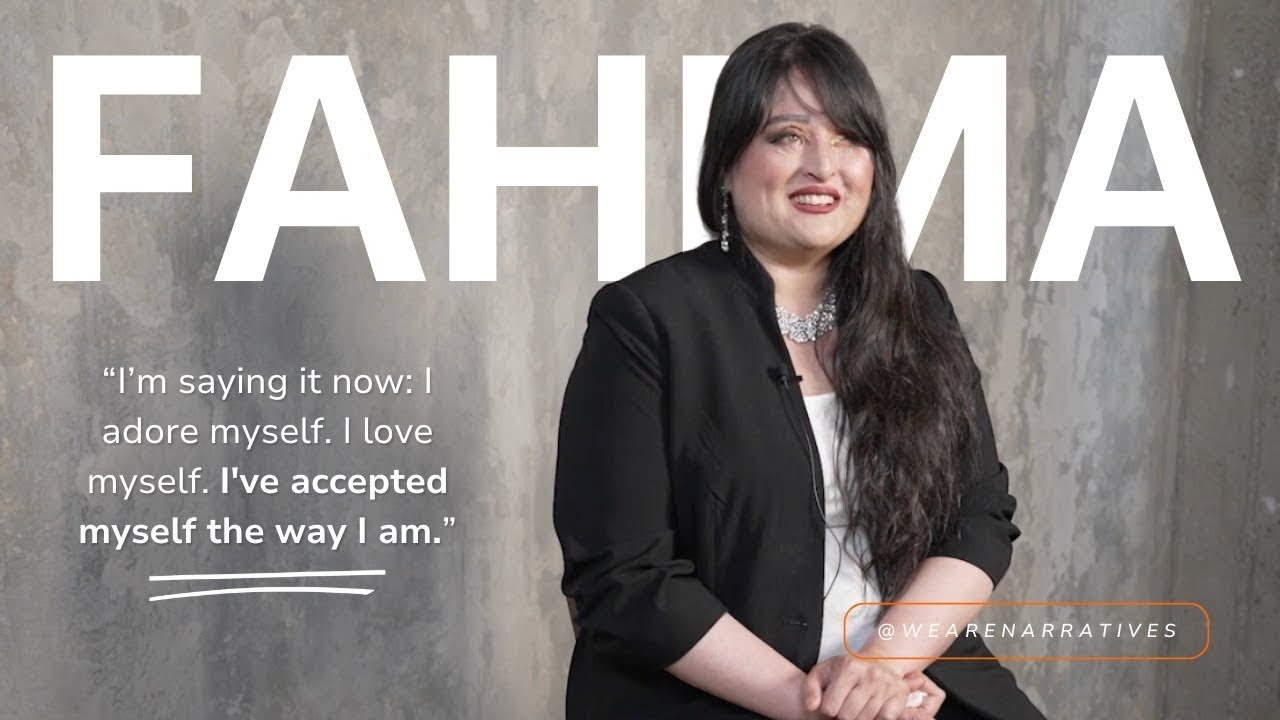
Fahima Sarfaraz: A Survivor's Journey After an Acid Attack in Afghanistan, Part One

This story is the transcript of a Narratives video interview, translated from Persian and lightly edited for clarity.
Content note: this story includes accounts of a forced marriage at 15, domestic violence, threats of sexual violence, thoughts of suicide and an acid attack. Names of her family members are withheld.
A childhood between two countries
Fahima jan, thank you for making the time to come and talk with us. Today I wanted to start with the story of your childhood. Where did you grow up, what was your family like, and what was your relationship with your mother and father like?
With greetings and respect to all the dear viewers, and to you. Well, originally, I mean my father and mother, are from Afghanistan, and before I was born they migrated to Iran, and I was born in Iran, in Tehran. And I think that in those times the conditions, from the point of view of migration, were not very good and not suitable, and financially, I think, there were some shortages. Anyway, they exist in every life, and they were in their life too. In short, I was born in Iran, in Tehran, the beautiful city of Tehran, at the Sevom-e Shaban Hospital.
And about childhood: I think, and I sometimes say this, that not only for Afghans, but for a high percentage of Iranians themselves, their childhood was somehow wasted. It passed in a way that now, when we want to go back and look, we say: well done to us that we got through it, and well done to those who, in such conditions at that time, with those hardships and that life and the challenges they had, got through it.
Did you have brothers and sisters?
Yes, I have 2 brothers and 3 sisters, and I'm the second child.
What was your relationship with them like back then, in childhood?
Well, childhood was good. Anyway, a person is in a state of not knowing; it's childhood and then adolescence. Afghans have a proverb that says the five fingers are not equal, or not alike, something like that. I mean, in every home, the children are not all alike. Anyway, the older a person gets, the more they can see the differences. And in our life, I was a bit more of a playful kid. I was more mischievous. I was always after searching, looking, exploring, discovering new things, and I wanted, from that same childhood or adolescence, to be something a bit different from them.
Married at 15
And adolescence, well, at the start of adolescence I got married. I was 15, and I separated completely from that life, from that family. Once you married, you came out, according to the customs that existed back then. It's over with your father's and mother's family.
You said you were 15 when you got married?
Yes.
Do you remember your life back then? How did you meet your husband?
If I tell it, maybe a bit... Many people say, when I tell something, they don't believe some of the things I say. They say that because the people of Kabul, Kabul in Afghanistan, are relatively more cultured people, and we, for example, are of the Qizilbash ethnicity, I mean the Qizilbash people, and Kabuli, these are a bit higher culturally, they're surprised by some things I tell. They say, in an enlightened family, why would such things happen?
Because I was the second child, I mean the second daughter, and according to people who came, and some of those around us, I was the most beautiful of their daughters, and there was a lot of attention on me compared to, say, my older sister. And I remember there was a time when, say, 4 suitors would come to one house at the same time. I knew 3 of them were for me, but this one I didn't know about. I thought it was for my sister.
And because they had stronger connections... There was a husband and wife we knew, and at that time there was a lot of talk about how so-and-so is a believer, and so-and-so's wife wears hijab, and he doesn't let his wife go to a wedding without hijab. They have a Pakistani dress; I'd call it a Punjabi. They said Mrs. so-and-so had gone to a wedding wearing a Punjabi, and he tore her Punjabi and took his wife out of that gathering. This was a very juicy story. Then, because they vouched for him, this suitor was approved, and I had no idea at all.
What's interesting is that a day or two before the day they were supposed to give the yes, like the Iranian baleh boroon, they came and brought clothes to take measurements, to see whether they fit me or not. My future sister-in-law turned to my mom and said that the bride was my older sister, and that they just wanted to see the size on me, and would only adjust the length. I put it on, very easily, and when I put on the second dress, suddenly they hugged me: "You're the bride!" I'll never forget it. I pulled the dress off my body and threw it into the courtyard and went into the room.
That's very interesting.
Yes. I went into the room and locked the door, and I was there for two nights and two days, crying. Then my dad would come. The photo of that guy that I had been given and had put on the shelf, I threw across the room, and I said, "You have no right to give me away without my permission. I'm young. Why don't you give the older sister?" And so on.
In short, after two days, which was the day of the baleh boroon, at our neighbor's house... I'll never forget it. I went from house to house, to my friends' houses, my aunts' houses. I said, "I don't want this. I don't want to get married." In short, nobody let me in, nobody opened their door to me, and I went back home. And anyway, the world of childhood was destroyed from there. I got ready, they did my makeup and dressed me, and, in short, for the baleh boroon... I think there may be one or two photos from that time in my album. I mean, my marriage started from there, with me having no idea that I was the bride.
And before the proposal, did you have plans? Did you want to go to university? Did you go to university later, or did you want to go back then?
Back then, yes. Well, because we were Afghans anyway, those opportunities weren't there for us to reach the level of university, or to study at a university. And our family was such that, for example, they would say if you have some literacy and can read writing, that's OK, that's enough. What does a girl need university for? Tomorrow she'll go to her husband's house and cook. But I had dreams. At that time I really wanted... As I said, because I was always after exploring and searching, I would have liked to become a journalist, for example. I would have liked to be someone in government and politics and big, big things. But at that time, none of it came true.
Was this proposal in Iran or in Afghanistan?
No, it was in Iran. I was about 9 when we went to Afghanistan. No, sorry, I was in fourth grade; a person doesn't remember the exact year. I was in fourth grade when I went to Afghanistan. I studied fourth grade there, and fifth and sixth and seventh, in Afghanistan, and then we came back. That going and coming back really ruined things for us more. It made the situation worse, and all our dreams were buried.
Back to Afghanistan
And what had happened? When you went and came back, had everything changed?
Well, the difference between Iran and Afghanistan, not only then but even now, is very big, in terms of freedom, in terms of ease of life and so on. And we went into a situation where the atmosphere was completely different, the people were different, the lifestyle was different, and times were going downhill financially. For example, the last year we were there, my father went to Iran and came back. I mean, because there was no work, he went back to Iran.
And the Taliban were there. The Taliban: war and fighting and killing. We went through many periods of war, of the terror the Taliban had created at that time. We witnessed all of it, not only me but the rest of the family. And part of my childhood passed loading and unloading goods with my dad, and was wasted. And this hard life we had in Afghanistan, much harder than the life in Iran, we experienced in Afghanistan as children.
When you got married, did you stay in Iran, or did you go back to Afghanistan?
When I got married, I was in Iran for about a year or two after the wedding. Yes, we were in Iran when my first child, a son, was born, and he was a year and a bit old when we went back to Afghanistan. And the conditions were much worse than in my childhood. The cold winter air...
What made you go back to Afghanistan?
Saying it is very hard. There were some issues that are really hard to express. Well, at that time I was married, so I wasn't the one making decisions; they were. They thought that the Taliban had gone and the era of the Republic had come, and they thought that now money was pouring from the doors and walls of Afghanistan, and they could go and do good business and have a better life. But when we went, the conditions were very, very bad. We went through very hard days. Nights going to sleep hungry, days going around hungry. Nights when we would buy just one small piece of bread and eat it with tea and go to sleep.
This was in Afghanistan?
In Afghanistan, yes.
If life in Afghanistan was this bad, what made you go back? Why did your husband want to go back?
Well, sometimes it's the interference of relatives. For example, I remember one of the reasons was this: there was a yard, an inherited property or something, which seems to have been an issue with his aunt's husband and others, who wanted that property to be brought back to life, so that the money from it would come into their hands. They made this boy responsible for it, so that he would go to Afghanistan and live there and take care of the two houses that were there. But it ruined our life.
Otherwise, was it good? I mean Iran, back then, after you got married?
With all its hardships, the conditions got a bit better. After my mother-in-law and sister-in-law went to Pakistan, life became a little bit easier for us compared to when they were with us.
They went to Pakistan?
Well, his mother was always traveling. She'd be in Iran, Pakistan and Afghanistan. Then at one point she decided to go to Afghanistan, and from Afghanistan she went to Pakistan. And their daughter too: they decided their daughter should go to Pakistan, where maybe she'd find a husband, marry, go after her fortune and such. And so they went to Pakistan and lived there.
After you had gone back to Afghanistan, did you go back to Iran again, or were you in Afghanistan from then on until suddenly...?
Yes. About nine months after we had gone, we went to Pakistan for his sister's wedding, that same girl, my sister-in-law. It was her wedding. Then from there, at my insistence, we got visas, and I went to see my mother and father. Well, my decision was to see my parents, but this man insisted... I mean, the plan they had was that he would take me to Iran and divorce me.
Talk of divorce
We didn't know the reason at all. Every life has its own challenges, its own quarrels, but not to the point that you wake up one morning and he says, "I'm going back. I'll divorce you here and leave you with your mother and father, and I'll take the child and go." I'll never forget that morning. My mom and the others were asleep in the living room. I came in: "Mom," I said, "he's saying this. I don't know why." I swear to God, I said, I don't know what happened. And his argument was always that we had no understanding with each other.
Now I don't know what understanding he meant. In terms of personality, or in terms of family? Our family was a bit higher than theirs. I don't know what the issue was. At least at that time, it wasn't something very important, something we'd want to get a divorce over. But with my parents' intervention, it worked out again. But any life where the word divorce is said once, twice, three times, five times, that life isn't a life anymore.
How long had you been together by the first time he mentioned getting a divorce?
About three years, three and a bit. It was three years. But before that too, there was his harassment, his torture, his violence, his beatings. These were there, but he never brought up the word divorce, at least. And his own family said nothing. Nobody said anything if he hit me or harassed me.
So it was normal for everyone?
Somehow. I don't know. From what I saw with my own eyes, I think that in some families this is a completely normal thing. At least in their family it was like that. For example, their daughter was married to a boy during her engagement period, and then they separated, and she went to Pakistan and married another husband. And with another daughter of theirs, for example, she couldn't have children, and the problem was with the girl, and still they insisted, "Come, separate," and the husband wouldn't let her go. And another son, they kept going after him: he went to America and lives there. Why isn't his wife subordinate and obedient to his orders? He should divorce her.
I think that in some families, not only in Afghanistan, unfortunately, but in Iran or neighboring countries, such a thing is very natural, normal: getting divorced and divorcing. At that time, with my sister's husband, we would see that, no, he'd say, "A woman came into our house in a white dress, and she must leave our house in a white dress," meaning the shroud. But for this one, divorce was as easy as drinking water: "I divorce you, get out, I'm done with you." It was a very minor thing for him.
How did you get divorced, the last time?
Well, after a while his financial situation got good. His cousin worked with a very big company, people who had come from America to Afghanistan, and he gave him a job. And anyway, the money from friendships and the money from corruption, which he later blamed on me, made him rich.
And there's this proverb, in Iran and also in Afghanistan, which says, pardon me, no offense to all men, that if a man's trousers become two, then his work is done. Present company excepted; you are very different from such people. But this was a proverb about those whose level was lower, who couldn't handle being rich. This gentleman's trousers became two, just like that, and this girl and that girl... The days of poverty, the days of hunger, of going to sleep hungry, all of it was forgotten. The people around him multiplied. The girls multiplied.
I wanted to know: when you returned to Iran, since you finished seventh grade in Afghanistan and then returned to Iran, did you continue school? And if you did, up to what grade did you finish?
At that time, no. The conditions weren't there for us to continue, and we didn't continue.
So you studied up to seventh grade in Afghanistan?
In Afghanistan I studied up to seventh, yes. I mean, officially I studied to seventh, but I studied at schools that were for Afghans, unlicensed schools that didn't give a certificate. It was only teaching. I studied there.
You studied separately?
Yes, separately.
And were you able to get a diploma or something?
Later, when I went to Afghanistan again, after I got married and went to Afghanistan, yes.
Ah, you got your high school diploma there?
High school, yes.
Very, very good. And was your husband Iranian or Afghan?
No, he was Afghan, an Afghan who lived in Iran.
So it was through family that they were able to arrange this introduction and this proposal?
Yes, through another family that I mentioned.
Then when he decided that you should go back to Iran with the child, was it easy, going back and forth?
Well, yes. We got visas in Pakistan, Iranian visas, and went to Iran.
So every time, you went and came directly from Afghanistan to Iran? People could go?
Yes, they gave visas.
Very good. The next question, if it's OK to ask: what was the age difference between you and him?
10 years.
10 years. And had he gotten his diploma in Iran?
He hadn't, no.
Starting over alone
At that time I had 2 children. I had 2 children. And the divorce happened in such a way that he himself insisted a lot that we must divorce: "We'll have an amicable divorce," and, I don't know, "we just can't live together." But there were some issues, for example accusations that had been made, which were exposed a few months after we divorced. Through my own efforts they were exposed as slanders, and who they came from. They found the people. But the water had already passed over the dam. At that point there was no use in looking for a way back. Once something is over, it's over. There's no way back.
And then he knocked on this door and that door, and in short, he married again. And I took my 2 children. For a while I lived upstairs from them, through the waiting period under Islamic law, the iddah. I went through that, and I took my 2 children, and rented a new house, and moved.
And the time we were there was hard, because I always saw, even before we separated, I'd see his mother going from door to door to make proposals. They knocked on every door. But, fortunately, because of the reputation and the standing I had among people, every door they knocked on, people wouldn't give them a daughter. They'd say, "We know Fahima. Fahima is an active woman, a woman who wears hijab, has 2 children, is educated, loves people, is good-natured." And people would turn them down. God, every door they knocked on, someone from that family knew me, and so they couldn't find him a wife.
But a person can't always point to the positive points, or the negative points. I should say the positives too. For example, our situation got better, and he went to work. At least he had this merit: he pushed me to learn to drive, and I'd go to the gym, a sports club, and he helped me have a sports club in our own area. The first women's sports club registered with the Olympic Committee after the Taliban era was my club. This was a gain I had. I found the courage to drive in his house. Even with the pressure, the beatings, the insults, this was achieved anyway. This is the gain I had from that life.
And I think all my problems, that same freedom and ease, and the opportunities he had given me, mostly led to the relatives interfering. And anyway, no sin and no bad deed stays hidden. Later, the things he was doing came out: he was having relationships with women.
So you stayed in Afghanistan?
Yes, I stayed in Afghanistan.
Why didn't you want to go back to Iran at that time?
Well, at that time, when we had separated, I had no power in Iran. What would I go back to? I didn't have anything, any resources. Sometimes, honestly, even now I keep thinking about it. Even friends say, "This Fahima who is now like this, with all this ability and strength, fighting so many challenges, how come you didn't run away? How come you didn't leave that life and go?"
But at that time, I think, maybe this was for the best. Maybe I'd reached the conclusion to stay, because I was a person who wanted to be in politics, a person who wanted to be active. I knew I didn't have those opportunities in Iran. For example, educationally, I didn't have the kind of certificate I'd need to do some activity or have my own business. But in Afghanistan I had these things. I had my club. Then the club was closed, but there was the organization, then a driving school, and I was a candidate, a nominee, for the House of Representatives. Even if I wasn't elected, I ran. I had the audacity and the courage to go into the conditions of a male-dominated, misogynist Afghanistan. I gave myself the courage to do this. These were the things, the reasons I didn't want to go back to Iran.
A divorced woman in Afghanistan
Excuse me, were your mother and father still in Iran at that time?
No, no. I was pregnant with my second child when my mother and father traveled from Iran and came to Afghanistan. But they weren't in my city. They were in another city.
What was the environment, the cultural situation, in Afghanistan at that time regarding the divorce you got? What was the atmosphere like?
Terrible. Infinitely terrible. Now, it may be that people have become a little more enlightened, but at that time it was terrible. Your name was "divorced woman," or "divorcee," and thousands of predatory wolves were waiting for how to hunt her body.
In the early days after I separated, I didn't tell anyone that we'd separated. I'd say, "My husband is in Europe." And even during the time I was a candidate for parliament, I'd say, "My husband is in Europe." And then slowly it came out that no, I had separated, and the predatory wolves among the neighbors came after me. Everyone started with obscene, dirty propositions, from their rotten, decayed brains that only thought about lust. The propositions started, and many times I faced danger.
To the point that, for example, I remember once I'd gone to the neighborhood supermarket, right under the apartments. There was a gentleman who had propositioned me many times, but I'd say, "I don't want anyone to come. I don't want anyone to touch me. I don't want to have a relationship with anyone." Then, in front of 7 or 8 other young guys, he pulled a gun on me and said, "Either you say yes right here, that I come to your house tonight and you open the door at 12 midnight, or I'll shoot you." I said, "Shoot. Go ahead, shoot right now. Put yourself at ease and put me at ease. You have the power; nothing will happen to you. But at least I'll be at peace."
It was that terrible in Afghanistan. For a woman who wants to separate, it's much harder than the things I'm describing. It was very, very, very hard. There was no help. Maybe there still isn't. There's no help for women who get divorced, or for women whose husbands beat them. Look, from the court, where it starts when you go seeking a divorce, or from the mullah who's supposed to perform the divorce, from there the obscene propositions and dirty propositions start, until the last stage of life.
So who is going to help, when your family isn't behind you, doesn't support you, isn't on your side? The people won't. Even our own family, imagine: I was in a situation where they'd suddenly call in the morning, suddenly call at night, with obscene words. Maybe saying them isn't necessary at all, isn't appropriate for me to repeat. They insulted and humiliated me. When your family does this, what do you expect from the people?
What about institutions that take care of women who have been divorced, or who have faced violence and abuse? Were there institutions like that there, shelters?
There were, but they weren't suitable places. It wasn't a suitable environment. It was a polluted environment, where the shelters that existed had all been sold off, unfortunately, and exploitation took place. People who cared a lot about their honor and dignity wouldn't take refuge in a place like that.
A second marriage under threat
Now, if you can, please tell us about the attack on you. As you were getting closer to that attack, what had happened?
What she means is, how did it reach the point where this attack happened?
Let me say this: the man from the first marriage didn't carry out this attack.
OK, so you had another marriage?
Yes, something like that.
Then please start that story.
Well, during the same period when I was a candidate for the House of Representatives, I was introduced to a gentleman. This also has a very long story; I'll tell a short part of it. These people were themselves candidates for parliament. It started with the acquaintance they made with me, and then came force and threats. This gentleman had a wife, had grandchildren, a daughter-in-law, a son-in-law, had everything. He proposed friendship to me, and then after a while he said we'd marry each other. But because I saw that this man had a wife, I hadn't accepted his proposal. And it got to the point where he threatened me. He said, "If you're going to reject my proposal, I'll abduct you." I mean, what they call "I'll kidnap you."
And was this someone you were seeing, someone you loved, or no, just someone you knew?
I knew him through another route, through his son. As I've always said in my talks, be careful of the friends who come around you, because a bad friend can throw you to the bottom of the well. A bad friend kept company with me, and this bad friend kept company with his son, and his son proposed to me. I rejected the son's proposal. As soon as I was free of the son, I fell into the father's trap.
And his father said, "If you don't accept my proposal, I'll abduct you, I'll kidnap you, and I and my guards will gang-rape you." This was a very ordinary thing, a custom among the rich and wealthy and powerful of Afghanistan. Not rarely; very easily, they did these things: to journalists, to female politicians, to women who were famous, well known, beautiful, pretty. It was almost a natural thing; these incidents would happen. And he said such a thing to me: that he would film me, and then I'd be forced to come whenever he wanted me, first for himself, for that illicit relationship or that lustful rape, and then he'd throw me under the hands and feet of the bodyguards.
So he was rich?
Rich and powerful, yes. When this came up, I said, then it's better now... I have no way out. I didn't have an escape route, in those conditions, when I had nothing financially. Whatever I had, I'd lost. And I accepted his proposal. I accepted, and in short, they said, "OK, then, in six months, after six months, when my family leaves, we'll have a wedding together, we'll do the nikah," and so on.
But, honestly, at that time I was forced to lie to my family that I had married this man: that we went to Dubai and had the nikah in Dubai, although there was no marriage contract at all. And, well, I assumed, I thought that six months later his family would leave, in six months to a year, and we were going to be together. OK, he's a man. I thought an Afghan man has a lot of honor: he says these words and he does them.
In short, this happened, and then that temporary marriage, the sigheh between us, was extended every six months, or every year. And the torment, the torture, the beatings, very terrible situations, very terrible, went on. In the meantime, I went to Germany for a few months to apply for asylum there, to get away from him. He dragged me back to Afghanistan again. He even came to Germany, to the point that I was ready to kill myself in Germany. But I couldn't. I didn't have the courage, or there weren't the means, and I returned to Afghanistan again. At that point the conditions became much worse, much worse than before. There was torture, there was the issue of the child, my third child, from him.
The first beating
When was the first time he beat you?
The first time he beat me was three months after we met, after I had gone into the relationship with him. The story is a bit interesting. This man was 22 years older than me, and his wife was five years younger than him, his first wife. The problem he had was that he couldn't get along with his wife, and he'd come and blame me: "You go and do magic and amulets," I don't know, "you do these things so that I can't sleep with my wife." Nonsense. Sometimes I'd say, "No, I swear to God, go. I've forgiven you. I don't want you at all. Go, be hers." That's where the beating started, from there, and the beatings were to the point of death.
Excuse me. During all this time, while your sigheh kept continuing and being extended, your 2 children from your first marriage were with you, right?
Right.
And meanwhile you had another child with him?
Exactly.
And you had to take care of all 3 children?
Yes.
Had he provided a home for you?
Yes. We had rented an apartment. The house was in my name, yes.
And did his family know that a second wife existed?
At first, no, but later, yes.
How was he able to keep this relationship, this balance?
It was such that, by humiliating and insulting me, he would convince them that he had nothing to do with me anymore. And every time they found out about something new, he'd take some route, some technique, to convince them. But he never said, "She's my wife." He'd say, "She's my girlfriend." They'd say she was forced, a poor wretch, and he was keeping her. They didn't take it seriously.
Leaving for America
Then explain what happened, exactly, that it reached the point of this attack. What had happened two or three days before, and that day, exactly, what was this attack and how did it happen?
Well, there were many reasons that made him want to do this. For example, there were some religious arguments, and the fact that I was active. When I married him, I had stopped everything: my organization, our driving school and the sports club I had for women. All of it had stopped.
When it got close to America, our relationship kept getting worse day by day, and the argument was over the child: he wouldn't let me take the child, and wouldn't let me bring him. I worked with the Americans, and I had this case, something called an SIV, the Special Immigrant Visa, whose abbreviation is SIV. It was in process. We filed the case, and it went through his brother's office; the whole process was with his brothers. At first it was OK. Everything was set for us to come to America, and if we wanted, we'd keep that loving relationship. Two years before we filed the case, it was like that. He himself was even supposed to come to America and Canada with his family, and we'd have that relationship.
But then the relationship went to ruin, because this gentleman started illicit relationships with others. And then, about four months before we came, he got stuck on this: "I won't let you take the child." And the relationship we had was getting worse day by day, because any woman who is beaten, insulted and humiliated, the relationship weakens that much and is destroyed. And we came to America. I came to America with the children.
Where?
To Tracy, California. The city of Tracy, yes. We came there. But two months after we arrived... As soon as we arrived, six days later, this gentleman started: "Get up and come. I was wrong. I don't know what I did. I swear, I did this and that. Get up, come back. I won't hurt you or harass you anymore. I made a mistake listening to my family and rejecting you. All this time that I hurt you and didn't let you be active... Get up, come back."
He had heard that I'd come to America and that I might start our activities again, the work for women, and take it up again. Well, in fact, he was what we call a Taliban in a necktie. This gentleman was a Taliban in a necktie. Back when we were in Afghanistan, American forces raided their office. 4 of his bodyguards were killed, and 2 went into a coma, because they were making suicide vests in their office. He killed his nephew, and nobody found out. They'd kill people, bury them alive, and nobody found out. And he was one of those people whose family, after we came here, worried that all these secrets, the things that happened, would be exposed.
And when he told me, "Come back, I was wrong," all of it was just part of a plan to drag me back to Afghanistan. It wasn't from the bottom of his heart. "Come, we'll do the nikah again. We'll be together. Then I'll give you some money, $500,000. Go buy a house for my child, and live there; don't rent. I'll give you $50,000 to set up a business for yourself, to have a business." Words that could really draw me in.
But I knew him. Because one day before we came, when we'd bought the tickets, he didn't allow me to bring the child. We went to the airport, me with my 2 children, and for a week my child had been all I could think about. I didn't eat anything. I only cried, because I was supposed to leave the child behind. And the day we were going to the airport, my mother was there, and I handed the child over to my mother. We dropped them at their house, and we came to the airport. But that motherly feeling didn't allow me to go. I came back. I came back from the airport and said, "I won't go anywhere without my child." And that day, I used every technique necessary to persuade him to let me bring the child.
To bring him to America?
Yes, to bring him with me to America, that first time I was coming to America. Maybe that action, my decision, wasn't right. It wasn't right. But at that time I did it. And these were the memories that made me know he was infinitely dangerous and savage, with madness and insanity in him. He's psychotic. I didn't want to go back.
But my family pressured me a lot: "If you don't come, we'll disown you. If you don't come, we won't forgive you." And he kept threatening: "If you don't come, I'll destroy your family." Even four or five days before the trip, I remember I told him, "Cancel my ticket. We just came to America. Let us settle in a little; then I'll come." He said, "OK. If you don't come, I'll destroy your mother, your mother and father," things like that. And however much I begged my father and mother, "Go to Iran, go to Pakistan, go to India, go somewhere and hide, so that I don't have to come. If I come, this man will do something to me." I really thought he'd take the child, or shoot me and finish me, and I'd be at peace. That's what was in my mind. But the story was something else entirely.
The day of the attack
When my family didn't support me, I went to Afghanistan alone with the children. With the children, I went to Afghanistan. And there was no nikah gathering, no wedding ceremony, nothing. From the moment we arrived, there was fighting and quarreling and arguing. And he took my phone from me. In the week, the five days before these events happened, I didn't have my phone at all. I had no phone. He took it under various pretexts and wouldn't give it back. And there was arguing, fighting and quarreling, 100 percent.
And my mother insisted a lot. She'd say, "Go with him. That relationship you have, go and have it. This man has repented. This man doesn't want to do these things anymore." And I'd say, "Mom, this man told me, come, I'll do the nikah. I don't want to have an illicit relationship with someone without the nikah." But my mother pressured me very, very much. Very much.
And on the last day, the same day this happened, there was supposed to be either a driver or a guard, a bodyguard, to take me to a seminar. It was an academic seminar that I always went to before I went to America. And this man pressured and insisted: "No, go to this seminar. It's Thursday. You go; you like this seminar; you should go." I said, "I don't want to go. I sense danger. Haji, I don't want to go. I sense danger, please." He'd say, "No, you're a lioness. You're so-and-so. A guard will take you, or a driver will take you."
And the day I got ready to go, I said, "Well, who is it, of the guards and drivers?" I named them and said, "Which one is it?" He said, "Go by yourself. You're a lioness. What do you need a guard for? What do you need a driver for?" I said, "Even if I'm a lioness, you know that I'm afraid. I don't want to go." "No," he said, "go by yourself." Then I said, "Then I'll take my youngest." I said, "I'll take him with me." He said, "No, he isn't allowed to go anywhere." I said, "Then I'll take my older son." He didn't want to allow me to take my son. I told my son, "Come with me." I begged him, "Come with me."
Then, when I went to get ready, he came and gave his opinion on what I should wear: a blouse and a skirt with a jacket over it, because it was winter, and my bag with my shawl, which I usually matched. He took a picture of me. Right when I wanted to go out, he took a picture of me. And then, when I changed my headscarf, he said, "Wait, wait, let me take a new picture." And a quarter of an hour earlier, when I wanted to leave, the phone was in his hand. I said, "I'm going." He said, "Wait a quarter of an hour, then go." As if the person who was supposed to come and do this thing hadn't arrived yet. He made me wait a quarter of an hour.
And when I was leaving, he took the picture. I was putting on my boots, and I saw he was busy with his phone. I said, "Haji, what are you doing there? Haji, do you want to send the picture to someone?" It didn't go to the gallery. It seemed he was sending it to someone, on WhatsApp, on Insta, somewhere. "No, no, no, no," he said. "No, no, no, no, I made a mistake." Some alarm bells rang for me there: why does he want to send a picture? But because my heart was very pure, I didn't take it very seriously.
And I was cleaning my boots, and he says to me, "Don't. God knows what will happen to these boots." I said, "What do you mean?" He said, "No, no, well, it's muddy outside. They'll get dirty. It's raining." I said OK. I got up and stood, and suddenly he came. He was very restless that day. Very restless. He really was a restless man that day. He came, smelled my neck, kissed it and said, "Maybe I'll never be able to kiss this neck this pure and clear again." I laughed. I said, "Are you going to riddle me with holes, Haji?" I said, "What is it? I don't want to go out. I don't want to go." "Mom," I said, "I don't want to go out."
My mom... I carry a lot of pain from my mom. A lot. A few minutes before I was going to leave, my mom kept insisting: "Why don't you go with him? Why don't you live with him?" I said, "First the nikah. Whenever he does the nikah, I'll go and be his partner." My mom turned, beat her chest and said, "May God take this beauty from you, that you're so proud of. And now you won't accept anything." When she said this, I didn't answer. I was just half not speaking to my mom.
They came out. I called my son: "Come, let's go." Then I heard the clink of my key, as if the key had fallen on the floor. Then he called out to our son: "Come, where did you put the key? We might need it, so that we can come down after you." I said, "The key was on the table just now. I heard it." I said to my son, "Come, let's go." In short, I went down. Because I drove, I opened the car door and threw my bag onto the front seat. I could still see his shadow, my son coming.
Suddenly, from behind, something came at my throat, like this, with this hand, and pulled me back. I thought maybe someone was joking with me. I saw a warm liquid, a warm color, pour over my face. I was still thinking that someone was joking with me. My son called out, "Mom, don't touch your face. They poured acid on it." I couldn't believe it at all. I couldn't believe it at all. "Are you stupid? What? Are you crazy? What acid? Why would they pour acid?" "Mom," he said, "for God's sake, don't touch it."