Undercover with the NYPD: Too Black for Uniform, Too Blue for Your People
This story is the transcript of a Narratives video interview, lightly edited for clarity.
Growing up in the South Bronx
What was New York like?
The first 10, 12 years of my life, it was very much what's depicted in the movies. It was very different. It was very dark, very gritty. I saw a lot of things growing up as a young child in the South Bronx. I was here during the blackouts in the '70s. I actually remember when the lights went out that day, and I remember the destruction and things going on in our neighborhoods, and how our neighborhoods really lost out during that blackout.
Now, this is a time post Vietnam War. You had vets coming back home that weren't accepted. Times were hard. There were a lot of labor cuts during that time. We didn't grow up in a bustling, booming economy, but my grandparents and my family, I was definitely raised by a village. They definitely made it happen with what little we had at that time. And my grandmother was basically the matron of the neighborhood. She really helped bring the neighborhood together, and I get emotional when I talk about her, because if it wasn't for her, I wouldn't be here right now.
The night at Manhattan College
Now, what led me up to taking this job and joining the NYPD, and not going further with college: I had an incident at Manhattan College, and this was my frat brothers. We were invited to an event at Manhattan College by their student union and our student union. So we came up from the Village, from NYU, to fellowship and party and hang out with our friends that went to Manhattan College. But it was the after-occurrence that really put a bad feeling and a bad taste in my mouth.
So after the function was over at Manhattan College, we were being escorted, or being walked, back to the front gate towards 242nd Street, Van Cortlandt Park, because that's where the train stop was, and that's where Manhattan College leads to. Manhattan College is a Jesuit school. They have priests there, so on and so forth. We were all welcome. We were their guests. But as we are being ushered, you can say, or being escorted or walked out, who do we encounter at the front gate of Manhattan College but a tall white police lieutenant in his white shirt, with a group of rookie cops, on a bullhorn, who kindly told us to get out of his neighborhood. And it wasn't pleasant.
Now, he didn't know us from Adam. He didn't know what these 8 men, or what these 8 kids, would have become. He just made the assumption that we were there. And the people from Manhattan College, the priests and the brothers, whoever they were, just looked on while this man with his bullhorn belittled us. He basically followed us, walking outside his squad car with his group of... I think now I can say I know what they were, because I ended up in the police department afterwards: his rookie cops, his NSU, or whatever they used to call them back then. They started following us and walking us towards the train station, but apparently we were moving too fast. There were a couple of expletives blurted out over the bullhorn as he ushered us along.
And then at that time, there was a song out by the Geto Boys called "Mind Playing Tricks on Me." Remember that song? One of my guys was singing that song. He was just singing a line of it out loud, and this man, this lieutenant, this commander, unbeknownst to him, did not understand our culture, what we were about. He took offense to that. He thought we were talking outside the box, or whatever like that, and he hems up one of my friends, locks him up, roughs us up and dares us to do anything.
There were 8 of us. They ended up taking 2 of us, and he made the threat: "If you follow us back to the station house..." which was located on 231st Street, right off of Broadway, the 50th Precinct, one of the precincts back in the day. And there were many of them in the Bronx that I feared driving through as a cop. There's certain areas that I feared driving through, and that sucks, and I was a police officer. It didn't matter.
But he didn't know what kind of kids we were, and he didn't know what kind of men we were going to become, and he didn't know who he was dealing with. You talked to the wrong group of young men, because we just came off of fighting for an Africana studies program at our school, and you think we're going to sit back and let you take our guys and not show up to your precinct? So guess what we did. We walked, and we showed up, and we stood outside the precinct, waiting for our 2 guys to come out.
So the young rookie cop comes out, a Spanish guy. It's like, "Yo, didn't I tell you guys? This guy's going to lose it." We're like, "So what?" So we stood across the street. We waited across the corner, and we stood right in front of the door, waiting for our guys to come out. This lieutenant comes out, takes 2 more of us and brings them back inside. But we still stayed, and we stood our ground and waited till our guys got released. Now it was just 4 of us waiting outside. We waited in front of the 50th Precinct for our guys to be released, and then they gave our guys, I think it wasn't even DATs, I think it was summonses, and sent them on their way.
But all that could have been avoided if he would have just treated us with care, and treated us as if we were human. But you've got to understand, during that day and time, during that era... Communication is key, and what we lack in our communities is communication. We don't know how to talk to each other and get out and resolve our problems, or get things out. And that's what hurts us, and what will continue to hurt us as a nation, if we don't learn how to speak, and how to listen, and how to comprehend, and how to understand, and how to have those hard talks, those talks that no one wants to talk about, until we start getting gut-checked and really speak about what's right.
And you want to talk about morality and moral leadership? You want to talk about empathetic leadership? Then, you know what, there's an old African proverb that says if you want to invoke change, it starts at the dinner table, and it starts with those little conversations. Do you have a friend that you can invite over that's not your color, or not of your essence, or might not believe in what you believe in? Are you willing to have them sit and talk? It's not going to be until then, until we have those real hardcore talks, until we really face each other as a nation, that we're ever going to invoke any type of change. Just the basic communication, the basic in-between-the-lines. And that's what that police lieutenant lacked and did not understand.
Joining the Housing Police
So that set it in motion. I went back to NYU, and I told my supervisor about what happened that day, and I also told him about the offer that I was given. And you know what he said to me? He said this: "Okay, you talk about them so bad, and this is what happened. What are you going to do about it? How are you going to help change it? How are you going to provoke change, or bring about some sort of change? You talk so much about it. The only way to do something that's worthwhile is to do something that's positive, that's progressive, is for you to try to do it within. We talk so bad about it. Why won't you do something about it? That's the problem."
And that's when I said to myself, you know what, maybe I'll take the job. And he said, "You know what, take that job and see if you can make a change within. And if you don't like the job, you're always welcome to come back here."
So I took the job. And while my friends were graduating from NYU, and graduating in the park, and throwing their hats up in the air and jumping in the fountain, I was walking across the stage in Madison Square Garden with a gold band around my arm, meaning that I was one of the top students in the police academy. And I had joined, at that time, the Housing Police, because I chose to go into the Housing Police instead of going straight into the NYPD.
So how many police departments were there at that time?
Transit, Housing: three. There were three at that time.
How many are there now?
There's only one now. They all merged into each other in 1995.
I thought you were going to say there were more now, like a drug one.
They all merged in 1995, during the Giuliani administration.
That's how he sold "I'm going to expand your police department"?
Yeah, he expanded it. He merged us all, and it was a good thing and it was a bad thing, but it did some work. And from there, I just started moving up within the department.
How long were you in Housing before all of this merging happened?
Before the merge, I was in Housing for three years, and then the merge happened. And as soon as the merge happened, that's when I found my star, and I found that through an old Housing lieutenant that I used to drive. I was a sergeant's driver.
And what did Housing mean? What did you do as part of Housing?
I chose the Housing Police because it was the New York City Housing Authority. They controlled the projects, the housing developments of New York City. They were a police department that specialized in just the housing developments throughout all five boroughs. It's extensive, and it was very interesting. It's a federally funded police department that catered to the residents of NYCHA, right throughout here. And right over here you have one of the largest housing developments, right here in Queensbridge, which is a few blocks away. Mott Haven in the Bronx, Claremont Village in the Bronx, the Polo Grounds, St. Nicholas Houses, Amsterdam Houses, Manhattanville, Grant Houses, Wagner Houses, Pink Houses, Rutgers Houses, Riis Houses, Baruch Houses. There's not a place that I have not worked in New York City throughout my career in law enforcement.
So my career started in the New York City Housing Police, and it quickly rose and developed right after that. While I was in the New York City Housing Police, they had certain initiatives going on at that time, and that was the beginning of broken windows policing and a lot of little experimental things to shape and mold and combat crime at that time. I chose the Housing Police because I grew up in the housing developments. I grew up around the housing projects. I know it like the back of my hand. These are my people. This is where I'm from. That's where I want to be, and that's where I thought I could really have an impact.
So I started off in the Housing Police, and I started off in central Harlem, right on 140th, 142nd Street, right in Drew Hamilton Houses, where a Housing Police station was built right into the development. That's where the station was, and I covered central Harlem for the beginning of my career. And while I was there, I drove the lieutenants, and I drove the supervisors, I drove the sergeants. I was a sergeant's driver at that time, and I came upon a young sergeant who saw something in me that I did not see. This was right before the merge, and right when we were going into the merge, he was like, "You're not going to make your star here. Where you're going to shine is in Narcotics." And in '95, right after we merged, no longer than a month after we merged, that's when I got picked up by the Narcotics Division, NYPD.
Recruited as an undercover
And was this Narcotics Division big at the time? Was it getting bigger because of crack?
Yeah, it was big at the time. It was big. The Organized Crime Control Bureau.
So it was the biggest of all of the units?
Yes, yes.
So they were trying to recruit everyone for this?
They weren't trying to... not everyone.
Okay, you were special.
No, no. At that time, I was recruited as an undercover candidate. At that time, there really was no application. There was just a picture, a photo, boom, and you got called in. You got sent to an auditorium at an undisclosed location. They show you a video of how operations go, and they ask you, "Are you in or not?" At that time, I think it was about 15 of us who were chosen to go to this location and sit there and look at this, and observe and see if this was for us. I think out of that 15, 10 took the job, and from there it started snowballing. We started moving.
So what does undercover life look like as a rookie, or earlier on, as a young African American male cop?
It was quite interesting. Very interesting.
What are some memorable stories?
Very memorable. You've got to understand, my father had 3 sons, and of his 3 sons, my father would always say that being the youngest of the 3, you have a little bit of everything: a little bit of book smarts, a little bit of street smarts, a little bit of savvy. And that's what it takes to really become an undercover in the New York City Police Department.
So from there, the star just started to rise. I became a detective early on in my career. At the age of, what, 23, I was already a detective. I wasn't in that long. At that time, you had to have at least nine months in an investigative track to achieve the gold shield. They changed the rules after a while, made it 18 months or two years in that capacity. But the reason it was such a fast track is because a lot of undercovers put their lives on the line doing that type of job. You're severed from the department in a certain way, because you're out there buying drugs and guns, and you're putting your life on the line. No vest, no shield.
And do you just get some leads, and then you just go and try to buy and make friends?
No. I mean, there are points where you can self-generate a case, but for the most part, a lot of information comes in through intelligence reports and through 911 calls. Every 911 call that's made, paper gets generated on it, and from there those complaints get issued out to the different bureaus they're associated with. If they're narcotics complaints, in those locations, from those 911 calls for drug sales here and there, you get your information that way. And they have complaint reports that are filled out, what they call kites, on locations, and you get direction through that.
So you've bought a lot of illegal drugs in your life.
Yes, I have. And do I look like it now?
You do not look like it.
Probably one of the best to ever do it.
One of the best to ever do it? You have to tell us a story or two, then. A couple of the ones that are in your mind, at least.
You've got to understand, towards the end of my career, I became a supervisor after I got promoted to the rank of sergeant. And not that long after I was promoted to supervisor, I was called back to the bureau as a supervisor to run a narcotics unit. And then eventually I got promoted again, to the rank of supervising detective squad, SDS, which is a specialty rank, sort of along the rank of a lieutenant, and I became the commander of my own unit in Northern Manhattan.
And all of this happened before what age?
All this happened through my whole journey, all through my 20s and my 30s. You figure, I joined the police department when I was 20 years old. I retired when I was 42. So the majority of my life has been on the straight and narrow. Yeah, all my life. I really didn't have, you can say, a really flashy life, because of the things I did and the roles I took on. But I began to live my life upon my retirement.
Broken windows policing
After retirement. And how heavy were those 20 years or so?
Those 20 years were very heavy. You're looking at the years of broken windows policing, quality-of-life enforcement and mass incarceration. And I hate to say I played a part in it, especially early on in my career, being involved in one of the first quality-of-life enforcement teams that was out there, before I went to Narcotics, as a community policing team, a sweep team that was out there issuing books of summonses, C summonses, being issued for quality-of-life offenses, that would later on generate numbers and cause rifts within our communities when it came to stop-and-frisk and other types of aggressive enforcement, and so on and so forth.
Did you feel like it was wrong at the time?
Did I feel like it was wrong? I felt like I was doing God's work. But I'm also part of the community that's smart, that really can see through a lot of it, and a lot of it was BS. But my thing is this: the quality-of-life enforcement did somewhat clean up a lot of neighborhoods.
What does quality of life mean?
Quality of life: basic loitering, trespass, vagrancy, unlawful possession of marijuana.
For loitering, you could arrest someone?
Yeah, you can issue a summons. For an open beer container, for urinating in public, for the squeegee men at the corner, cleaning the, what do you call it, for blocking the vestibules of the banks, and so on and so forth. These are things that people very rarely are summonsed for now. Very rarely.
That broken windows policing model, the thing about it, they went after the small things in order to get at the big things, because they were having big problems. And a lot of it was to generate confidential informants and things like that, to break down a lot of these organizations. And it did clean up the communities in such a way, but the aggressive manner they went about it was kind of unempathetic. But the plan worked successfully.
But what do you do when you are too successful, and you're overly successful, and you go beyond the measure? What happens when the bosses push you to go further and go more? There was no succession plan. I don't think there was really any succession plan. What would we do when we have all this cleaned up? What route are we going to go? Once everyone's in prison, once everything is done, where are we going to go? Are you going to keep kicking a dog when it's down? Eventually that dog is going to survive. That dog is going to bite back, and that's what has happened in our communities and across the nation. You can see it.
What do you mean by bite back, and when do you think that happens?
They're going to fight back. Survival, the fist, our human instinct. You could only keep a man down but so long. Eventually that man's going to speak back.
But do you mean the relationship between people and government?
People and government, between people of the community, between the police and the community.
Was there a point in time when you could say there was still high trust in law enforcement? Do you feel like when you were a police officer there was high trust in law enforcement, and it changed at some point?
I could say that. You could say that there was high trust in law enforcement, but there's always been trust in law enforcement, and there's always been trust in the police department. But when you violate that trust, and when people see these images, and when police departments violate their rules themselves, that's when it becomes a problem.
Undercover in Internal Affairs
Now, I happen to be one of the very, very few officers that happened to be undercover in both the Narcotics Bureau and Internal Affairs as well. So my integrity is beyond high.
What does that mean, in Internal Affairs?
Internal Affairs, I locked up police officers. I investigated corruption.
And you were undercover for that? So they had no idea that you were investigating?
I was undercover in two bureaus, not at the same time. One right before I got promoted to supervisor. A lot of times, what the police department used to do, in order to fill the ranks of Internal Affairs, because no one really wanted to go, they would send people who were on promotional exam lists to fill those ranks and do investigations, basically to learn integrity and to learn internal investigations and how they're properly done.
Now, I went to Internal Affairs, and I was part of a group called Group 55. It was basically a surveillance unit. We really didn't put hands on a lot of people, but what we did do, we investigated a lot of high-profile crimes that happened to involve crooked cops, and not just crooked cops but political figures as well. So a lot of the stuff that I did, or that I didn't do, and was involved in, a lot of it can't be mentioned. But a lot of it made the news. And from there I got promoted to sergeant, and that's when I went back to Narcotics.
Is there a story you can mention, something that maybe broke the news?
Maybe a little bit down the line. A little down the line. But I was involved in a lot of heavy cases when I was in Narcotics, as an undercover in Narcotics and as a supervisor in Narcotics as well, because the unit that I was in charge of in Manhattan North, in Northern Manhattan, which is probably the drug hub of the whole Eastern Seaboard of the United States, we got involved in a lot of heavy things that went on in Upper Manhattan.
Northern Manhattan
Could you give us some details, without being specific about anyone?
I had a couple of cases involving major weight and heavy figures, home invasions, in the Washington Heights and Inwood area of Manhattan. I played an influential part in a neighborhood block cleanup on Post Avenue, which was known as a heavy drug trafficking area in Northern Manhattan, to the point where I was given a nickname, 50, by a lot of the residents that lived up in that area.
Post was a very peculiar street, because it was divided among three different zones. You had upper, middle and lower Post, more towards Dyckman to 207th. From Dyckman to Academy, you could get any amount of weed you want, or pills. From Academy to 204th, you can get bags of coke or whatever like that. From 204th to 207th, you can get weight, kilos, things like that.
And would you know this? And would you come and do big arrests, or would you use these people as informants to get to...?
We did a major sweep up there that was recognized, and took down about 35 to 75 people in one fell swoop.
And generally, the people that were being arrested, were there ever any wealthy users that you were finding and arresting, or were you mostly focused on...?
Some. Doing basic enforcement, like buy-and-bust enforcement up there, because it was right next to the bridge, right off of the GW, which is a major thoroughfare, and you can go six ways to anywhere right from that area. We'd get a lot of people coming in from out of state. One time we caught a kid from West Virginia with about 20,000 ecstasy pills in canisters of Barbasol shaving cream, hollowed-out canisters of Barbasol shaving cream. And you would never know that this kid was the ecstasy king of West Virginia. Opie-looking kid, redhead with glasses, looked like a nerd. But he was driving around up in Manhattan with West Virginia plates, with a young African American male, that if you see them two together, they had no business here together. You know what I'm saying? Little tip-offs like that, that you bump into.
Going into houses, and traps that will fall out from the ceiling, and things like that. You come across a lot of instances where you encounter these things. And a lot of great work by detectives that worked for me, that were under my direction, under my leadership, and did a lot to combat the narcotics that were being trafficked in those areas up there.
When you look back, what is the work that you're most proud of from that time frame?
The work that I'm most proud of from that time frame is the work that I did towards the end of my career in Northern Manhattan as a supervisor, that I personally took a hand in. And looking back, and looking at a lot of instances that have happened across the nation, and looking at a lot of units and the way they conduct themselves and do things, you really have to be diligent and do your due diligence when you're in charge and control of units like the ones that I worked with. No mistakes can be done. What happened in places like Tennessee and Kentucky, with Breonna Taylor, and things like that, under my watch, that would never happen. That would have never happened.
Why do you think that stuff happens?
Because then you have investigators that don't do their part and properly investigate. I had an advantage, being a former undercover and now being a supervisor of a unit that does that type of enforcement. I know exactly what to look for, know exactly where to go, know exactly what to do, and everything is hands-on. My surveillances and my recons were personally done by myself. No other supervisor in Northern Manhattan could probably get in where I got in.
You mean basically being able to investigate other police officers, and being able to detect...?
Oh, that's when... that was when I was in Internal Affairs. Well, so, for clarity, I'm talking about doing narcotics investigations.
But you were saying, with Breonna Taylor and these types of things, they wouldn't happen under your watch. Why?
Because as a supervisor, I was hands-on. I personally went out and did the recon myself. So if I'm going to hit a door, I'm going to know that's the door to be hit. Why? Because I marked it. And a lot of supervisors that weren't like me couldn't move in the areas that I moved in. You couldn't pull up in your CBR 954, park in front of the building, flip your helmet back, in your biker jacket, walk into a location, go mark a door, come back down and know that's the spot that you hit, and then the next morning go back and hit that spot, because you've got personal eyes on that spot. Those are the type of things and advantages that I had over a lot of supervisors that I worked with.
What made you this way, versus...?
Being where I come from, being part of the community, and still having family that's connected to the streets. What better way to be acclimated, be up to date? Your little cousins, your friends, we still talk, we still mingle. What's the trend? What's going on? And being able to move around. And you know what, I still lived in the hood. I still lived in the South Bronx.
Two roads
So what are your views on law enforcement now, being out of it?
Being out of it, I think, you know what, not for nothing, like I said before, for a lot of years growing up, I made that sacrifice in 1984 to go away for my education. And in a lot of ways, I felt that during the time I spent my career in the police department, I failed myself, and I felt like I failed my people. Not to say my people as a whole, but my grandparents and whatnot. But in a way I didn't, because I went away to accomplish a goal, to get a degree, and to come back and to make a difference. But what I learned in my older years is that I did. I went about it a different way. Two roads emerged. I took the one that was less followed, like that Robert Frost poem. And even though it might seem like it was the hard way, it was the right way, because it was the way that led me to where I'm at right now.
And that's why I consider myself a criminal sociologist, a criminologist, a sociologist. My way of giving back is through education, through actually experiencing what you read in textbooks. I actually lived it. So I lecture not only from theory and textbook, but I also lecture from actual lived experiences, and that's what brings everything twofold. So I think everything that I went through led up to this, where I should be in academia and teaching.
So with all of the actual practice and the theory now in your head, when you look at the criminal justice system, what do you think are the top issues that are most pressing in your mind right now?
Some of the top issues that are most pressing in criminal justice: accountability, being held accountable for the actions. Accessibility. Communication. There are so many different aspects to policing that can be touched on. A lot of things are warranted, and a lot of things are unwarranted. Like I said, the number one issue that I see is communication, and the way we use language, and how language is used and how language is communicated.
What we have to come to is a point where the police departments, and the people in the police departments, come to understand that they are public servants. You take the job to serve the public. That is your goal. That is your mission.
The best advice that I was ever given by anyone wasn't from a police officer. And I'll say it again: it was from my grandmother. And the one thing she told me was this, right before she passed away, August 24th, 1994. I remember that day like this. I tell you, she was my best friend. "Treat people the way you would want them to treat me." Meaning her. Treat people the way you would want them to treat me. Treat them with respect. Treat everyone the same, and give them back that energy that they give you. But treat them the way you would want them to treat me. And I took that with me throughout my career, and I still keep that with me to today.
And one of the most crucial points within the NYPD mission that I always take to heart is the point when it comes to the values, and they talk about integrity, because so much is expected of us, because we expect so much from others. So we have to hold our integrity high, and that's where I take my cue from. That's what I get guided by, and I keep that to today within me. Treat others like you would want them to treat...
In the police department, did you find that there were a lot of people who were high integrity like yourself, or that the majority that you encountered were not?
Yes.
The majority you encountered, you felt, were high-integrity people?
A lot. You've got some that are high integrity, but then you do have bad apples. Everything's out there. Sometimes the bad apples outweigh, or distort, what the message really is, because you've got a lot of hardworking men and women, a lot of hardworking people, that operate within the police department.
But how do you prevent low-integrity people from getting into positions of power like that? Because that's one of the challenges.
It's going to be a challenge, especially when you're in an organization that's a civil organization, that's open to the public, where basically you have to take a test to move up within. So anyone can come in, and any type of person can come in and be influenced. But it's their upbringing. That's why I always call for... I think there should be some sort of residency requirement, and people who actually are from the community should be given a chance to work here. I don't think that a college degree is really needed to do law enforcement type of work or criminal justice type of work, but a college degree does enhance it.
I think once you took that route away from those who really want to do the job, those working-class people, those blue-collar people that really wanted to do this job and really want to make a difference, once you took that optional way for them to get a leg up, to get a segue into this type of work, I think you took away a lot of that connection. Because you do have some people out there that want to do this job that might not have a chance to do this job, because they don't have the accessibility to attain it.
Discipline and fitness
So you mentioned being an athlete in high school, and I'm curious: throughout your life, what are the habits, the rituals, a sense of spirituality, that keeps you mentally strong and the type of person that you want to be every day?
The discipline. Being disciplined, being able to set a goal and to stick to it.
But what do you do to maintain your discipline? Is there anything you read? Do you write? Do you work out?
Well, being disciplined: if you saw me about a year ago or so, I'd probably have been about 100 pounds heavier. Last year, I took on a journey, a fitness journey, after one of my very good friends, who happened to be a doctor himself, passed away from a stroke. And I said to myself, if my friend, my brother, and he was a medical doctor, and we were the same age, if that could happen to him, what could happen to me? So I took it upon myself to dedicate myself to a life of fitness, and it's been working out, and I'm at where I'm at now. So I went from 292. I'm 217.
That's pretty impressive.
And you ask me why I wear this sweater when I come in and it's 80-something degrees outside, but I feel comfortable, I feel good, and I feel good in my skin. And I stick to the program. And one thing you'll learn about me, especially over the course of life: if I get locked into something, then I'm locked in. And I don't let a couple of days go by without working out or doing something dedicated to fitness and to movement. Because, I'm aging myself now, I'm in my 50s. I want to be more mobile. I want to be light. I don't want to be bulky. I want to be nice and lean and be able to move around and function. So my workouts are functional workouts: a lot of core, a lot of kettlebells, a lot of stairs. And I got back into biking, a lot of biking. So I do a little bit of everything. I'm kind of obsessed with it.
Spirituality?
Spirituality, of course. I go to Grace Baptist Church in Mount Vernon. That's the church I'm claiming. And also mental health. During my doctoral journey, it was a lot of ups and downs, a lot of highs and lows.
Back to school
This was after I retired, and went on with the rest of my life. Because after I retired in 2012, that's when I said I'm going to go back and complete everything I did not complete as a younger man, and complete that mission. So my first year after I retired, I went to culinary school for a year, so I got a culinary degree, a degree in culinary management, from the Institute of Culinary Education, which was on 23rd Street at the time. So thank you, Brian. Thank you, Allan. Shout out to you guys. You guys helped make that happen.
And then I happened to fall upon a continuing ed program at a school called Concordia College. I went to an open house right after I finished my culinary degree, I immediately rolled in right after the open house, and I ended up finishing my bachelor's degree. But at this time, the school did not have the Metropolitan Studies background that I had at NYU. I left NYU with 103 college credits. I should have graduated, but instead I became a cop. So what they did was, they took all those credits, they rolled them over, and I ended up getting a degree in business. So I got a BS in business, business administration.
Now, this was 2016. So I retired in '12, in '13 I got my culinary degree, in '16 I finished up with my bachelor's. In between, while I was about to finish up, the school had a master's program in business, and I was debating whether I should take a crack at law school, because I had the criminal justice background, or whether I should go with my master's. I ended up getting into the master's program, which was an 18-month program attached to that BA. So I ended up rolling over into the master's program and received my master's the next year, in '17. So now I've got a BS in business and an MBA.
At that time, I was considering law school, so I was taking the LSAT and studying for law school. But at that time, when I was in the master's program, I was a grad assistant with one of the business professors, helping out students with finance and economics. And I did such a good job with that that the professor who was there was like, "Listen, I don't think law school is your route. That's not your lane." Because I applied to a lot of law schools. I got turned down by 10, and I got into one, and that school was in California. Towards the end, I was just cutting the cuff, and I was discouraged. I was like, "What am I going to do?"
This man, Philip Rothman, he said, "You know what, that's not your lane. Education is your lane. I just completed a PhD program. I think you'll be a great candidate for it. You should consider this program." So he sponsored me to join this program, and it was more rigorous than trying to get into law school. You've got to go through all types of boards, you've got to do all types of live writing samples, sit before this one, sit before that one. So I ended up getting into the PhD program.
Right after I received my master's, the next year, I joined the program, and it was a fast-track, accelerated program, so you can get your PhD in 36 months, doing all your coursework, your field work, your dissertation and everything all at the same time, within that three-year period, as opposed to getting your PhD in the traditional sense, which usually takes about five to seven years. So I did the advanced program. Really, do they accept a lot of students into that cohort? Because it's so complex, and it's very demanding, and you have to keep a certain level. But in the midst of the program, Covid hits, so we get delayed. But I ended up finishing.
And within 10 years, within a decade, within nine years after I retired from the NYPD, quote-unquote a college dropout, I had a culinary degree, a bachelor's degree, a master's degree and a doctorate, before I hit my 10-year mark of being retired. So within that first nine years, I completed all that.
Leaving the force
I realized I forgot to ask: why did you decide to retire when you did?
Because in the NYPD, after 20 years of service, you have that option of retirement, because of the way the job is situated. You have that option to retire, and your pension is basically secured and locked in at that 20-year mark. So every year after 20 years is just extra added on. So why play Russian roulette with your pension after those 20 years, when you're already locked in? Anything could happen.
So, you know what, in 2012, my father passed away that January. By July of 2012, my heart wasn't in the work no more. I was feeling a certain kind of way. And after spending a weekend at a Fourth of July detail, and hearing all those people and all those explosives going off and all those fireworks, I said, I might have to call it a day. So I went in the next day, that Monday after the detail that year, and I went down to the pension section, and I had them run my numbers. And they said, "This is what you'll look like if you retire, because you already completed your 20. You're in your 21st year. If you want to leave, this is what it'll look like." And I said to myself, you know what, maybe I'll take a chance on myself. And I stepped out, and I say it's never too late. It's never too late.
I don't feel old. I think the police department kept me young, especially during those years, those 20s and 30s, because I wasn't out on the street doing things that a regular person would do at my age. I was basically out here living a straight life, actually upholding the law. So things had evolved.
If you could go back and give yourself one piece of advice along the way, what would it have been? Let's say before you joined the police.
If I can go back and give myself a piece of advice, I would say don't be too hard on myself. And as I was saying before, during my doctoral journey, I sought what a lot of Black men don't really do, and what a lot of people in the African American community don't really do, which is mental health counseling. And I think me reaching out to someone just to talk things over and talk things out, someone that wouldn't be judgmental, that wouldn't take a stance, that would just be there to listen and hear me out...
Because you've got to understand, from a young age, at the age of 20, being given so much responsibility: one, that you can take someone's freedom; two, you can take someone's life; and three, you can have your own life taken. And I've seen so much, and I've done so much, and I've seen so much bad, but I've also seen so much good. And I kept a lot of people's secrets, but what do I do with mine? Who do I talk to about mine?
And it came to a point where I had to say to myself, I had to talk to someone. I had to seek this out. And I think that was the most adult thing I've ever done in my life, and it took a lot for me to seek that, and to look for that help, and to actually sit down, open up and talk with someone. And over the years, my personal relationships, whether it be with a significant other or a baby's mama or whatever like that, what lacked was that openness and that line of communication.
And I think me reaching out on that mental health tip, reaching out for someone that would be non-judgmental... And I looked for someone specific. I wanted an older female, preferably African American, with a similar background, that was possibly in higher ed or whatever, that lived the life. And I found that, and she's been the best thing that ever happened to me in my life. She just helped me open up in ways that I've never opened up before, to even find my person, and me, and to find that other person that I'm looking for. And it has been the best thing.
The dichotomy of man
It seems like, and I think she maybe helped with this, but was there a point where you feel like you were ever jaded about humanity?
Yes. I have a large mosaic in my apartment that one of my detectives, who was into woodwork, made for me after I retired, and I call that piece "The Dichotomy of Man." Because it's a canvas with the blue, black and white stripes of the American flag, but in the police colors, the Blue Lives Matter type flag colors. But it's blended and merged into the other side of the canvas, which is the African American flag, the red, black and green: red for the blood, black for the skin, green for the land. And they're immersed, blended into each other. And then on the top is the NYPD patch symbol in one corner, and on the bottom of the display are all the shields that I possessed, that I held throughout my career. And then he has my designation as SDS, with my name written on the bottom.
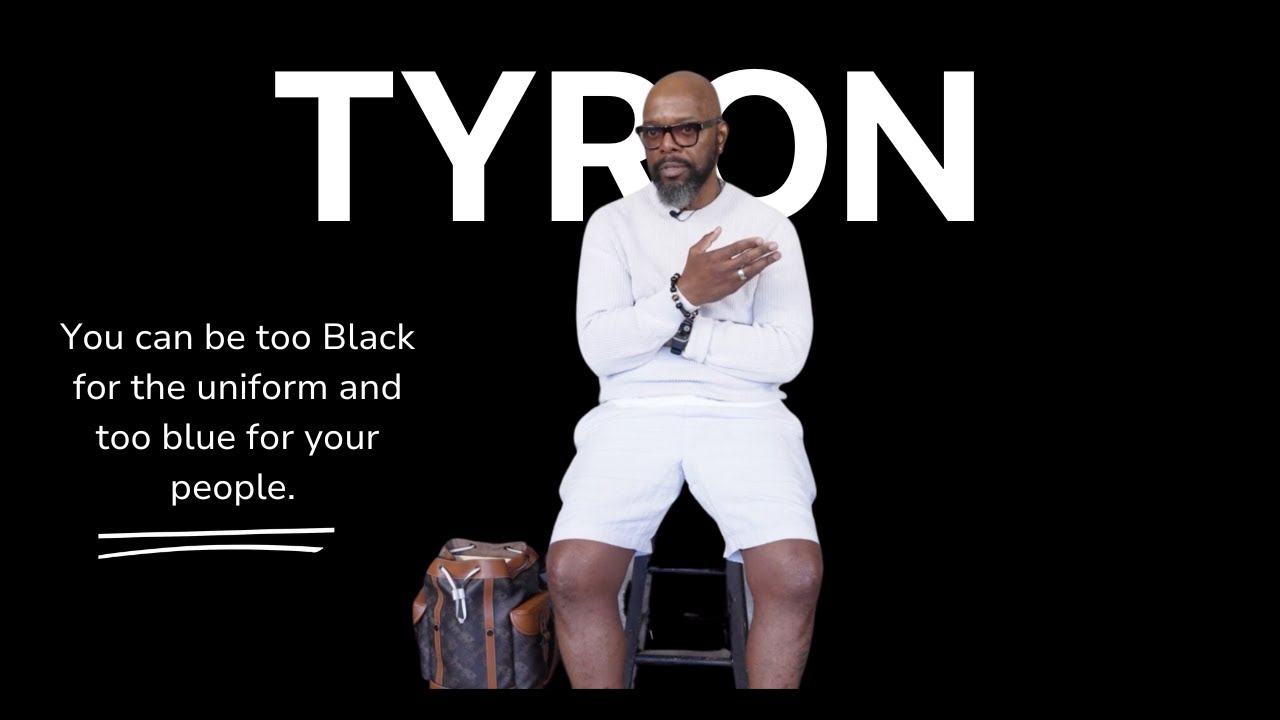
But that canvas explains a lot, because even though you can be considered too Black for the uniform and too blue for your people, and there was always that division there, there was always that pull there when I joined the police department, what kept me different than others is that I always had that voice in the back of my head from my grandmother. And I'll never forget where I came from, or where I was born, or where I was going, or what I experienced.
And I think the experiences throughout my life, the early part of my life, from a young child to the age of 13, had a role to play in that. And then from 13 to 18, when I lived in Hudson, Ohio, that had a role to play in it. So I lived in two different worlds, and came from two different places, and both of those places have built and made me. I lived in the world of affluence, and I lived in a world without. And they both came together when I came to college. And when I joined the police department, both those worlds collided again, but they were both separate. The police department had its own world, and my community had its own world. I would go home to my community, and by some I would be ridiculed. I would go into the police department, and by some I wouldn't be accepted. And then within the police department, they had their own subcultures and divisions within, just like within my community. So dealing with them both has been a mission in my life. But I've learned how to navigate both, and none of them are different than the other. In the end, we're all human.
And are you optimistic about humanity?
Yes, I am.