Fahima Sarfaraz: A Survivor's Journey After an Acid Attack in Afghanistan, Part Two
This story is the transcript of a Narratives video interview, translated from Persian and lightly edited for clarity.
Content note: this story includes accounts of an acid attack, an abduction, threats of violence and the abuse of a child. Names of her family members are withheld.
The attack
They came out. I called my son: "Come, let's go." Then I heard the clink of my key, as if the key had fallen on the floor. Then he called out to our son: "Come, where did you put the key? We might need it, so that we can come down after you." I said, "The key was on the table just now. I heard it." I said to my son, "Come, let's go." In short, I went down. Because I drove, I opened the car door and threw my bag onto the front seat. I could still see his shadow, my son coming.
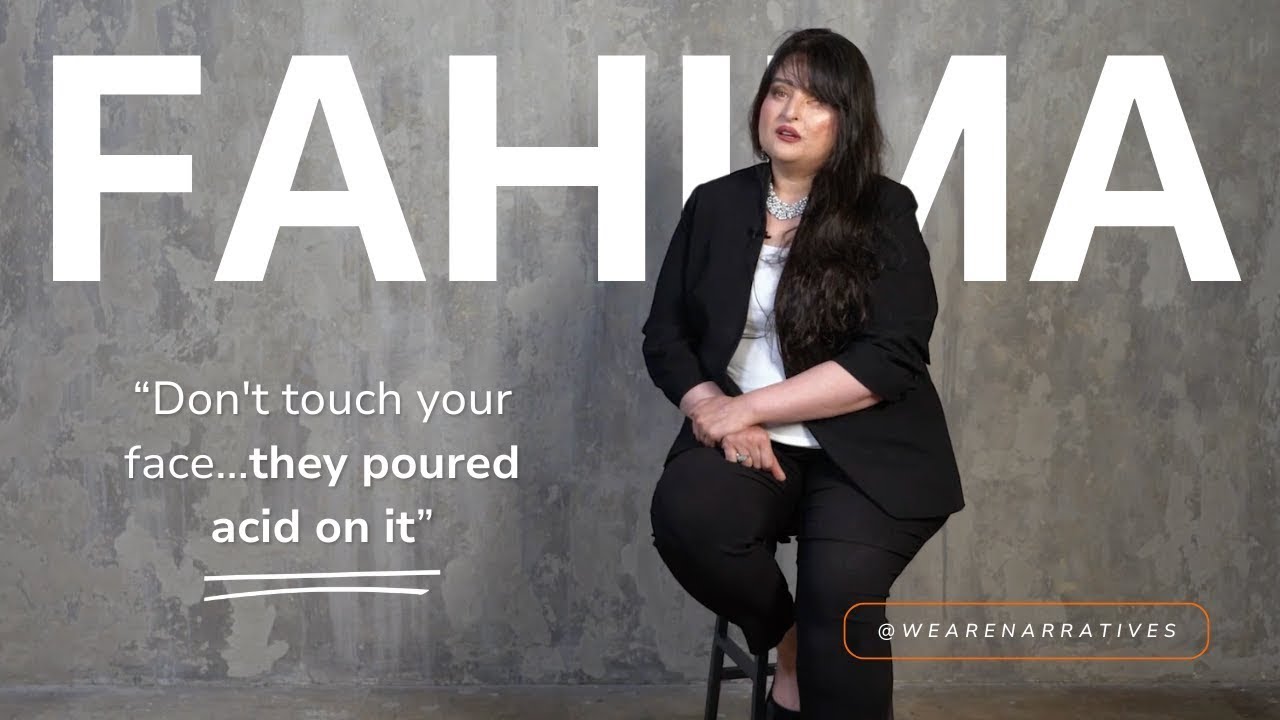
Suddenly, from behind, something came at my throat, like this, with this hand, and pulled me back. I thought maybe someone was joking with me. I saw a warm liquid, a warm color, pour over my face. I was still thinking someone was joking with me. My son called out, "Mom, don't touch your face. They poured acid on it." I couldn't believe it at all. I couldn't believe it at all. "Are you stupid? What? Are you crazy? What acid? Why would they pour acid?" "Mom," he said, "for God's sake, don't touch it."
Then the burning started. That burning started. But the only thing I remember from that moment is sitting on my knees. A few months before that, there had been the acid attacks in Isfahan, and when I looked at the pictures from Isfahan, I saw girls coming on social media asking people for money to have surgery. And I'd say that whenever I went to America, I wouldn't let them ask anyone for money. I'd support them myself. I'd raise money for them myself. One of those girls had said that a man had collected money for them and never passed it on, and it had pained me a lot. When I sat on my knees, that's the only thing I remembered. I looked at the sky and said, "God, why me? I wanted to help others. Why me?" I just kept screaming that.
Then my son came, took my hand and took me up to the fourth floor. In the hallway I just screamed, "Haji, damn you, you filthy man, this is your doing! Filthy, damn you, come out! This is your doing!" I was beating on his chest.
Then we went down. He wanted to take me to a hospital where he knew people, but I said, "No, I don't want to go there." I named another hospital and said, "Let's go there." But he drove me around so much, so much, that a hospital that wasn't seven or eight minutes away took us an hour and something, close to two hours, to reach. He drove into traffic, took the long way, and he forced me to open my eyes. He kept saying, "Fahima, did it go in your eye? Fahima, did it go in your eye?" I said no. My mom would say, "Did it go in your eye?" I said, "No, it didn't." "Open your eyes, Fahima. Where are we?" A man who was born in Kabul didn't know where he was? It was the famous bazaar called Lycée Maryam, the famous Kabul bazaar, and in the Lycée Maryam bazaar he says, "I don't know where we are. Open your eyes." In short, I opened my eyes. When he realized it had gone into my eye, he was relieved. Then I got out of that car. We took another car and went to the hospital, and then the misery began.
If I may ask: you said your son was coming toward you and was a witness. Did this man grab your head and pour the liquid himself?
Not the man himself. They had paid someone. And interestingly, of the $5,000 they had paid, he had taken $3,000 from me.
Were you able to identify that man at all, to see him?
No. Well, he was behind me. He was behind me, so I didn't see him.
Your son was in front. Did he see him?
My son saw him. It wasn't the man himself. They had paid someone.
The man himself was upstairs?
Yes. The man himself didn't have the courage or the nerve to do it. So much for his honor. What can I say.
Did your son know this was going to happen, that this was the plan?
No, no, no. My son didn't know, and my mother didn't know either. My mother had cursed me, but she didn't know this was the plan.
So you never found out who it was, who attacked you?
No, we didn't find out. Only that it was a person they had paid.
No justice
And later, after the hospital stage passed, about five days, on about the fifth day, we came to America from the hospital there. We extended my ticket, and all 3 of the children came to America with me. And in the hospital, he himself kept coming and going, saying, "If you raise your voice, I'll take the child from you. I won't let you take the child." No guard, no police could come near us. Well, Afghanistan's police are usually bought. For money they sell everything, the way they sold the homeland and have now left it to the Taliban. For money. Everything is money. From the highest officials, from their president, down to the smallest soldiers. Only the soldiers get sent to be killed, and the rest, the politicians and the powerful, all sell their honor for money, unfortunately. And this man kept coming and going in the hospital, harassing me and threatening me. I was there five days. It happened on the 11th, and on the 16th we left with the children and came back.
And you came to America with your children. You haven't gone back to Afghanistan since then?
Why, I did go back. For two months I was in the ICU in San Francisco. And when I came back home... Even while I was in the hospital, he kept saying, "Bring my child." And when I came back home, there were days when the doctor gave me a letter saying no, you're not allowed to fly at all with this wound on your face. Again, here, my mother and my family didn't support me. However much I said, "Mom, I've lost my beauty. I've lost six, seven years of my life. I don't have the strength to lose a child. Get up, let's leave that damn country and go somewhere," they wouldn't accept it again. Pardon me, they used very bad words too: that they should ruin their life for the sake of a child? For the sake of a child, how and why should they scatter their life and get up and go to Iran? "No. Get up, take the child, give him back, go live your life and leave us alone too."
And then, about five months after the attack, I was forced to take the child back to him. The day I was taking the child, I was forced to send my 2 older children to their aunt in another state, because they were under age. In America, in Georgia. And I went to Afghanistan for one month. I had hope that he would let me bring the child back again, but no, he didn't allow it. There are many other stories, but in short, he didn't allow it, and I came back to America alone. My children didn't come back from that state, from their aunt's.
Losing her children
And about three or four months later, eight months later, the children came home without me knowing, to harass me so that I would give them up for adoption to their aunt. They were there about a month and something, and they harassed me a lot, to the point that they raised a hand against me.
Your children raised a hand against you?
Yes. Well, they insisted that I give them up for adoption, but I wouldn't.
How old were the children then?
At that time my younger one didn't say anything in general. He wasn't on this side or that side, but he wanted to go and be with his brother. But my older child had very, very, very sinister plans.
How old was he then?
The younger one was 12, and the older one was 17. 17 and about 8 months. Yes, almost 18.
And why did they want this?
Well, look, there are some things that I can't speak about on their behalf. Maybe they have things to say too. When we were in Afghanistan, this man, the same person who carried out the acid attack, their stepfather, had abused my second child, who was 12. That was something I didn't raise my voice about. One of the reasons the children left was this.
And the second reason, possibly, and I'm giving this as a reason, the second reason is something they said out loud: "Mother, you do whatever is necessary for your family. You abandoned your child, a piece of your own body, for your mother and father. You listened to them. The mother who didn't feel for you, who dragged you to Afghanistan and said, come, marry this man, forced you. And now that same mother is forcing you again: with this burned face and one blind eye, you're going back to Afghanistan, where they might kill you. She's forcing you, and you're listening to them. We're not obligated to sit here for you. You keep sacrificing yourself for them, but we're not obligated to sacrifice ourselves for you." And he would say, "You can go to a shelter now. You can't support us anymore."
Excuse me, may I ask how old you were then?
32. When this happened, I was 32.
Was the person who did this ever punished?
No, no. Well, they had power, they had money. Because the police didn't investigate, it was never exposed that these people had paid, that they were behind it. No, nothing like that happened.
You didn't tell the police anything at all?
Well, I couldn't get in touch with the police, because I was in the hospital, and the police weren't allowed into the hospital. This man had bodyguards at the hospital door. His driver was at the hospital door. He himself was always right there. We didn't have the conditions at all. And there was that threat: "If you open your mouth, I'll take the child." At that time, when the incident was fresh and all the proof and evidence were there, he silenced me with "If you raise your voice, I'll take the child from you." That's how he shut my mouth.
Her mother and her faith
Since the last time you went to Afghanistan, have you gone back again?
Of course not.
So you've stayed here. How is your relationship with your mother now?
Honestly, terrible. They never want to accept that they're at fault. It's better if I put it like this now: whatever a person does, whatever happens in life, rather than constantly looking for someone to blame, a person should look a bit at themselves, at what they did. It's true that they insisted, but I was the one who did it. I was the one who listened. If I'd had then the awareness, the information, the knowledge that I have now, I wouldn't have decided to go. But if they would accept, "Yes, we insisted too, and you weren't aware then, and you went," that would give me a little peace too.
I respect her only because she's my mother. I love her. I talk to her. Even now, just a day ago, she spoke to me very badly, said very bad things I don't like to hear at all, and I hung up. I said goodbye. Usually I don't argue with anyone; I say OK, goodbye. But I couldn't calm down, and today I called again and asked how they are. And unfortunately, no, it's not a good relationship.
Are they in America?
No, they're in Iran.
They're in Iran?
They left Afghanistan, yes. Just before the fall of the Republic government, around the last time I was in Afghanistan, they left and went back to Iran.
When you were in Afghanistan, and when you were in Iran, you were Islamic, religious. Are you still? What is your relationship with Islam and religion now?
Well, when I was in Iran, in childhood or adolescence, when we were at my father's house, yes, we'd get beaten over the morning prayer. Sometimes we'd say the other prayers, and for the morning prayer there'd be a kick: "Get up and say the morning prayer." Yes, there were prayers and such, but we weren't much for the mosque and the takiyeh. Just Muharram, the important days of it, which we'd see out in the street. My mother would read the Quran and so on, but I think that more than religion, she insisted on culture and tradition, what had remained of it. And interestingly, I remember that on the second day of my wedding, I got a beating I'll never forget, over getting up to say the morning prayer. From my husband.
Your first marriage or your second?
My first marriage, yes. And later, when we went to Afghanistan, because my husband's family were more religious, I was in a more religious mood too, and I had hijab, to the point that I wore an abaya and was much more covered than at the beginning. They were very much mosque people, takiyeh people, always busy with these things. They were like that.
But now, since this happened and I've gotten to know all kinds of people, many have said that Islam caused it. But I always said I don't connect this much to religion and faith, because look, in India there's this too, where it isn't Islam, and in many other countries it happens all the time. It doesn't only come from Muslims. It's connected more to a person's character, the savagery of a human being, coming from the madness and insanity that arises or exists inside him. No, I'm Muslim, but the beliefs and convictions I had before, I don't have now, fortunately.
Starting over in California
How is life in California for you now, life after acid was thrown on your face?
Now, I'd say, it has changed very, very, very much. When I came from Tracy to Los Angeles, I was homeless. For 15 days I was literally on the street, 15 nights and days. And then, through the mosque and the Iranian centers, I found my way to the Afghan mosques, and from there to the consul. And I was introduced to some people who took me into their home. Step by step like that, for about a year, I lived with Afghan families, and then a few years ago the government helped me and gave me a place to live, and I was in Los Angeles for a while.
It's been a year now since I moved to Orange County, and since moving to Orange County, my own mental and emotional state has gotten a bit better. I had very good friends here too, and there I've found new friends who help me more with the projects I have. More changes came. One of my biggest strokes of luck, among the people who helped me a lot, was Mr. Max Amini, and some other friends I was introduced to. And from that time until now, a lot has changed. A lot of difference has come into my life.
You said you worked for the American government, or with Americans, when you were in Afghanistan?
Yes. We worked for the American government, I mean with Americans, for the American government; it was both. We worked on counternarcotics there, for about four years and a bit.
And because you did that work, they helped you come to America?
Yes. A lot of the Afghans who have come now came mostly through having worked with the Americans.
A second plot
And why were you homeless for 15 days?
Well, because I had no money. I had no income. Let me tell you like this. After I took the child back and came here, a plan came up for me to go again, because I had nothing anymore. I came to this decision with someone I had gotten to know, who it later came out was also involved in this acid attack. A young man I had gotten to know. I went to Afghanistan so that I could marry him and live with him, because of the promises he had made: that we'd go to India, I'd have surgery, we'd build our life, and that kind of talk. And I went to Afghanistan, even though the plan was something else entirely: this man was an accomplice of the other one. It came out later. It came out two years ago that this young man was an accomplice of the man behind the acid attack.
And interestingly, during the month I was in Afghanistan, one day he went out of the house. It was my birthday, I think, and he went to buy a cake. He called me and said, "Fahima, do you want to come and choose the cake yourself? There are a lot of cakes here." Then, when I wanted to go out of the building, a car braked, a car with black windows, and they pulled me into the car. They threw me into the car, yes. All of this happened after the acid attack. And they kept mocking me: "Blind eye. Close one eye; the other one's blind. We'll take her and put her out of this life right now," and so on.
Then they moved me to an apartment in the area called Macroyan, the Macroyan apartments. There were 4 people there; that young man wasn't there. 4 other people, 2 women and 2 men, were in that apartment. And their plan was for that same night. I was in the room, the door was closed, my hands were tied. And the next morning, before it got light, they brought me a drug and gave it to me to take, so they could move me to the main place. I had learned something useful from Turkish films: I didn't swallow the drug. I kept it dry behind my lip, and when the person left the room, I took it out, and in short, I pretended to be asleep. When they were taking me downstairs, I made a racket right there in the lobby of the building, and the cleaners came, and in short, the police came, and the 2 women were arrested. But they had been bought off; the people there said everything is about money. And four days later I got my ticket again and came back.
And they were supposed to take me and cut me into pieces. Cut me into pieces: that was the order of the man, Haji. To rape me and then cut me into pieces, so that I'd disappear, dead or alive. And the first plan was for this young man himself, with his cousin: his cousin would come into our house and attack, beat him up a bit so that nobody would suspect him, and kill me. But this was exposed to me before it happened. He said, "No, we had this plan, but we don't anymore. I was wrong. I'm being honest with you. I love you," and that kind of talk. "We'll go to India, we'll get your face surgeries done there, we'll get money and go," and so on.
And then, when I came back to America again, it still hadn't come out that this young man was involved. And the man who had paid for the acid attack had told him, "I'll give you $40,000. Show her this, and tell her, come, we'll go and have your face surgery done. When she comes, hand her over to me." This was when I had slowly started appearing on social media. "Hand her over to me, since she doesn't want to keep quiet, she doesn't want to shut her mouth, she doesn't want to sit at home. Hand her over to me so I can pour acid on her from the top of her head to the tips of her toes, gouge out her other eye and throw her at her mother's house." This came out too.
How the plot came out
And this was the man you had gone back to Afghanistan with? Did he tell you this, or how did you find out?
This was after a long time. The second time I went, I married this young man, the young man himself, who I found out later was in touch with them. In the one month I was there, I was beaten so much that sometimes I'd think, how much life did I have in me? I was beaten and harassed so much. I was only looking for a way to escape, and God helped me, through the police, to escape from Afghanistan.
Then, when our relationship was completely over, and that nikah, that marriage contract, was canceled and the divorce was read here, this young man himself told me that this plan was there from the start. Before we came to America at all, the first time we were coming to America, it had been designed by this man's son, the man called Haji, who poured the acid. By Haji's son, and Haji's first wife, and the neighbor's son: that this young man would come into my life, find a way in and build a friendship to use against me. But at that time they hadn't gotten anything on me to give me a bad name in Haji's eyes. They didn't want it to be revealed that they too had a hand in this conspiracy, the conspiracy for the young man to come into my life. They had no proof at all to show against me. But later, after we came to America, some things fell into their hands: that I had been in touch with this young man through all this back and forth.
If I may ask, who was paying for all of this?
I had my own money at that time. What really burns me is that when I came from Afghanistan, I had $21,000 in gold, but our neighbor tricked me, and I went and sold that gold for $7,000. And now, a ring that I bought back then for, say, $200, a ring I didn't want in my life anymore, I took and sold for $500. But the $21,000 I sold for $7,000.
And this man didn't help you?
No, no, no. I was the one paying his expenses. When he'd say "Come," I'm talking about the second husband, when he'd say, "Bring my child, come, we want to go to India and fix your face," and so on.
So none of them helped you financially at all?
No, no, no. As I said, even the money for the acid attack: he told me, "Fahima, something urgent has come up at the construction site. We need $3,000. Give me your money, and I'll pay you back by tonight." I handed him the $3,000 myself.
You had cash?
Cash, yes.
And during all of this, while you were, excuse me, with this young man, your third child was with his father?
Yes. The first time I took the child back, he kept him.
On love
What are your thoughts now about love, about finding a partner or a man again? How do you feel about love, about being with someone, with one person, with a man?
It's a bit hard to answer this question, because there's a very low percentage of men who are honest, truthful, truly in love, who truly love in whatever form and can live honestly. Well, in the first three years I was completely destroyed. But in these last three years, many times I've gone on dates, talked with people, but they lie a lot. A lot. In the past three years, recently, just last week, actually, they lie a lot. It has somehow become that people want you just for their lust. People aren't looking for a life anymore. It seems they're looking for a partner just for that. It's very, very upsetting, but really, people aren't looking for a life. They're more after lust, after being together once, twice, five times, 10 times, which I personally hate intensely, and I don't let anyone looking for that kind of relationship come near me.
It's good that this awareness and these events have all become experience, and have raised my mental and emotional resilience so much, and given me so much knowledge, that after talking once or twice, I can recognize what's going on in that person's mind. I'd love to be able to start a healthy life with a healthy person who is honest, truthful, who wants to build a life. But it's very hard to find.
Have you ever been in love?
In love... I don't know. Anyone can be in love, even at 80. I think love can't be a whim, something that comes from a whim and quickly disappears, which unfortunately has become very common in this day and age. Or that you like someone because they're attractive, pretty, tall or this and that, and we call that love. Yes, that kind of thing has happened. But someone I'd fall in love with heart and soul, that hasn't happened.
There's something I say myself. The story I told you was interesting: last week I went somewhere and saw someone who was attractive to me, and because he was in the right place, I thought he must be the right person too. And somehow I connected with him through social media, and when I talked with him, I saw that no, he wasn't what I thought at all, at all. That person is already in a relationship with a woman. He had liked me too, and he suggested, "Come, let's be together." Actually, I think he's wealthy and well off. "I'll support you with some of your problems myself. I'll be beside you, and I'll try to fill some of your empty spaces. But I'm not looking for a deep relationship, a relationship where I build a life, something long term, a long relationship with responsibility." I said, "Go. Go in peace. I don't need it at all."
But I define love like this. I say love is a feeling that arises. The heart goes. The heart goes; the heart isn't in your hands. Maybe for a person who isn't even worthy of you seeing them and liking them. But the heart goes. It's we who nurture it or destroy it. I say this: when your reason nurtures it, it turns into love. But you can say to yourself, "No, this person isn't right for me. OK, I, Fahima, or I, so-and-so, want to have a healthy life. This person is looking for pleasure. This person is a cheater; he's cheating on another woman, so he might cheat on me. Or why should I go into a relationship with a person when it isn't clear what my future will be?" There are these things. We can destroy the feeling that has arisen.
Now, if I get up and say, "No, OK, I saw that he's attractive, good-looking, tall, rich too. Oh, I'm in love, oh, I'm crazy about him," I keep watering that love, watering it, making it bigger. Then at some point I go into a relationship, and it fails, and I fall to the ground and am smashed to pieces, and I come out of it, and that's what people call love. I think love is what we ourselves nurture or destroy.
Afghanistan from a distance
When was the last time you went to Afghanistan?
The last time was six years ago.
Six years ago. Now that you haven't been to Afghanistan for six years, what are your thoughts about Afghanistan?
Honestly, for me there are the people of Afghanistan, there's the country of Afghanistan itself, and there's the dirty government of Afghanistan. The dirty government of Afghanistan, we set aside completely. It belongs in the garbage. But the people, well, we also have very good people. Afghanistan itself, I love it. The country of Afghanistan, the atmosphere of Afghanistan, the air of Afghanistan, its streets and alleys, I really love. I love it.
And some people, unfortunately, because of low culture and no education, no schooling, have cultures like tribalism and some inappropriate customs they made for themselves, which have remained. That part I hate completely. I don't even like to think about it. But again, we have some people who are kind. It's a very low percentage, maybe, people who understand, who understand you. I love them. I adore them.
I'd like our country to progress someday, Afghanistan to progress, for education to begin, for people to be able to study, for this decrepit culture of misogyny and the lack of culture that exists to be destroyed, and for us to be able to have an Afghanistan with peace and purity, and for me to be able to travel there. But for now it isn't possible at all for me to go to Afghanistan or to Iran. The circumstances aren't right for me to do that. But overall, I love Afghanistan. I love the country of Afghanistan itself.
And here, until a few months ago, I wasn't connected with many Afghans. When I was homeless, Afghans helped me, but they were religious Afghans, and after I took off my hijab, they're not with me the way they used to be. But recently I've found good friends: Afghan women who are active, who do business and trade. There are men too, good men who are really supportive, good backers, at least emotionally, who lift your spirits and understand, who get it. Well, I think every place has different people. Every country has good and bad.
What message do you want to give to women, whether in Afghanistan or in Iran?
What I've always said: the first thing, the most important option, the choice that can change a person's life and move it forward, is reading. When we read the experiences that people write about their lives, it makes us learn too, and find our way much better, the way that fits our own life.
And that they never give up. Never surrender. I mean, try. If, mentally and emotionally, they need to calm down, they should give themselves the right, and accept for themselves that they've gone through problems, or are in problems. Accept those problems. They're surely looking for a solution. They can go looking for a solution and find one, and raise their inner strength, their mental and emotional strength. Not just endure hardships, but fight, look for a solution, to find the right path. I think that if we just stand in one place and endure, this won't be solved. They have to look for a solution so that it gets solved.
There's one kind of patience where you're patient and you move forward step by step, looking for a solution. That's good. The patience where you say, "A calamity has come over me, and I have to be patient": no, that calamity will never leave your path unless you want it to. My message is for women and men, for everyone.
Safety, work and painting
My only question is this: you're very young, and a bright future could be waiting for you. I want to know what plans you have to support yourself, financially and physically too, because that man is still alive, right, the father of your third child? What plans have you made for yourself, socially, financially and for your safety?
Well, in terms of safety, that man doesn't have the courage to come near me anymore. My power has grown so much, so much mental and emotional strength and ability, and the people around me... I've reached the point where, if he has the courage, he can send me his address, where he lives. And there's a story from a few years ago, from Turkey, where he had gone. I'll tell you about it later.
In terms of safety: when I was in Los Angeles and stood up as a campaigner for this Woman, Life, Freedom revolution, I was harassed quite a bit, not a little, a lot, by the mullahs, by people who were extremists, and that's what made me leave Los Angeles and go somewhere I could be safer, to Orange County. I have a case with the police. Wherever I go, the police know about it. They're informed, and to some extent they look out for my safety.
And financially, I worked at one of the stores for a while, but it took infinite energy from me, because most of the programs for women, and the events and gatherings that organizers held, were on Saturdays and Sundays, and at that time I always worked Saturdays and Sundays. That stress kept lowering my energy for the work itself, and it was destroying me day by day that I couldn't take part in anything, and it made me quit the job. When I moved to Orange County, I worked there for a while, then quit, and I was unemployed for a while.
But now I say that working isn't shameful at all, any kind of work. The important thing is that a person's hand isn't held out to other people, that they work until they can find better ways. Now I work a bit with my car, so I can cover my basic expenses. It's hard. Sitting with all kinds of people is hard. It's not that I have a security problem from that side, but working with a car, where all kinds of people are going to sit in your car, gives me a bit of stress. And I hope I can find a better job. I'm looking for one. I'm waiting to see what happens.
And at the same time, I'm writing my own book, the book of my life. And I write an article every month for a reputable Iranian magazine. For a while I was studying language and painting, which I dropped this semester, because I have to look for work, a better source of income. And I practice painting, so that through painting and writing I can be the voice of women. The basic goal is that in the future, globally, I can become known as a person who stood up for the voice of women, who stood up for the voice of the oppressed.
And, well, this work is volunteer work for now. Of course, there's a woman who, unfortunately, reached out to me about two months ago. She's in Iran now. She's an acid attack survivor; this happened to her in Afghanistan. I've tried to introduce her to some organizations, and I'm looking for a way to get her out of there. With these things I do, I'm mostly in touch with people who are victims.
Face to face in Turkey
What was that story about Turkey?
The Turkey story: a few years ago, three years and a bit ago, I went to Turkey, because I wanted to see if I could find good doctors for surgery and such. And before that, he had been threatening me through social media, telling me to shut up and so on, because I had these pages. And I told him, "I won't shut up. I'm coming to Turkey. If you're a man, show yourself." I knew they were in Turkey. It was an excuse for me to be able to see my child, and also to be eye to eye with them, so he'd understand that I wasn't the person I used to be anymore.
That's what happened. I went, I saw my child, and I saw this man. I sat face to face with him and said, "You are a very vile human being." Something I could never say to him in those six, seven years of my life. I said, "There's no one viler than you in the world. I never exposed your family's secrets, but maybe now I will." And just this I said: "You have no conscience at all. That forehead and those eyes that bowed down to your hand, and kissed it and pressed it to its eyes out of respect, you wanted to destroy them." That much I said. I said, "I sat face to face with you just to say this."
And how was your son?
My son... They had thoroughly brainwashed my son. Imagine, an 8-year-old boy turns and says, "Mom, my aunt so-and-so and my aunt so-and-so are Shia infidels, like you." This was a child, at that age.
So your son said you had become a traitor?
Yes. He said that you too, yes, he said you've become an infidel.
Because you became Shia? I mean, you were Sunni and became Shia?
No, no, no. I was Shia. He said, "Aunt so-and-so and aunt so-and-so," he named my sisters, "are Shia infidels like you." They lived in Afghanistan.
Right.
Well, we were Shia by religion and still are, generation after generation.
That was the first thing your son said to you?
Yes. Not the first thing, but one interesting thing he said. And what's interesting is that they had told my son that he was the son of his first wife, and that I was a thief and a traitor who had come and stolen the boy from their house and taken him to my own house by force, and that his real mother was her. Then I told my son, "This father of yours is lying. You are my child."
Then I turned to his father and said, "Look, because I respect you, because you're a human being, I won't say anything about your humanity. Now is the time. Now is the time for you to turn around and tell the real story, before a day comes when the child gets up and leaves. You're tormenting him with this. You don't know what a mistake you've made with this lie. You're destroying this child. Now is the time to tell the real story, because one day the child will grow up and get out of your control, and he'll go take a test, and it'll be proven that he's my son, and then he won't even be willing to look at your face." Then he turned and said to him, "No, I lied. Your mother is Fahima."
So since then, has your relationship with your son gotten better, or do you still not talk to him?
No. No, it's over. No... Actually, hearing those words from him left me with a little less of that ache and restlessness. Yes, it's hard. I remember him, and I cry for him. Now, the other two, because of their disloyalty and the things they did, I don't miss them as much. They're my children. I wish it hadn't happened. I wish we could have been together, the way we planned: to escape the sorrows and troubles of Afghanistan and live here together, have the best life together, have birthdays together, celebrate holidays together, have parties, go out, enjoy ourselves, travel. I wish these things hadn't happened and that all of this had become our plans. But it didn't happen. They were disloyal, and they weren't there.
Painting the wound in gold
But it's my youngest child I long for most. I'm very restless for him, and I miss him. But, well, that's life. It happens. It's better for a person to accept some situations sometimes. That's what I say: if you accept the situation, you can pass through it. You can bring yourself out. The important thing is to pass through that difficult stage and look for a solution. Staying in it destroys a person a little. My youngest, still... God willing, one day they'll come back.
Where can people find your paintings, maybe buy them?
Not yet. I haven't dared to bring them out yet. I don't know, I think maybe they're not complete, maybe they haven't gotten good enough yet. I forgot to bring that picture. I wish I had brought it with me. But soon, God willing, people will find them online.
Instagram and TikTok: where can they find you?
I'm on TikTok, and I'm on Instagram, under the same name, Fahima Sarfaraz. And the next plans I have, God willing, are to make a website, so we can post through my website, and to work a bit more on my painting.
There's a picture I had from before. The first project in college, for a portfolio, used a picture from before. Our project was that we had to take a picture and make some changes to it for the portfolio, and it had to be a face. So I chose my own picture, and I left this part of my face just like this, and I put gold color on it, so I made gold out of this wound. I really love that one. I'd like to work on it, to make something prettier and more flawless out of it, and paint it. But, God willing, in the future, I hope I can bring them out faster.
Loving the face she has
My last question: you're a very good-natured person for someone who has been through so much hardship. Every day, when you get up, what are your thoughts about life, about people and about your own life, that you can be so good-natured and happy, and laugh, and be positive and optimistic?
Thank you for saying that. Thank you. Well, I think anyone can be down sometimes, however energetic, however happy they are. For example, actually, these last two or three days I wasn't in a good state at all. I didn't do any work at home at all. I just sat. But I accepted that condition: "Fahima, right now you're not feeling well. You're depressed. Or not depressed, sad. You've gotten down. So give yourself the right, and accept it. Don't do any work. Don't stress at all." When you do that, I think the next day, which was today, I woke up more cheerful, I woke up fresher. I got up, and from the moment I woke up this morning, from 5 o'clock, I had that excitement about coming here. I did my makeup, got dressed and got ready like this.
And mostly I try that, when something comes, I accept it, and don't let myself drown in it and let it go on for a long time. If one day I'm not going to touch anything, everything's dirty, I leave the dishes, the house isn't vacuumed, I just sit and stay inside myself, I accept that, and I stay like that, until the next day I can be fresher.
And sometimes this face of mine... Actually, from the bed, when I wake up, there's a mirror. I sit right in front of my face. But most of the time, when I wake up in the morning, I say, "I adore you." Yes, that's what I say: "I adore you." Mostly like that.
Sometimes people say, "Fahima, would you like to go back to before this incident?" I say no. I never want to go back to before this incident and have this eye and this face be beautiful. Now I'm happier, because there are no sick people around me. Now I'm wise enough to choose the people around me, wise enough to choose the right people to have around me. And this heart of mine is happy. I can make decisions. I can live freely. I'm the one who makes the decisions in my life, and I can choose between the right path and the wrong one. A beauty that's going to drown me in sorrow and keep the wrong people around me, I don't need that at all. I think a person can build themselves and keep themselves in a good state. And as they say, reading builds a person most. Reading is the biggest and best way to keep a person on their feet.
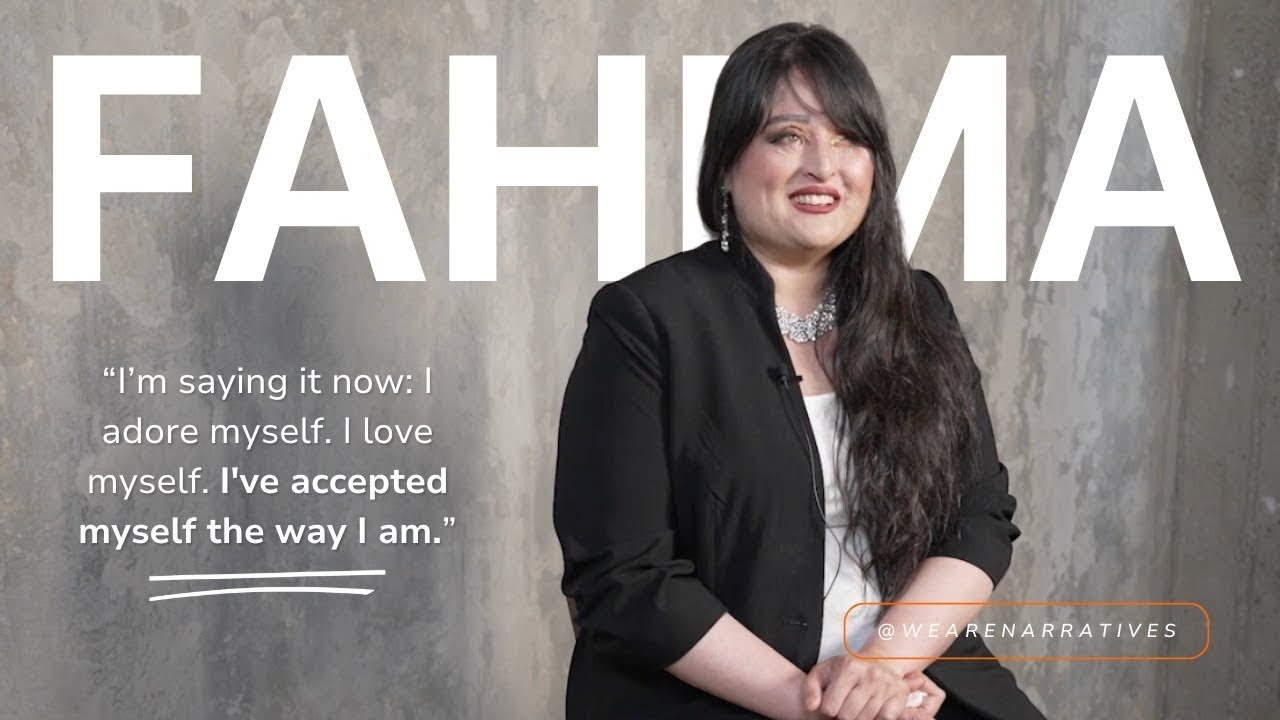
I really mean this. I've said it on my own pages, and I say it now: I'm in love with myself. I love myself. I've accepted myself just as I am. My last eye surgery was about three or four years ago. The last time I went and they did surgery on my eye and it didn't work, right there I made a commitment to myself: "Fahima, stop. You are what you are." Some people said to cover my eye. I say, "I am what I am. If you have a problem with it, don't look. Fahima, this is who you are, and you have to accept it. You're beautiful, you're pretty, your heart is pure, and you don't harm or hurt anyone." That's what I told myself, and from then on I was done with surgery. I'm looking to grow and build myself.
Your story is really inspiring. You're kind.
It's friends like you, good friends like you, who have been beside me at every stage of life that brought me here. If I didn't have these friends, I'd be nothing. My first memory, let me tell you about Max: the day Max came, the first man who hugged me after this incident was Max, Max Amini. At that moment I felt a sense of calm, and I understood that no, there are good people in this world too, kind people who can hold you close. And I'm happy that I have you all. Thank you. This is the biggest blessing I have in my life. Thank you for inviting me.