Law Student Organizes College Campus Protests
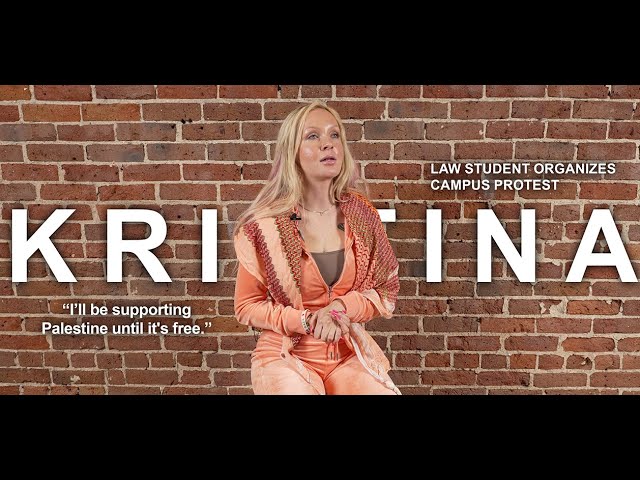
This story is the transcript of a Narratives video interview, lightly edited for clarity.
Getting involved
I really got involved with organizing around Palestine 10 years ago, during my undergraduate at Earlham College. It was there that I really got exposed to what the real gist of the conflict is and what the real Palestinian struggle is. I was afforded that because we had such a large Palestinian student population on campus, because it's a Quaker school, and there's a Quaker school in Ramallah in Palestine. So we had a lot of Palestinian students who were more than willing to speak up and get people engaged. And then on top of this, at Earlham College my first boyfriend was Palestinian, so I was very much invested. My good friends were Palestinian or Arab.
Right now I go to the college of law. I'm pursuing international public interest, probably international human rights, and probably doing human rights monitoring abroad.
Palestine is such an all-encompassing issue. Any progressive, socialist, left-leaning person should absolutely include Palestine in their activism. And my activism is definitely not limited to Palestine. It also involves racial justice, gender justice, sexuality justice, economic justice. It's so all-encompassing. For example, during the George Floyd uprisings in 2020, there were so many people bringing keffiyehs and Palestinian flags, and so many people in Palestine were protesting in solidarity against police brutality in the United States.
We're going to talk a lot about the experience you've had on campus, how the administration has treated you, how the student body has treated you, the community. But I always like to start at the beginning, so we know a little bit about who we're talking to. Tell me what you were like growing up and what your childhood was like.
Growing up, it was me, my twin, my little brother, and we had three stepbrothers and one sister. We all grew up in Maryland. Maryland is definitely more diverse than Colorado, so moving to Colorado was such a culture shock, because not only was there such a lack of diversity, but growing up in Maryland was much different than that. It was definitely more progressive and open.
And then I also come from a multicultural family. My stepdad's from Ghana, so I was already aware, without really being politically engaged, of racial justice issues, with my stepbrothers and their interactions with police, and negative interactions with police.
I'm from the suburbs in Maryland. I'm from Columbia, Maryland, Howard County, so that's definitely the suburbs. It's definitely the area where we're just close enough to Baltimore that people want to claim the street credit inherent to Baltimore, but it's definitely not that. It's the suburbs. We were middle class. We didn't want for anything. Growing up, my mom always said, "Well, you always have clothes on your back, food in your stomach and a roof over your head." So that's just how I understood how we were living.
A Quaker college
I can tell from the way your high school experience was that you were feisty, and not afraid to go against the grain, which translates to being someone that stands up for Palestinian rights, because historically that's such a third rail issue in America. So talk to us about undergrad. Talk to us about your experience and how you first became introduced to the conflict between Palestinians and Israelis.
I transferred to Earlham, and this is a liberal arts Quaker school. I can't remember the initial time I got introduced, because everything at Earlham was just so intersectional. There would be actions for Tibet, or for racial justice against police brutality, and always, in every instance, Palestine was there too, because of course Palestinian students are there too.
We had a Students for Peace and Justice in Palestine on campus, and not just Students for Justice in Palestine, because the Quaker rules are you have to have peace and justice. It was like the seven principles. So I got involved with Students for Peace and Justice in Palestine, and we would host events like BDS 101, which is boycott, divestment, sanctions 101. It's reminiscent of the student protests against apartheid in South Africa, and this is what Palestinians are advocating for now.
We also do Palestine 101, because so much about organizing around Palestine on college campuses is really starting from the ground up. As Americans, if you're born in the United States and you go through public school, unless you're culturally introduced or you have a friend, you really don't understand what's going on in Palestine. In school I was taught, well, all the three major religions are there and they're fighting right now. Okay, but why? I never understood what the why was. And I think it's very intentional that students are not taught what the why is in Palestine, because it's so much easier to just deflate it to a religious conflict, like what happened in the north of Ireland, Catholics and Protestants, when it was really just English settlers and then indigenous Irish people. And that's the same in Palestine.
So going to Earlham just really connected all of these issues for me, and it really taught me that every conflict we're experiencing right now has been in history. It's just a repetition of conflicts until we do something to change it.
Quakers are well known for conscientious objection. But tell us, who are the Quakers, and what is their philosophy that you've grown up in?
I couldn't speak more highly of the Quakers. That's the Religious Society of Friends. Although they were English settlers, they were the more progressive sect of Christianity. What Quakers recognize is that everybody has the light of God in them, and everybody is able to communicate God's truth and God's word through themselves. Because of this, Quakers view everybody equally, because God's truth is in everybody equally. And because of this, Quakers were one of the first anti-slavery abolitionists in the United States, and they've really been on the correct side of social justice movements, liberation movements, in the United States.
They also believe in nonviolence. Because of this, you'll find a lot of Quakers or Quaker organizations involved in peace and justice movements. There's the American Friends Service Committee, who's doing work around Palestine and immigration justice, and the Friends Committee on National Legislation, which is all about disarmament and anti-militarization. So Earlham College, being based on these principles, is not directly invested in weapons companies, unlike almost every college or university in the United States, which remains invested, for whatever reason, in weapons companies. So it's good. Because they're so peaceful and nonviolent, they've taken a financial stand in a very substantial way to fight against apartheid, genocide and ethnic cleansing in Palestine and other places around the world where the US is imposing their military presence.
Living outside the bubble
Can you speak a little bit about what happens to people when they only exist in a circle where everyone else is just like them, and how your life has differed from that? How has diversity changed your ability to relate to other people who don't look like you?
Americans, 100%, speaking generally, live in a bubble. There's so much we can afford to not know about, and that's to the detriment of so many people around the world. So going to Earlham, for me, and meeting people and understanding them, and just seeing the unnecessary hardships that, in all honesty, I funded, not me personally, but my government, and I let it happen through my taxes. It's just so hard to accept, and I don't want to accept it. I see it for what it is and I don't accept it. And I think it takes meeting people who are different than your background, who have experienced what we have not experienced, to really understand that.
I think what's really unfortunate in the United States is we reinforce white supremacy and anti-Palestinianism in a way where Palestinians, maybe they're not telling you their story now. They're nervous to, or scared to, or don't acknowledge their Palestinian identity, for fear of what other people's reaction, usually American white supremacist reaction, is going to be to them. I have friends in Florida who say they're Italian, and they're Palestinian, because they just don't want to get into it with people. They're scared of the reaction. I have a woman I work with who also doesn't acknowledge her Palestinian identity, especially not right now.
I think we can do a lot by not reinforcing that, by taking measures to really affirm lived experiences and stand by it. For me, I wear my keffiyeh every day. It's an obligation. I'm not going to normalize what's happening at all. I'll bring attention to it at all times. And it's not about me. It's just showing that, hey, I see what's going on is wrong, and I'm taking a stand. This is wrong, and I'm showing that it's wrong. Maybe it's just symbolism, but it's outward physical solidarity, and I think more of us should do that, because I think Palestinians are living in very, very fearful times. Yes, we're not getting bombed here. Their families are. And yes, they're not getting bombed here, but they're scared to talk about it. How horrible is that?
I'm a 2L. I've been talking about going to law school since I've even seriously considered it, even my first internship during undergrad. "Oh, what do you want to do?" "I'm just going to be a lawyer. I'll be a lawyer," this, that. So I got my undergraduate degree, and then I'm like, well, I'm not ready to be a lawyer yet. So I got my master's in Belfast, in the north of Ireland, and that was conflict studies, basically studying settler colonial conflicts and social justice. And before that I had worked in Palestine, because I always thought I wanted to do human rights law, and I think that's just the path laid out for me, because I can't imagine anything else.
Law school and the system
So how is your first year of law school?
Law school is terrible, though. If you want to be a lawyer, go to law school. If you want to be a politician or something else, don't go to law school. Please don't do that to yourself.
First year of law school is very, very difficult, because the whole year is just doctrinal subjects that they test you for on the bar. So it's very, very dry. You don't get to pick. There's not a lot of choice. There's not a lot of discussion, because most of what law school is, is reading major cases where any justice is kind of justifying their fascism, and then we kind of accept that. Especially lately, with taking away affirmative action, overturning Roe v. Wade, all these. And who does that empower in law school? The people who agree with those decisions. So what can you really say to that when you're working in a system that's really empowering certain kinds of people, certain kinds of politics?
It's really hard as an activist to advocate for a system, or work within a system, that essentially upholds white supremacy through imprisoning disproportionately Black people in the United States. But I think there's something to be said about having a radical presence within the profession, because my whole goal is to be there to support people who are engaged in radicalism, who are engaged in supporting Palestine, through whatever measures that takes. So yes, I don't agree with the system. This is the system we have right now. So if this is how I can contribute to the progression of a movement, then this is what I'll do.
We're doing a lot of interviews with people who are working to change the system, often from within the system. So can you talk about the impact of that? I mean, that must be a constant tension, and honestly, I assume it must be chafing. How do you work with that kind of tension?
I think I'm still working within the tension of upholding, let's just say it, a white supremacist system, and being in it. Because I'm not bought into the idea that you can change a system from within. I'm kind of bought in that you can be an advocate or a helper within the system for people who are trying to change it. And it really is difficult for me as someone who's been engaged in direct action and activism for 10 years now, where as a lawyer, if you want to take the bar, if you want to have your license as an attorney, you really do have to get in line to a certain extent. So it does limit, ethically, what you can do if you do want to keep that position of power. And I can't say I justify it. It just is what it is.
Tours in Al-Khalil
You mentioned that you spent time in Palestine. That's unique for many people. It's certainly unique for someone with no familial or cultural connection. Tell us when you went, why you went and what you personally witnessed.
To start, for what it's worth, there is an academic boycott in Palestine, to hopefully financially strain Israel enough to end its occupation. And there's also competing ideas about whether people should go as tourists to Palestine. I personally advocate against that, because the money you do spend there does go and support the occupation. That being said, I was there for a month. So I do have to grapple with the idea that not only was I there, and in essence, yes, I was doing human rights work and I was assisting Palestinians with objectives that they couldn't do on their own without international support, but I was contributing to the occupation. It's just inherent with going.
After I graduated from Earlham College, I began an internship with CODEPINK in Washington, DC, and they had really strong ties with Youth Against Settlements in Al-Khalil, Palestine, also known as Hebron. What their work is: they are human rights defenders, nonviolent, and they give tours demonstrating apartheid in Al-Khalil, in the West Bank. This apartheid is a direct result of Israeli occupation and the moving of settlers into Palestinian land, which is all of the above against international law, but there's no real international intervention preventing that. Palestinians live very, very difficult lives under these conditions.
They were demonstrating apartheid, and the whole point of apartheid is that Palestinians, by Israeli law and force, through the Israeli occupation forces, cannot enter certain areas of Al-Khalil. So what I did was give tours on Al-Shuhada Street. This is in Tel Rumeida, in Al-Khalil. They had Shuhada Street. Well, they do have it, but it's under Israeli occupation. They're currently building settlements at both sides. At the start of this street are occupation soldiers, so young, they're teenagers. I'm not making excuses for them, but it just goes to show how indoctrinating it is, how young they are, and how they're just taught to use force against the locals, humiliate them and kill them.
Right next to Shuhada Street is Checkpoint 56, and I believe it was 2015, the occupation soldiers shot a teenage girl at the checkpoint, and the bullet holes are still in the bottom. Palestinians can't go. If you have a blue or green ID, which is also another form of apartheid in the West Bank, and you're Palestinian, you cannot get in. You can have an American passport, any other passport, and still be Arab and walk in, but it depends on your nationality, and they use this with the IDs.
So I would take all of the tourists, and it was required by the occupation forces to show them your ID, and then they let you in. On this street you would see billboards for building settlements, and houses that were taken from Palestinians by the occupation that they can't go into, stores that are closed that used to be owned by Palestinians. I would just walk them through and show them: they used to do this, they used to do that, they can't, and now they're building settlements. All of it's illegal.
The occupation soldiers didn't really give me a hard time, but I think that's the benefit of being an international, to some extent, particularly a white international. They're really not going to harass you in ways that they will with Black or Arab internationals.
What is it about that street that's important to show?
That street connects a huge shopping center, and then it goes all the way to the Ibrahimi Mosque, which is such a huge pillar, well, not a pillar. In Al-Khalil, it's such a huge place in Islam. So it totally disconnects the movement from Palestinians. And not only that, it took away all their shops. It took away a lot of people's homes. I still have a friend in Palestine, and he'll cry remembering, "I used to walk that street with my dad when I was a kid, and I haven't been there in years." I think it's been almost two decades since they've had that street.
I'm still in contact with people. They're just taking more streets, and now Palestinians are limited to one walkway, and it's very difficult. Now there's even more checkpoints in that small area, because they're trying to push Palestinians out and move the settlers in by making life as hard as possible for Palestinians. So I think it's just an example of how difficult the occupation is making life there, and it's intentional.
And your purpose of giving tours is to bear witness, to show people what's really happening?
Yes. The tours were open to any international who honestly was interested. I even gave tours to members of parliament from Spain, or other members of parliament from Europe, a couple of times. And it was to bear witness, because I agree with Youth Against Settlements, because their approach to human rights is from the ground up. We should absolutely be listening directly to people on the ground experiencing it firsthand. So it's just a firsthand account to share with the international community. They can take it to their positions of power and say, "I saw this. I experienced this. I was not only at a checkpoint, I was at a makeshift checkpoint where they checked my ID, and if a Palestinian walked in, they would have shot him." And so hopefully they can take that message to international bodies, their own governing bodies, and do something to convince someone, anyone, any system, to end that treatment, or to sanction that treatment of Palestinians.
Tear gas in Nabi Saleh
I know someone who visited Palestine when they were young, and they said to their mom at the time, "Why don't people know about this?" And the mom said to her son, "They do know." So what's scarier to you: that people don't really know the truth about what is going on for Palestinians day in and day out, or that people do know and they don't care?
I think it's a lot more dangerous and disheartening and sad when people do know what's going on in Palestine but choose to ignore it, or choose to actively commit ongoing atrocities, than it is for people who don't know. Because for people who don't know, I feel like there's still hope that there's empathy in them, that they can see that this is wrong. But I'll continue to be in shock, in disbelief, at people who see with their own eyes what's happening and then either choose to ignore it or choose to encourage it.
Did you witness anything violent?
I would say I witnessed violence when I was in Palestine, at the hands of the occupation, every day, because violence comes in all forms. Maybe I didn't see them directly beating people up, but I saw Palestinians wait for hours at a checkpoint in the rain, waiting to get in. And it's so arbitrary, because the occupation soldiers will hold Palestinians for as long as they want. I've seen occupation soldiers just enter into people's land and knock on doors, and the presence is intimidating. We're not going to act like it's not. And then it's violent when these occupation soldiers are placed everywhere, not even at a checkpoint. They're in the middle of the field, in someone's apartment building. So you're walking into an apartment building and there's an occupation soldier sitting right there, and you're just trying to go home and eat dinner. That's violent.
But on top of that, we were all tear-gassed in Nabi Saleh. This is where the Tamimi family lives, and they're world-famous human rights defenders. It's a whole family, and the occupation targets them directly, just because they are not just popular, but the international community really respects them. And I respect them too. They're amazing, and they should not have to go through what they're going through. Bassem Tamimi was arrested at the border between Palestine and Jordan by the Israeli occupation. He was kept arbitrarily, and this is what they do, with no charges, for as long as they want. He came out, he was so skinny.
This is what happens. The occupation shows you how they treat people. They arrest these people arbitrarily, and then when these Palestinians come out, they're so gaunt, the sadness in their eyes. And then they just keep retraumatizing them. Like Ahed Tamimi: every time the occupation soldiers arrested her, they broke into her house and woke her from her sleep. That's intentional. They want you to be disoriented, disheveled, not ready, and then they can detain you arbitrarily and starve you.
But this particular action was just another demonstration against settlements, because the village of Nabi Saleh, it's outside of Ramallah, and there's a settlement just across, in view. If you go on a hill, you can just see them. So they would participate in frequent demonstrations where we'd all take a Palestinian flag, we'd march and show the settlement that Palestine's still here. There was no violence going on from Palestinians or the international community supporting Palestinians, but there never needs to be violence on their end for the occupation to respond with violence. So they were tear-gassing us. It's just a threat. So, tear gassing, and we had to get onions.
Even the children there will also engage in direct action resistance. There's one girl there, Janna Jihad, who's also a popular reporter in the West Bank. She knows by sound the type of bullets they're firing. She's like, "Oh, that was a live bullet, that was a live round," or "that was this round," or "this round, nonlethal." So, the fact that she even knows what that sounds like. And a month before, her cousin had got shot in the head by Israeli occupation soldiers with a rubber bullet. It completely chunked his head. It was insane. That was right before I got there. But the fact that they have to live through this, and their family members are frequently killed by the occupation, it just says a lot. It's just ongoing violence. You can feel it. Even when I was in Jerusalem, you can just feel the tension, and it's just not right.
Rachel Corrie and leaving
You're not the only white American who's traveled to Palestine. One of the more well-known, but our audience might not know: Rachel Corrie. So tell us who Rachel Corrie was and why people remember her.
Rachel Corrie was an anti-occupation, pro-peace activist, and she was in Gaza. She was with the International Solidarity Movement, where activists from all over the world convene in Palestine and then engage in actions directly supporting Palestinians. She's popular and she's famous and revered. People love her. Even in Al-Khalil, the coffee shop I went to, there are pictures of Rachel Corrie. It's so sweet.
She was murdered by an Israeli because they were demolishing homes. The occupation was demolishing homes in Gaza. She was trying to stop a bulldozer from destroying a Palestinian home, and the Israeli drove over her with a bulldozer and crushed her lungs and punctured her. That killed her. Her activist friends found her, but she died soon after. There were no reparations made between the United States and Israel. The family sued Caterpillar, and I don't think it was successful.
Caterpillar is the brand that manufactures the bulldozer. And she was from Washington, is that correct?
She was, and her undergraduate, her alma mater, actually was one of the first colleges to divest from companies invested in Israeli occupation since the encampments of spring 2024.
Do you have this kind of ongoing feeling of, I almost want to call it survivor's guilt, because you've seen the suffering that's happening there, and you've been able to leave, and it's still happening?
Yeah. When I think about going to Palestine, and then even leaving Palestine, what a tremendous privilege that is as an individual. Because one of the big issues in this conflict is that the occupation refuses to allow Palestinian refugees to return, and it really inhibits Palestinians who were born there, their freedom of movement. So the fact that I could just get in and out. Palestinians don't have an airport. They have to go to Jordan. And I could just fly into Tel Aviv-Yafo and get out whenever I wanted.
Guilt's not useful, but it is guilt, that I can just do that so easily and just leave it behind, when so many people want to go back who have never been. Or if they want to leave, it's so difficult for them, because they have to go through all the checkpoints and then the border, and then they're even faced with backlash in other countries that they go to, just because they're Palestinian.
But because of this, what I feel deep, deep down is that not only is it an obligation for me to continue to talk about Palestine and continue to be engaged with Palestine, it's what an honor that I know, and what an honor that Youth Against Settlements even allowed me to assist them in their very, very crucial work for human rights.
After October 7th at DU
You have this deep, burning passion and sense of righteousness in calling attention to the Palestinian cause, pointing to truth in an area that you feel darkness has covered, that the media has not accurately covered. I can imagine, come October 7th, you had so many conflicting emotions, but you knew you were about to see something horrible unfold. So what did you do?
There started to be marches with the Colorado Palestine Coalition, who have been doing amazing work organizing all around Colorado in every way, and I was engaged in that. I guess I wasn't expecting such a large response on campus, but I saw that what was happening in the rest of Colorado and the rest of Denver was just not being reflected at my law school.
The chancellor would absolutely send a whole lot of emails condemning Hamas, the normal thing, and supporting Israel, repeatedly supporting Israel, even when they began their aggression against Gaza, all of the civilians. He wouldn't mention Gaza when that happened. He wouldn't mention Palestine when that happened. It was just ongoing sympathy to everybody who lost their lives on October 7th, which, yes. But also, there's more people suffering than just a certain people who suffered. So that was irritating me, and I think that was irritating a lot of people.
I would send emails back. Not that they did anything, but at least he can't say, and the administration can't say, that they weren't confronted with it. I also sent emails to my administration at the law school. They were receptive, but not a lot came out of it, because I was basically saying, look at all these violations of law. You don't even have to agree with it on a political level, but legally, you're supposed to be objective and impartial, and you're supposed to say, well, that's a violation, that's a violation, and we can't just stand by violations. But that felt futile.
But there was the first rally that I attended on campus. I was talking to someone from the Colorado Palestine Coalition. I was like, "Do you know anything that's happening?" because I didn't know enough people yet. And they're like, "Yes, someone's organizing this." It was in November, so this was the first rally at DU. And of course they brought the cops, whatever. It was just your basic rally, where people of different backgrounds and identities were speaking about how they feel and how it relates to them, like as an Indigenous person, because we have a huge Indigenous community at DU who are also deeply affected by what's happening in Palestine, because it reflects so similarly.
The chancellor sent an email after the rally saying, "I don't condone what this person said." And I wouldn't say it's as much his politics as much as it is saving himself from lawsuits, federal lawsuits.
And I do see that there wasn't a lot of action on campus after November. I think a few of us were just sending emails and doing what we can, and then going with CPC. But as soon as January hit, he was still sending those emails nonstop, and it was just the same thing over and over and over again. It just felt more and more insensitive as the death toll rose, because what are we talking about anymore? You said what you needed to say in your past three emails. Now who are we serving?
So I messaged my friend who started the rally, who organized that rally in November, and I was like, "Do you want to do something? Should we organize something?" Because I can't stand these emails anymore, because it's just normalizing. What we were doing as a campus, from the top down, was normalizing what was happening in Palestine at the hands of the occupation.
So we started DU for Palestine. It was me and two other friends, another law student and a PhD student. The goal of this was to get formal recognition as an organization on campus, and at least build the foundations of a pro-Palestine presence on campus, because it was just lacking. Yes, there's a social justice office, but in terms of rallies and a very progressive community coming together, it was just nonexistent, really. So we started that. But you've got to write a constitution, and you've got to do this, and you've got to do that, and it was taking forever.
The talk and the doxing
Our first event was in March, and this was basically a Palestine 101, because my undergraduate thesis was about the colonization of Palestine, and I wanted to talk about that history. I had done Palestine 101 at Earlham. I did BDS 101 at Earlham. I got a master's. It would just be a waste if I didn't speak to my experience and what I know, and help people understand it in very, very simple terms. What the European settlers did to Native Americans, that's what the European settlers are doing to Palestinians in Palestine. And that's what the European settlers did to Native Africans in South Africa, and that's what Europeans did to Indigenous Australians in Australia. It's just so copy-paste, copy-paste. It's European colonialism.
We wanted the title of our first event to be antagonizing, because it needs to be. This is a divisive issue, and we need to build community, and we need to take a stand. It was called "The Zionist Colonization of Palestine," which is what it is. The first half was me talking about the history, and people were damn near bored, in the sense that it was so historically dry, because it's history. The colonization started in the late 1800s. It was a colonial movement. The settler state wasn't established until 1948, and that was the aftermath of the Nakba, which I think more people are aware of, which I'm grateful for, because what we're seeing now is just an ongoing Nakba. The Nakba never ended. It just continued and escalated, until Palestine will be free. One state, equal rights for all.
But of course, people don't like divisive pro-Palestine content or speech. They don't like pro-Palestine viewpoints on campus. Certainly people who are against Palestine and very pro-Israel, or people who don't want to respect Palestinian human rights, certainly weren't going to respect my event. So I was recorded by a student there, who put me in a Facebook group of parents of students on campus who are pro-Israel, and thus began the doxing. It's a normal strategy used by pro-Israel people in the effort to scare and silence pro-Palestine people, and essentially punish them through targeted online harassment. Because they don't need to touch me. They don't need to say anything to me. What they post about me online, they're hoping the right person will see it, who will do it for them. And that's what's occurring right now.
As a result of the recording in the Facebook group, and the group sending that video to different news agencies, they published an article about me. Who did it was the pro-Israel group there. Of course they didn't link their names. It's an online newspaper called Intermountain Jewish News, but it's a complete doxing article. They put my full name in there as many times as possible, with the hope that it shows up in the algorithm on Google. It's just so embarrassing, because I could have told you what I did. It was just basically a play-by-play of what I said, and it's like, yeah, I stand by what I said, because it was based in history. So I don't have to verify it. I'm just saying it.
That was in March, and then in April, I had just finished the constitution. I was going to send it in so we could be established as a formal student organization, and the encampments started. I think it started at Columbia University, and it was a total wave, globally, of the encampments. These encampments get a lot of heat for being, quote, antisemitic and violent, when in fact, no. It was certainly a criticism of Israeli policy, but there were plenty of anti-Zionist Jewish people in attendance and supporting it and involved in organizing them. And on top of that, do you think we can afford to hit people and engage in violence and then be seen as legitimate? We don't have to do anything, and we're still seen as illegitimate. You'll still call us violent.
The encampment
The encampments that you witnessed were not violent?
They were just tense. The encampment started in May of 2024, and that encampment was nonviolent, at least on the hands of the people who support the encampment, who support Palestine. But we had one big rally, and there was a dude, a pro-Israel dude, being very belligerent, just running through and elbowing, yelling. So that was the violence I saw.
Our school didn't call the police on us, which I thought was a very smart and tactful move, because at the Auraria campus, at CU Denver, they did call the police on their students, resulting in like 40 arrests, and traumatizing interactions with the police. And now DPD, they say, "Please do not call us when it comes to protests like these, because we have no justification for these arrests. You just don't like students peacefully protesting on public property."
That violence I saw was coming from the anti-Palestinian crowd. But other than that, it's a bunch of tents, people feeding each other, having teach-ins. Activists from decades ago, anti-war activists from Vietnam, came to our encampment. And this wasn't at our encampment, but Angela Davis went to the Auraria encampment. So if anything, it was a huge teaching skill share. It was such communal living, people doing the dishes and insisting on it. I don't know how much more peaceful it can be. The only thing that wasn't peaceful about it was that we set it up on private property and we didn't want to leave, because our school is invested in weapons companies, and companies engaged in funding Israeli occupation.
There's a long history of students, college undergraduate and graduate students, protesting for social causes, and it goes back centuries. What do you say to people who say these protests are belligerent, violent, antisemitic, and if nothing else, useless?
I would say to every activist, or everybody engaged in this moment, that the greatest catalysts for change are also the things that will face the greatest repression. The only reason that the encampments and pro-Palestine protests and viewpoints are receiving so much backlash is because it's going against the dominant political ideology that's been in place for decades, and the people in power are very scared and very nervous about our viewpoints and our capability to cause change.
So when people called the encampments belligerent and antisemitic and violent, I always tell people, well, that's because that's what you project onto Palestinians. It's your bias, racism and prejudice against Palestinians, that you assume that they're violent, aggressive, antisemitic or belligerent, that is why you think that anything or anyone supporting them is also the same. So I would say that it's really the people who are against these protests, these very justified anti-genocide protests, that need to check their own bias, because it's their own bias that is being projected onto it.
The purpose of the encampment is to keep things peaceful and engage in civil disobedience. Dead grass is the only violence that exists, because people, at least in our encampment, were given disciplinary actions for property destruction, and it was for grass. That's the violence of these protests. We are not the boogeyman that you wish Palestinians were, that you wish activists supporting Palestinians are. A government engaged in sending weapons and political sanction at every level, not even trying to get a ceasefire in Palestine, that's the real issue. That's the violence. That's the belligerence. And that people who dare to be against the militarization and the genocide of Palestinians are treated as violent and belligerent is just not factual.
I think it's very, very easy, and this is what centrists and right-wing people do, to just frame left-wing people as out of their mind, or so emotional. And it's, well, I've seen a dead baby on my phone every day for over a year. Something's wrong with you if you're not doing something. So for anyone saying that the encampments were belligerent and violent, I would say that a lot of the belligerence and violence were stoked by people whose political viewpoints are being very challenged right now. They're feeling very insecure right now, and they want to take it out on people who are engaging in peaceful demonstrations. That's what I've witnessed.
And to go towards the antisemitism claim, I think that's very disingenuous, because plenty of Jewish people, first of all, do not acknowledge the legitimacy of the state of Israel. They are vehemently anti-Zionist. And even if they're not, they still support the Palestinian right to life, and they're still anti-genocide too. So to prescribe a viewpoint and politics onto an ethnicity or religion is very disingenuous, just because it doesn't match your own and you're of the same ethnicity or religion. Being anti-genocide is, and should be, for everybody.
What comes next
Doxing is very serious, and it's very scary. What's underneath the tough reaction you have, of, you can't mess with me? I suspect there's more.
So I've been telling people I'm engaged with on campus, other organizers, in regards to getting doxed: if it was going to happen to anyone, it should be me. It's not right, but it's okay. My body, 100%, is scared from the stress.
What is your hope, broadly?
This is why I'm here. This is why I'm doing this. What happened with South Africa, one state with equal rights for everybody there, I see that for Palestine. I think it's inevitable. I think it's a matter of time. I hope I can go back and see my friends, and meet my teacher in Gaza, who's with her kid.
And I just hope that... What should have never happened again is happening now, and it hasn't stopped for 100 years. There's been a genocide nonstop somewhere in the world for 100 years, and this is just one of the concurrent genocides, with Sudan, Congo, Tigray, Myanmar, Palestine.
So my hope is that even at a small level, I can get people engaged, and feel emboldened, and feel strong enough and educated enough to just take a stand. I want people to feel like what you see with your eyes is correct, so act on it. Don't let any system, any opponent to what you're seeing, stop you from pursuing what's right, because you see it, and that's enough.
What can we expect from you once you have your law degree?
I hope to continue working around Palestine. For my past two degrees, my entry essay has been about Palestine. So I know that if I think so much about it, and I'm working so hard in support of this cause, it's inevitable. This is my life. If I'm not there, I'll be around it, and I'll be supporting it until it's free.
As a Jewish American mother, I want to thank you for the work you're doing.
Thank you.