From Prison Lifer to Successful Entrepreneur: The Incredible Transformation of Quan Huynh
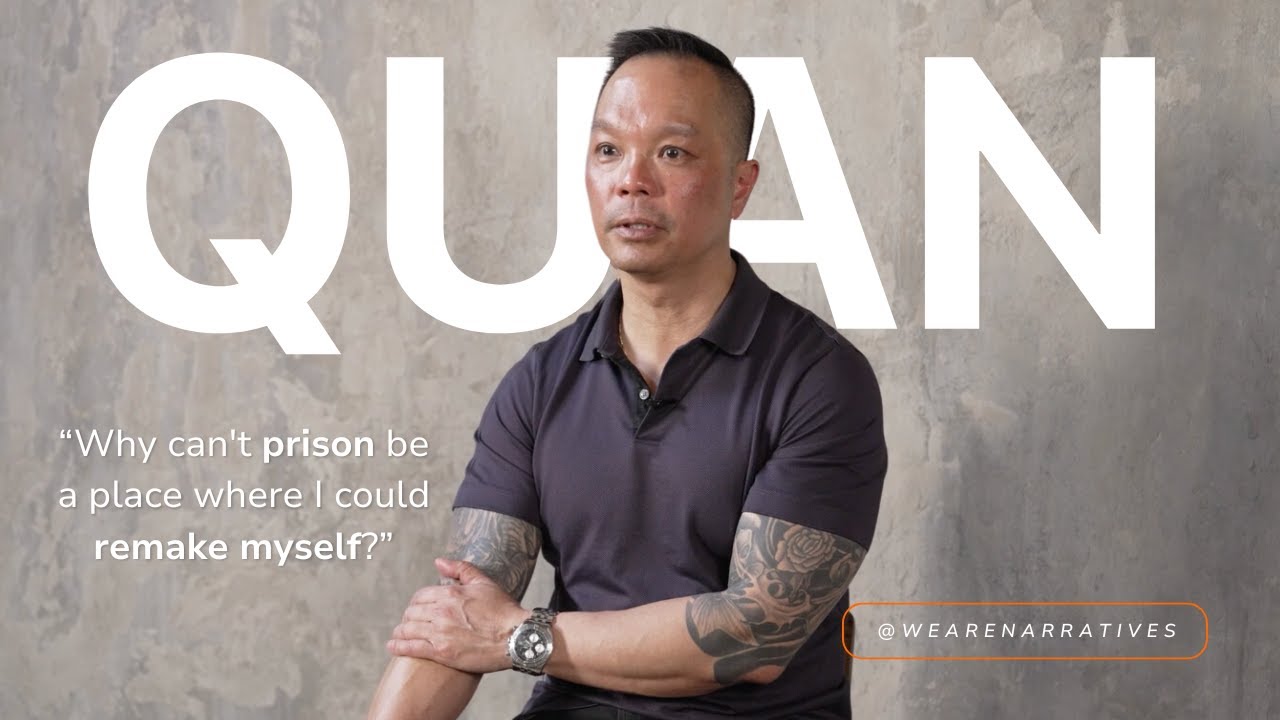
This story is the transcript of a Narratives video interview, lightly edited for clarity.
Content note: this story includes accounts of gun violence and a killing.
Growing up in Utah
Quan, thank you so much for joining me today. I'm excited to tell your story. Every story starts with childhood. Can you tell me a little bit about your upbringing?
My early childhood and upbringing: I grew up in Provo, Utah. I'm a first-generation Vietnamese refugee. My father was actually a South Vietnamese military officer. He trained with the US forces, so he knew the landscape of America. My mother had never seen snow before. So when we lost our country, my father decided to settle us in Provo, Utah. I wouldn't doubt that we were the very first Vietnamese family to settle in Utah.
I loved being a kid, running through the woods. But I also did experience what I now know to be racism. With my father, I always felt loved around him. He created the Vietnamese Refugee Association, and I remember as a little boy I got to accompany him on these long car rides, so I could always ask him a million questions. I didn't understand at the time why he was helping other Vietnamese immigrants and refugees settle into our new homeland. He was my hero. I used to see him on the news, because of a lot of the work he was doing in the community. He was being recognized. So I'd see him on the news, and he was my superhero.
My mother, on the other hand, has always been very stoic, and a lot of times, to me as a little boy, her words felt harsh. I don't think she meant it that way, but that's just how it always landed with me as a little kid: oh, I'm never measuring up. I'm not doing good enough. So those were the distinct differences. One thing that did make me feel loved by my mother was her cooking. She loved cooking for us, and she would just stand over us and watch us eat.
What was school like for you in Utah?
School for me in Utah... Now that I'm thinking about it, I always remember feeling like I didn't fit in. I remember wishing, why can't me and my family look normal, like everyone else around us? I do remember that. I don't remember much else about school in Utah, because that was only until fifth or sixth grade.
What happened after fifth or sixth grade?
My father got diagnosed with leukemia when I was eight, and his condition started to get worse, so we decided to move out to California, where his family lived.
Did that make you angry as a child?
I don't know if it would be angry. I think it was more confusion, and feeling isolated.
What was high school like?
Well, my father passed away when I was 13, and the day he passed away was the day of our first communion: my younger brother, my younger sister, all of us. Leading up to it, our only thought was, OK, the day we eat the bread for the first time, our first prayer is going to keep our father alive. And I remember that morning, when I woke up to get dressed for Mass, my sister was the one who told me, "Oh, I heard Grandma and Mom talking last night. Dad died." And then I went in and told my younger brother.
It was just so bizarre, because we didn't talk about it. We went to church pretending we didn't know my dad was dead, but he was already dead. My mom and grandma had decided they didn't want to tell us until after Mass, and we already knew the whole time. So it was a really weird experience, and we never once talked about his death again. Looking back now, we should have gone into therapy. This was devastating for all of us. But we never talked about it. We just brushed it under the rug: your father's gone, and Quan, you're the oldest, you have to... For me, it felt like this pressure: you have to hurry and grow up to take care of your family.
Starting to hustle
What was the first sign that that was what would have to happen, that you had to hurry up and grow up and start helping out?
I think even before my father passed away, I was already working. At 12, my first job was as a newspaper boy. And my younger brother and I had already begun hustling on the streets, because my dad was already going in and out of the hospital, and we didn't have money to buy shoes or things like that. Of course, every young kid wants to fit in, and we wanted to have cool shoes, so my brother and I were hustling just to buy our own clothes. And I think my mom just saw, oh, these kids are already working. So I think it was around when he started going in and out that we started working, and then hustling on the streets.
I remember at 13, 14 years old, I already knew how to break into cars. I remember my mom saw a whole bunch of car stereos under my bed one day, and she was like, "Oh, what is this?" And I just told her, "Oh, I'm fixing those." And she was like, "Oh, you're such a smart kid." She didn't know we were breaking into the cars. That's how we were beginning to make some type of money to buy our clothes and shoes, and just feel like we could fit in at school.
How did you learn how to do that?
One of my friends' older brothers: that was what they were doing. I remember I went with them one night, and there was this rush of excitement, and feeling like I fit in with them. My friend showed me, "Here, this is how you do it," and he started showing me how to break into the cars with just a flathead screwdriver. And I remember the first time we opened up a glove compartment and there were credit cards, and the older guys congratulated us: "Oh, this is what you do now." And they took us to eat.
And later on, these guys who were already doing stuff on the street started grooming us: "Oh, this is the stuff that you do."
At what age did you feel like you needed to go work, to hustle and make more money for yourself? Was it around the same time your dad was passing?
12, 13. Right before my father passed away.
So did you start hanging out with these people more often, the guys who were teaching you how to break into cars?
Yeah. When I look back at that progression: by the time I was 16, I remember they had printed these payroll checks, and they said, "Oh, we have this new thing. Quan, you have a car now. This is your job. You go to every BofA in Orange County and drop these checks off. Here's the debit card." So I knew the PIN. I remember I just put on a hoodie, put on a hat, and we deposited the checks. Each check was under $800. At the time, I guess there was a glitch in the BofA system: if you deposited a payroll check, it was supposed to hold it for three days, but since it was under $800, it didn't. So every check said $799.98, $795, whatever, right under $800. I drew out a map, and I hit every BofA, so at the end of the day there'd be like $20,000 or $30,000 in the account.
And the next day they would bring in somebody who looked like whoever's account we were using, like we were playing the account holder, to go in and pull all the money out. Then they'd call me and my friend: "Oh, good job, guys," and they'd give us some money. And I'd go buy my video games, and I'd buy beef jerky, and I had extra money at school, and I was like, oh, I'm kind of cool. I have this thing.
Then the thing was to get other local gangs to do stickup robberies. They'd lay people down and pretend just to rob the money, but the main thing was to go into places that had payroll checks and grab the last 10, 12 pages of the payroll book, so they couldn't report it. They didn't know it was taken. Then they'd take those payroll checks, and we'd use those same ones to deposit. So the currency we were going after was the payroll checks.
So I started learning. They got really sophisticated. I don't know how they knew, but one time their house was about to get raided, so they told me, "Quan, come over and pick up this suitcase." I drove over, picked up the suitcase, ran out and got in my car, and then the police raided their house. So I had this suitcase in my house for a few days, and I'm looking at it like, man, what is in here? What is in here? It just had a three-number combination, so I was like, let me figure this out. I started at 000, 001, and finally got it open. That was the first time I held a gun in my hand. There were two guns inside. There were more payroll checks, a bunch of cash, a bunch of stuff. I was like, oh, this is cool, and I started pointing the gun at the mirror and looking at myself. I was like, oh, this is really cool. I was 16 years old.
Wow.
They got busted by the feds about three months after I was already in for my first arrest. I read in the newspaper: organized crime ring responsible for, I can't remember, defrauding BofA of 20-something million. I remember 20-something million. They had all this money, and I was like, what did I get out of this? We were the ones running the payroll stuff.
What age was that?
17. That was around 17.
So your first arrest was before you were 18?
Yeah.
Two years in juvenile hall
What happened with that arrest?
I was arrested because my brother and I, because of our experience in Utah, always had a chip on our shoulder when it came to anybody professing to be a skinhead, or anything to do with white supremacy. If there were guys with shaved heads, or guys walking to school with swastikas, we would purposely try to hit them up: "Oh, you're a skinhead?" So they kind of knew our group. And I think my brother did a burglary with one guy from school who later started hanging out with a bunch of skinheads, and that guy told on my brother.
We caught the guy who told on my brother at a beach party, and he had a bunch of skinhead friends around him. My brother called him out to fight, and some of the other guys were about to jump in. I think it was around that time that one of my good friends had just gotten a .22. When they tried to jump in, he pulled out the gun. There were only 4 of us, and I think it was 20-something skinheads, but when he pulled that gun, everybody just backed up. That was the first time we saw, wow, the power of what a gun right here could do. This is the best equalizer in the world. And that just drew us in. After that, it was, OK, let's bring the gun here, let's bring the gun there. And people started talking: "Oh, Quan and his brother and that group, they carry guns." I think that made me feel like, oh, I'm kind of cool. I'm legit.
A few months after that incident, my brother called me. I was working at the time at Subway sandwiches, and my brother called me and said, "Hey, Gumby," which was the name of one of the skinheads, "just called our house and threatened to kill Mom. We're going to find them tonight." They said, "What time do you get off?" I said 10:00. They said, "OK." They stopped by the Subway and told me, "Yeah, this is what's going on." So I asked my coworker, "Hey, do you happen to know where these guys live?" She drew a map and gave it to me, and I shared it with them, and they said, "OK, we'll be back at 10:00, and we'll find them, and we'll shoot up the house." That's what we all said. So I said OK. We had never shot anybody, or shot at any houses or anything.
At 10:00 I got off work, and my brother didn't come. I went home, and my brother was lying on the bed under the covers, and I said, "What happened?" He said, "Oh, we went to the arcade, and somebody else showed up, and he showed us where the house is." And Red ran up and shot 3 people inside. He said one of my older friends had ordered the other guy, "Hey, if they come, I want you to shoot them all in the face." So my brother was pretty terrified.
Within a few weeks, they arrested all of us, including me, for conspiracy. They got me for conspiracy because I asked my coworker for the map, and she gave me the map, even though they never used that map. And they didn't arrest her, because she was white. And I'm thinking, OK, this is just further evidence that this world is against me. So that's when I went in as a juvenile. That was the first arrest. And it was a few months later that I found out my other friend and his buddies got busted on the federal case.
What was your mom's reaction by that point?
I think absolute shock. She had no idea anything was going on.
She had no idea?
Because once my father passed away, my mom was working full-time, so she was never home. It was just me and my brother running the streets. And school came easy for me in high school, so my grades were always good. I could be running the streets and still get good grades. There were no red flags for her.
The California Youth Authority
You pleaded guilty?
I pleaded guilty to conspiracy to commit a crime, and I ended up doing about a year and a half, two years in the California Youth Authority. They sent me up to the California Youth Authority. But at first I was in juvenile hall, and then they charged me as an adult, and I went to the county jail.
Why did they try you as an adult?
That was just California law. If you were doing a serious crime and you were over 15 at the time, they could charge you as an adult. My brother had just turned 15, so they didn't try him as an adult, but because I was over 15, they charged me as an adult. Those laws later went down to, I think, 14. They could send kids to life without the possibility of parole.
What was juvenile like?
It was terrifying. But later on you realize, OK, you find your place. This is your group. You're with the Asians. Some of those Asian groups or gangs I knew of, because they were some of the ones who used to do the robberies for our friends. So I kind of knew these groups or these guys, but we didn't all know each other. We just had to stick together.
What about your relationship with your brother?
He and I were always close, especially when we first went into juvenile hall. But when they charged me as an adult and I got taken to the county jail, he stayed in juvenile hall, and later on he went to the California Youth Authority, on his own separate path. But there was always part of me wondering what happened to my brother. I hoped nothing ever happened to my brother.
How did you spend the time while you were there, those two years?
I read a lot, and I learned to play cards. I started gambling. I learned from the older guys: this is how you gamble. And I actually got pretty good at it. The older guys always liked to play with me, because they'd taught me to count cards, so I got good at that. That made me feel cool. This OG coming back from prison is teaching me how to play Spades and pinochle, and he's actually picking me to go gamble with him, and these are big stakes we're playing for. So that was kind of fun.
Were there moments of fear?
I think there were constant moments of fear, but you just hide it. You don't talk about it. You shove it down. I think the first mission I volunteered for was because of fear: what would the guys think of me if I didn't put my hand up? They said, "Oh, who wants to volunteer?" And like a dummy, I said, "Here, I'll volunteer." And then we ended up attacking somebody.
In prison?
At the county jail.
At the county jail.
Yeah. That was the first time I actually saw how brutal it could be when you beat somebody really, really badly. The person didn't even look human anymore.
Reentry at 19
How long after that were you released?
A year and a half, about. I went in at 17, and I got out when I was 19. It felt like a different world. I went in when I was in high school. I didn't graduate high school. Now everybody who was in high school with me knew I'd gone to jail and the California Youth Authority. And with all my experiences in the California Youth Authority, of getting in fights and being in riots, I saw the world differently, and I felt like I didn't fit in with this outside world. The only guys I knew were the ones I'd shared that experience with in there, and those were the guys who later became the core of our gang, because now we were hanging out, and we had this shared understanding, this shared experience of how to show up.
So I remember having that perspective, but there were also the expectations of my mom wanting me to go to college and find work. So of course I did that too. I enrolled in college, and I remember the counselor at the time asked for my high school diploma, and I didn't have one. I don't know why, but I just told her, "Look, I just got out of the California Youth Authority." And she had me take the assessment test, and I tested well enough to get right into English 100, so I didn't have to take remedial stuff. Compared to some of my friends who got out and had challenges with their own counselors, with feeling judged or stigmatized, she was really good for me.
What happened next? What was your relationship like with your mom, and with the community you'd known before, the one that wasn't the gang and the street life?
With my mom, I was happy to be home. But going back to how she always communicated, that I wasn't measuring up: you're home, and now you have to take care of your family. My brother was still incarcerated. He didn't get out as early as I did. He had to do five years straight, and I got out after about two years.
But then I was in college, and like I said, school came easy, and I think it was in college that I suddenly felt, oh, I'm actually smart. In high school I didn't feel smart, but in college I was like, oh, I can hold my own against people here. I was in classes with some of my friends who were locked up with me, and they were struggling to get C's on the tests, and I was acing them. This is coming easy for me. OK, I can start trying to apply myself. But I just didn't know where or what, because there was always this part at the back of my mind: I've been arrested, and I can't find work, and it's hard to find work.
Did you want to be in college, or did you feel like you were there because of the expectations of society?
Looking back now, I think it was just an expectation of society. You have to have a college degree, because somebody successful has to have a college degree, which leads to a good job and all of that.
Did you get work next, or did you go back to hustling?
Where did I start to work? I remember I worked at a call center, and I was closing a bunch of sales, but the owner was being shady about paying me for the sales I closed. It never lined up. So then I got a job at Home Depot. What most likely happened is they ran my background check, and when it finally came back, they used an excuse to let me go. Let me see what else. Then I got a job at the Gallup Organization, which I really enjoyed. I was really good at that, doing the interviews, calling people, doing exit interviews, things like that.
Avenging a close friend
What brought you back to the gang and the street?
Well, the gang and the streets were always there. For me, it was synonymous: these are my friends. It was like a dichotomy. I had my school life, where I could show up for my mom and what she deemed successful, and there was a part of me that really enjoyed the nightlife, going out to the clubs, being known as this group of guys.
And I guess it came to a head when a really good friend of mine got killed in a shootout between us and a different gang. That really messed me up, because she was like the older sister I never had. I didn't deal well with her death, because for me it just became: OK, I'm just going to go looking for the guys who were responsible in that situation.
At what point was this? Were you still in college during this time?
Yeah.
So you were still in college. And what happened with this woman who was your friend?
We went to a club, I think right around her birthday, and while we were inside the club, another group of guys came in, from a rival gang. We started fighting inside the club. Security broke us up, and they pushed the other gang out, and they wouldn't let us out. That meant the other gang was able to get to their cars, which meant they had access to their guns first. They knew my car, so I knew they were going to follow me. So the plan was that everybody getting into my car was supposed to have a gun, and everybody else was supposed to sneak off a different way and let them follow my car, because we knew there was a dead-end street where we were going to try to lay out an ambush.
So we pulled down the street, and I told one of my friends, "Jump out right here," and he was lying there for the ambush, and we went down the dead-end street. And suddenly my friend pulled up, and she was drunk, and she was like, "Oh, where are we going now?" Like, what are you doing here? Things are about to go down. And right when we were telling her, we could hear the gunshots going off behind us. That was probably my friend, both sides shooting at each other. I told her, "Just take off for the freeway," and her car followed us. When we pulled out, we started shooting with the rival gang. I guess they chased us, but in chasing my car, the other car, I guess, just kept following her car. And her driver, I guess, panicked, and he crashed, and she flew out of the car, and that's how she died. She died on the concrete that night. When we came up, she was dead.
I'm sorry. That's tough. How do you recover from that?
I don't think I did. I think that put me in a really dark place. The only thing that gave me any sense of solace, which is really twisted to think about now, was... I didn't feel like I had done her right unless I found somebody to shoot at that weekend. I would go hunting for this other group, and even if I didn't find the other group, if I found somebody else who looked at me wrong or said something, I'd use that as an excuse to pull out my gun and just shoot at people for no reason.
And that first shootout, what were you getting out of it by being there?
That wasn't my first shootout. By that time I had been so ingrained in the rush and exhilaration of gunshots, and the smell of the gunpowder, all of that tied in, and just this sense of excitement.
Trying to break free of the hustle
So was that your last gunfight?
No.
What happened in the time between then and your last gunfight?
I got violated a couple more times while on parole, for gun violations, gang violations. The last time, I did two years, I think for a gun and gang violation, because they pulled us over. We had gotten some new, I can't remember, TEC-9s or MP5s, some new automatic weapons, and we wanted to try them out in the mountains, so we needed some extra ammunition. We went to a Super Kmart to buy a bunch of ammo, and I guess it made them nervous. We paid for it all, but when we came out, the Orange County sheriffs were out there waiting for us.
They wanted to search the car, and we said they didn't have the right to, which they didn't. He knew we had guns in the car, but I guess he went off some law that says if there's ammunition by a car, he had every right, which later got thrown out, because that law was for spent ammunition by a car. But he went inside, and they found a bunch of guns inside because of our ammunition, and because I was on parole, I got violated, and I went in. I think I did two years on that one, and I got out in '98, angrier, more like, fuck the world. This place screwed me over.
And when I got out, I went back to work at Gallup, and within about a year I was their interviewer of the year. I got the interviewer of the year award. And by that time, I think I was one of four interviewers doing the exit interviews for Microsoft's employees. Bill Gates wanted to know what his engineers were saying. Those were the coolest interviews I got to do.
That's pretty incredible. What was that like? This was the early 2000s Microsoft?
No, this was '98.
'98. You were doing interviews for Gallup.
Before their StrengthsFinder book and all that stuff, before they had all that fame. Back then, I think they were only known for the Gallup poll, but we were doing a bunch of studies for Microsoft and several other companies, and I got to be an interviewer on that.
That year, they asked me to interview for a management position. At the time I was going to school at Cal State Fullerton, majoring in management information systems, because I always loved computers and games and stuff like that, but I didn't know what I was going to do with it. When they asked me to interview for a management position, I remember thinking, finally something's going to go right for me in this life. Maybe things are going to go right. And that interview was personality based: what do you think about when you drive home at night? What color matches this? All these weird personality-based questions.
About a month later, they called me into the office, and they were like, "Hey, we're sorry, but you're not a fit." They used the exact phrase, "You are not a fit," which struck a deep part of me, that feeling of "I don't fit in." You're not a fit. I remember hearing those words: fuck, things can't go right. And I didn't tell anybody about it. I didn't tell my girlfriend or my mom about it. I did what I knew best at the time: I went down to a bar and got drunk.
Within a few days, I'd called a couple of my gang buddies: "Hey, are you guys going out clubbing this weekend, this Thursday?" We went up to a club in Hollywood. I brought my gun along. And when I came out of the club, I saw a fight happening. Some of my buddies were fighting with another group. It got split up. And I remember we parked at a gas station to fill up gas, and some of my home girls called and said, "Hey, those same guys you were fighting with are over here. They claim they're from this gang."
I looked across the street and saw them, and I said, "OK, let them follow you. Just pull out onto the street, and we'll follow them." So we coordinated that. For about 15, 20 miles they followed us, all the way from Hollywood almost to Orange County. And when I saw there were no cars on the freeway, we pulled up next to them, and I shot into the car. I shot and killed one man and injured the other 3 occupants of the car.
And who else was in your car?
Just a couple of people who were never arrested, so I can't talk about those people.
Fair enough. Were you driving as well?
No.
So what happened after you shot into the car? What did you feel, and where did you go next?
The women in the other car called me and said, "Hey, that car is no longer following us." And that's when I realized they didn't know what had just happened. So then I instructed everyone in my car, "Hey, let's not talk about this." I told them, "Let's meet up," and I wanted everybody out of my car. That's when I checked my car for the gun casings and things like that, and started cleaning up my car.
But the next day, one of the women's houses got raided. I guess the rival gang had written down her license plate before they got shot, and they turned that into the police, and that's where the investigation began. About five or six months later, I was arrested, and they tried me for the death penalty.
On trial for murder
What were the court proceedings like?
Numb. I would feel numb about it. I think I told myself, well, it was my life or theirs, which is all bullshit, but that's how I justified it in my mind.
You pleaded guilty?
No, I did not plead guilty. Even up to the day of trial, I remember the judge asked the prosecutor, "Are you going to offer a deal?" By that time, I think the death penalty committee had reviewed it and said this is not a death penalty case, but it was still a special circumstances case. So on the day of jury selection, the prosecutor said, "The people do not want to offer a deal to the defendant. We want to give him life without the possibility of parole. He should never hit the streets again."
Wow. And is that what you were convicted of?
No. I went to trial, and I was actually convicted of second-degree murder. The jury wasn't sure whether I was the shooter or not, and they found me guilty of second degree, which meant 15 years to life. The gang enhancements they could not prove, because they couldn't prove it was done for the benefit of a street gang, that I was a gang member at the time, or any of those things.
Sentenced to life
But at the time, it meant a death sentence anyway, because they had not paroled one single life-term prisoner in the state of California since 1977. So I went in with a life sentence, thinking, OK, I'm going to die in here. So it doesn't matter if it's 15 to life, or five to life, or 100 years to life. I'm going to die in here, so I'm going to live the way I want to live.
What did that mean for you, living the life you wanted to live?
Not caring. Not caring about the rules. If something needed to be done, then we had to do it. If there was discipline, people we had to attack, or if there were fights, or if there was hustling to be done, I was going to be involved with all of that.
Did that persist through your entire time?
No. I think it was about 10 or 11 years that I lived that way.
Did that get you in more trouble? Could they even add time at that point?
No, because we had life sentences, so there's really no adding time. You could go to the hole, or they could take you to ad seg, away from the general population, or threaten to, but there was really nothing they could do. I have a life sentence. They can't add more time.
And none of that was miserable to you, getting sent to the hole?
No, because that's just part of it. In prison, you have to be written up, so it doesn't matter. I think it would have been miserable if I couldn't hustle, being involved with the gambling rackets, and hustling tobacco and dope, and later on cell phones. That was all part of what hustling was in prison.
Were you a drug user?
No, I didn't use. I was a drug dealer, a drug seller.
A spiritual awakening
So when did things change for you?
About 10, 12 years into my sentence.
What changed?
Several things. I remember receiving a picture of my younger brother's daughter for the first time, as a baby, and I'm looking at her picture, and it took me back to our childhood, because she looked exactly like my brother, just as a baby girl. And I was thinking to myself, how did my life end up like this? Am I supposed to die in here? How did this all happen?
I also found out, through a letter, I can't remember exactly, that my father's father had passed away, and that also made me think. My father passed when he was 37 or 38, and by that time I was in my 30s, and I was contrasting what my father created in his short time on Earth with what the hell I had done. And it just made me feel like, I don't know what I'm doing. That's when those questions first came up.
Of course, the thing that always gave me solace was still books. I was always a big bookworm, known to read four or five different books at a time. And I have this habit: when I'm reading a book and I'm really drawn into it, I look into the acknowledgments to see who else influenced the author, and that gives me other books, and I just go down these rabbit trails. I've always been fascinated with books on entrepreneurship. I can't remember which book led me to which book, but I stumbled upon books and stories of the saints, and in particular stories of saints who had failed in their lives and then gone on to create these legacies and found these orders for the church. That led me to books on mindfulness and personal responsibility, and meditation, and those became this new set of books, like, oh man, I feel really free and fascinated by these topics.
I think all of that became a perfect storm in my head, and one day I was on the prison yard, looking at the fence, and I asked myself, why do I have to view prison as punishment? Why can't this be a place where I remake myself, the way each of these saints or monks or other spiritual warriors had? The sun was coming up over those hills that morning, and I could see the little blades of grass, and I could feel the warmth of the sun. And up above me in the razor wire, I heard a sparrow chirping. I tell everyone, those sparrows had probably been chirping my whole prison term, and I never heard them. But that day I heard it.
I'd say that's where it began for me. Suddenly I saw, wait, these are men around me. Some of them are much further along on their journey, and some of them perhaps haven't even awakened yet. Now I felt like, OK, this isn't a cold, harsh, ugly place. This is a place where I can begin to rebuild myself.
A grief and loss group
I remember one of the first things I did was check in with a therapist, and that's where I began talking about my father's death for the first time, after 20-something years. It was in therapy, understanding that process, that I became fascinated with the grief and loss process. Being the consummate bookworm, I stumbled on Elisabeth Kübler-Ross and her writings and teachings, and that gave me a different lens. I started to see that all the men around me in prison were also suffering, also unable to mourn or grieve any of their losses, and there was so much suffering.
But I also saw a way out. I saw what therapy did for me. So I put together a syllabus on grief and loss and submitted it to the prison psychologist, and the psychologist loved it, and we started the prison's first-ever grief and loss group. To be in there and see men coming in thirsting for healing and knowledge, and being able to mourn and grieve, and seeing tears in men who probably hadn't shed tears in 15, 20, 30 years, that was really meaningful for me.
I think that's where I suddenly saw a different lens: wait, this is how I want to show up in this world now. And that's what I began to do. I began to get involved with other groups, create other groups, read books on facilitating and group dynamics, even delve into child development psychology, and how that leads into criminal thinking. All of those things: oh man, this starts to make sense for me. It opened up a whole different world. Those next few years, I was in some forgotten corner of the world, and nobody knew about me, but I felt free. I felt like I was doing meaningful work, and I was able to impact the little area of the world I was in.
And the gang you were part of in prison was OK with you becoming this almost monk-like figure? It just happened naturally?
I think several things. When I walked away from all of that, I had the connections. I was running the parlay tickets for several yards of the prison. I had the connection for tobacco. I had the connection for the phones. I was connected for all of that. And when I walked away, I just went back to my Asian car and said, "Hey, I'm done with this. I'm walking away. Who wants the connections?"
So it wasn't like I was going out backwards, like, "OK, police, take me off the yard. I have to get off here, and let me tell you about everybody I know." It was more like, "Hey, who wants this? I'm done." And by that time I'd done enough stuff that nobody was going to say anything. I think if I had said I was done and then started toeing the line, it would have been worse. But once I just did what I wanted to do, the other men got to see, oh, he means what he says.
And your brother, with that picture of your niece: what happened with his story? He didn't follow in your footsteps when he came out the first time?
No. Fortunately, those five years were really productive for him. He found himself too. Once he came home, I'd told my homeboys, "Never bring my brother into the gang." Of course he hung out with them, but they knew he wasn't going to get brought in. He hung out with them, and he took on their values, and they knew, that's my little brother. Later on, he went into real estate, and he did very well, until the crash.
Fighting for parole
When you were learning, and then you created this program inside the prison, you still had no end in sight?
Yeah. I remember there was a big ruling that came down, I can't remember, in 2008 or '09. It was a woman prisoner. She fought it all the way up to the Supreme Court, and she basically asked, what's the difference between life with the possibility of parole and life without the possibility, because it doesn't look like California is honoring life with the possibility. And by that time they had 30 years of data that backed it up.
So the courts came back with this thing called factors of suitability. They listed, OK, this woman got her master's degree in prison, she'd never been written up, so someone can be found suitable if they fit these factors of suitability: never been written up, perfect prison record, and so on. And on the other side, they had factors of unsuitability. When I went down that list, I was like, oh, I check off all of these. So regardless of this ruling, they're never going to let me out, and they're never going to let out the vast majority of us, because who hasn't been written up in prison?
But that was, I think, where it began. A small crack opened. After that, men began to litigate, and it happened more. Now the courts were looking at what's going on in these parole hearings: how are they still saying these men aren't suitable? So it began to open up.
And when was your moment of parole?
2015. I went to the board for the second time, and I think they had seen the groups I'd been involved with and everything like that. They were reading the regular thing, and I thought I was going to get denied, and suddenly they said, "We find that the prisoner is not a danger to society," or I can't remember the exact words. I was like, what? And I looked at my attorney: oh my goodness, they found me suitable.
And how long after that were you released?
Five months, because there's a five-month process where the governor has to review everything. I remember, in those five months, I intentionally told myself: for these 150 days that I'm going to be here, I have to mourn the relationships I've built. I have to really mourn the depth of all these friendships I've had, because I may never see these guys again. So I remember intentionally being there for each guy and just spending time, and not worrying about the streets. I'm here. I'm present right now. Let me enjoy these last 150 days in prison.
Was it enjoyable?
It was. Of course there were some disappointments, because some people didn't deal well with me leaving, and they weren't able to express it, so it came out in other ways, which is also normal. But yeah, it was kind of disappointing.
Becoming an author
You eventually go on to write a book. I'm curious: when did you go from being a reader to a writer?
Well, already in Utah, I used to like writing. As a 12-year-old in junior high, I was recognized for creative writing, and they sent me to UCI's creative writing school for the summers. But it was in prison, in the last couple of years before I left, that I joined a creative writing group. I remember reading the first story I wrote out loud in the group, and it was absolutely quiet, and you know that nervousness: oh my God, what are people thinking? It's too quiet. And the guys turned around and were looking at me when I got done reading, and they were like, "Oh, you're a really good writer." That was the last thing I thought they were going to say. They said, "How long have you been writing?"
It was in that moment that I realized, oh, I used to like to write. Why did I stop? And I realized I stopped writing after my father died. I didn't write for all those years. But I did begin to write when the light came on for me, after my sparrow-in-the-razor-wire moment. I began journaling a lot, so that was where I could pour a lot of my thoughts and start examining them.
The journaling was where I think I was really able to take inventory of my day: what worked well, where could I improve, what did I fail at today. Intentionally asking myself where I failed, to just be OK with failure. Say I'm reading a concept in a book and I want to practice it, and then I realize, OK, running it through my mind, this is how I could have reacted differently.
And I think examining my thoughts and writing them down, I had other opportunities come up where suddenly, I don't know how to describe it, time could slow down for me, in response to conflict or in response to conversations. Before, I'd be quick to be very harsh or critical of people. Now I could see, oh, the old me would want to say this, and I could see my mind wanting to say it, but I could just keep my mouth quiet and push that thought away, that tendency to want to say something harsh or demeaning, because it doesn't help, and it doesn't build anybody up. Whereas before, that was me: really quick to do it.
Getting out of prison
So in 2015 you get released. What is life like coming out?
Shocking. A lot of color. A lot of happiness. Some disappointments. I think the first week I barely slept. The first night was too quiet, too dark. I was used to hearing some buddy shuffling to the toilet; you could hear the sandals. I was used to hearing the keys of the guards walking, the institutional toilets flushing. There's always that dim yellow light. And at my brother's house, it was absolutely quiet, totally dark.
And then I'd wake up excited: oh my God, I'm not in prison. I remember turning on the TV. It was like 2 or 3 in the morning, and I didn't know how to work the remote, because there were a million channels. I'm looking: where's PBS? Why can't I just get to a regular channel? There were like 100 channels. Trying to go back to sleep, then waking up again close to dawn, and deciding, OK, I want coffee. I'm looking all through the cupboards, and I can't find instant coffee. Then I see the coffee machine, and I don't know how to work the coffee machine. So there was difficulty from day one, just readjusting to technology and everything else out here.
What about finding work? What was that process like?
I was very fortunate, because my brother had his real estate firm. The very next day, they took me along on their work routine, which started with early morning yoga and then went straight to his real estate company. So from day one, the day after I got out, he started teaching me what they were doing at his real estate company.
Defy Ventures
What was the process of learning about Defy, your current employer?
I actually joined Defy when I was still at Solano State Prison. We heard about this brand-new pilot program coming out of New York called Defy Ventures. One of my buddies came into my work one day, and he had this packet. He said, "Oh my God, you missed out on the craziest presentation. There's this new group right here. I know you'll love it. It's about entrepreneurship." He handed it to me, and it was a 30-page application, and it asked, tell me about your journey, about a journey of transformation, and what about entrepreneurship excites you, all this stuff. I was like, oh my God, this is perfectly in alignment with how I want to show up in the world and be part of a group.
So I enrolled, and I got to the first business coaching day, and they said they were going to bring in a bunch of volunteers. I'd heard people say that before. And suddenly that day there was music, and they brought in 40 or 50 volunteers, and I saw all this color and all these smiles, all these amazing people: "Oh, I work at Google. Oh, I work at eBay." So that was my first exposure: oh man, this is really cool.
What year was that?
That was 2015.
So that was pretty close to your release.
Yeah. I joined Defy, and then I was found suitable, and 150 days later I was released, so I was released before the pitch competition.
So you didn't get to do the pitch competition?
I didn't get to do that pitch competition inside, but I continued with Defy once I got out. There was a program they were doing in Northern California. I was in Southern California, and they had me fly up to San Francisco, and I did my pitch up there. You want to talk about the worst pitch in Defy history? That was me, on that pitch.
Jade Janitors
What did you pitch? What was the idea?
OK, I'll back up. I was doing a bunch of Defy coursework, and at my brother's real estate company, I found out the building owner was looking for a new janitorial service. When I first came to work with my brother, I'd tell him... I used to work at the prison hospital, so we used to clean the hospital, and I had an eye for looking at the baseboards. That's always what you check to make sure the place looks clean. And I told him, "This janitorial company here sucks. Why don't you create a company? I know how to manage it, and I'll run the team." My brother at the time was like, "Oh, well, you can't just create a company like that."
Then I found out the building owner was looking for a new cleaning company. One of the things in Defy, part of a pitch, is that you introduce yourself: my name is so-and-so, and I'm the CEO and founder of this. So I was like, OK, if they're looking for a cleaning company, I have to find a name for my company. I got on GoDaddy, because I knew that's how you look for a domain name, and I started looking up Gold Janitors, Platinum Janitors. I wanted something that sounded valuable, and those were all taken. Then I said, what about Jade Janitors? Asians, we love the jade stone, and it's also very valuable. JadeJanitors.com was open. I think it was $9.99, so I purchased the domain.
I had the building owner's email, so I emailed him and said, "My name is Quan Huynh. I'm the founder and CEO of Jade Janitors. I used to work at a hospital up in Northern California, and I know how to properly clean things." And he said, "Can you give me a copy of your business license and certificate?" I didn't know what that was or how to get it, so I asked some family, and they said, "Oh, you have to go to the county courthouse and file it in the city." So I did it that day, scanned it and sent it to him.
He said, "Can you give me a copy of your janitorial insurance?" I didn't know what that was, so I got on Google: what's standard janitorial insurance? It gave me different policies, and I found one I could purchase. I think it was around $400 to purchase the policy, and I had to sign up for a year, at $80 a month. That was the point where I said, OK, this will be my first gamble right here, because it's $1,200 or $1,300 for this thing, and I don't even have a contract. I have no employees. I don't have a company. But I thought, if I land this contract, it will pay for itself right there. So I purchased that.
Then the building owner said, "Can you give me a quote for the building?" Since I worked in the building, I already knew how big it was. I remember telling myself, oh, this will probably take me three hours to clean. I'll pay a person for four hours to clean here. This is what I'll pay him, and this is the margin I want. I sent off the quote, and they said, "Can you guys start Friday?" And that's how I landed the very first contract.
So I already had that company when I flew up to San Francisco. But the business I pitched was the same one I'd pitched at Solano: team-building training for middle managers. Because that's what I was really fascinated with: how do you build culture, how do you build a team, and how do you make it a safe space for teams to really support each other, especially with managers. Like I said, worst pitch in Defy history. And I remember flying home and thinking, why am I pitching a company I haven't created? Why don't I pitch the company I'm already running? I could fine-tune it, and all the lessons I learn from it I could apply to other companies, and I could create the other company later on. So at the following pitch competition, I flew out to New York, and I pitched Jade Janitors, and I got second place.
At what point did you go from being a graduate of Defy to working with Defy?
2017. Defy was expanding into Southern California, to build out a Southern California chapter. Back then they only had a Northern California chapter. By that time, I was getting burnt out in real estate with my brother. It felt like it wasn't meaningful for me; it was work. And we had also launched my family's restaurant nine months after I got out, so I was there from the concept to the daily operations. I was the main one doing the employment interviews, so I got to help manage the restaurant. But when I found out Defy was expanding, I was like, man, I think I want to go back to the work that felt meaningful for me in prison, being involved with stuff like that.
So I interviewed with Defy and got the program manager position, and I was tasked with building out what it means for reentry and post-release. That was 2017, and over the years my roles and responsibilities have grown. About two years ago, I stepped into the role of executive director for Southern California, and now we're the largest chapter nationally.
Step to the line
That's pretty incredible. Can you tell the story of the exercise you do at Defy, walking up to the line, and the questions around that, and the impact it has, especially when you see it? What does that do for you now?
You're talking about Step to the Line. That's our empathy-building exercise, where one side has men or women who are incarcerated and the other side has our volunteers. I had done that exercise in prison, because of my facilitating work. I had done quite a few similar exercises, so I know how impactful they can be and how they connect people. I think they're great ways for people with totally different life experiences, occupations, whatever, to find commonalities, and to find the humanness in each other.
What are some of the questions?
Some of the questions would be: OK, if you like country music, step to the line. If you like scary movies, step to the line. And then we start digging deeper and deeper, going into things like: if you heard gunshots in your neighborhood growing up, step to the line. If one or both of your parents told you they loved you, step to the line. If your parents have ever been incarcerated. And we just continue to find different reasons why people step up or don't step up.
It's incredible. As a volunteer, having done it, I've seen all of these incarcerated men cry when they come to realizations like, wow, my childhood had so much impact on the decisions I ended up making in life. Is there a specific story of someone you worked with that was so impactful you feel like you've got to share it?
Stanley was a man I met at a prison where we were kicking off a brand-new cohort. We were there to tell the men about our program and who we are, and I saw this man come up. His name was Stanley, and he said, "I just don't believe you're here. I just got done reading your book." He had tears in his eyes. Then he turned to our career manager, who was also formerly incarcerated and had disclosed that he'd done 26 years, and he said, "And now I get to see 2 lifers in front of me who are home. I want what you guys have. Is it possible for me?" He said, "I don't speak English well. Can I do this curriculum?" And we assured him, yes. It's not going to be easy, but you can do the curriculum, and more importantly, this is going to be one of the best decisions of your life.
And to be able to see Stanley's progression, each time I went back in, to see the joy he began to exude. Then to see him at the final pitch: not only did he graduate, but we got to tell him at the pitch competition, on his graduation day, that he got a 100 on his final, which was extremely difficult. He got a 100. And then for him to share that he's a lifer, he may never go home, but Defy taught him how to die with dignity. For me, that was one of the best proofs of concept. I got to see him from the beginning, and then this new man. And then for him to tell me at graduation, "Hey, I want more of Defy. Do you think it's possible for me to come back as a peer facilitator?" I was like, "Yes, please apply." He was like, "Do you think I can do it?" And in my head I'm thinking, this would be the most amazing peer facilitator to help support the next cohort. He still didn't see it yet, but I saw so much beauty in this guy, and what it did, compared to who he was when he first came in.
Redemption
What does redemption mean to you now?
Redemption... The possibility to live a meaningful life. I think every human being can be salvaged, no matter how many terrible choices they've made. For me, there was a realization one day when I realized I was not born a murderer. It was because of a series of wrong choices I made over the course of my life. So I think, reverse engineering that, if I began to make correct and intentional choices each day from then on, then I could become a better human being. Of course, going back, there are possibilities of redemption, and like I said, every human is salvageable. I think dehumanizing somebody with words like felon and murderer and ex-con, all those things can be dehumanizing.
Can you share some of Defy's success from a recidivism standpoint?
To give you context: right now in California, it costs $132,000 to incarcerate one human being for one year. That's more than the cost of a four-year college tuition, right, in some cases. And in that one year, times however many years they do, you should be preparing them for reentry. But once they come home, within three years, 67 percent of those men or women will be back in prison.
Contrast that with Defy's numbers, which I'm very proud of. We run cohorts of 50 men or women through our program, which costs about $85,000. Contrast that $85,000 with 50 men and women at $132,000 each; that's about $6.6 million. So $85,000 versus $6.6 million. And our men and women have a recidivism rate of less than 15 percent.
I see it firsthand once they come home: the hunger, the thirst. In our program we really teach them: you're valuable. You can contribute to your communities. You can dream. There are bigger possibilities than just working a 9-to-5. There are bigger possibilities than, oh, you're just going to do construction. You can do many other things. You can do whatever you want to pursue. And I see them embody it once they come home.
How do you maintain your relationships with all of these people, when you go through the process of helping someone in prison and then they come out? I know there's a degree of separation for volunteers. How do you balance that, and the presence you have in all of these people's lives?
Well, I think the best part of my job is getting to tell a man or a woman, "Welcome home." Seeing them actually come home and getting to welcome them home. As a Defy staff member, and as an author, I get quite a bit of mail from men and women who are incarcerated, but because of my position at Defy, I can't write them back, because I'm going back in, and that's a gray area that could jeopardize things. But I tell them I read all their letters. And every time I walk in and walk out, I walk out with a piece of why I do this work. I'm going to continue to advocate for them. I'm going to push for employers to hire, to change their practices. Push for lobbyists to support our work. Push for foundations and corporations to continue to help us do the work we get to do.
What can individuals do to help support, one, Defy Ventures, and two, you and your work?
Well, I think first, if they want to see what we do firsthand, join us in prison. Come in with us. I think that's the first way to see it. What better way to shatter the narrative a person may have told themselves out here: these are prisoners, they should be locked up forever, those are murderers, those are the worst of the worst. And then you go in, and you see these are just human beings. Some of them have made very terrible choices, but at the end of the day they're still human beings. And at the end of the day, what do we want our future communities to consist of? You want to lock them up forever? They're not going to be locked up forever. So why not invest in them while they're inside, so that when they come home they can give back 10, 20 fold to their communities?
I love that. Thank you so much for your time and for telling your story. And of course, people can support you by buying a copy of your book, Sparrow in the Razor Wire.