Famous Conservative Is a Psychedelic-Assisted Therapy Evangelist
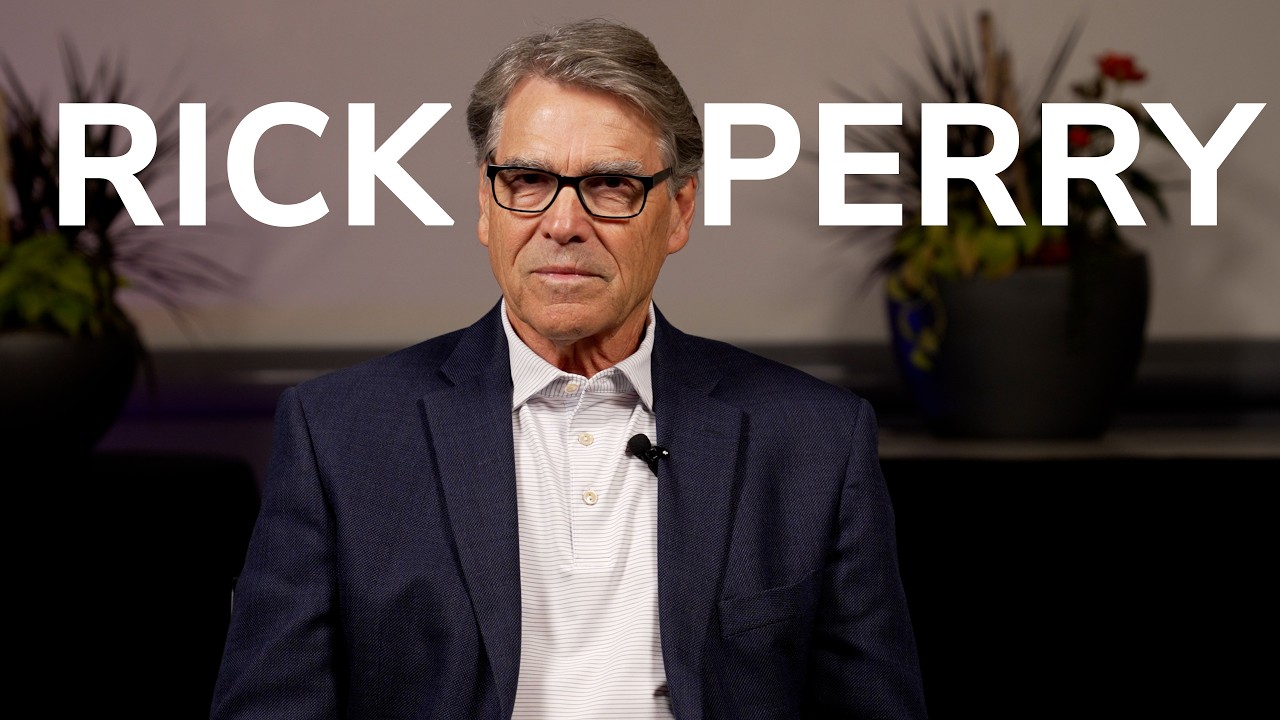
This story is the transcript of a Narratives video interview, lightly edited for clarity.
I'm Rick Perry, former governor of the state of Texas.
A conservative upbringing
What inspired you, as a traditionally conservative leader, to advocate for psychedelic-assisted therapy?
Well, a long journey, to say the least. I was born in 1950. So by the early '60s, I heard this really interesting music that was coming out of England by this group called the Beatles. I think it was in 1963. I heard this song called "I Want to Hold Your Hand," and I was like, I like that. And that was my introduction to the 1960s that changed the world.
Along with that came the psychedelic scene in Haight-Ashbury in California. I grew up in a very conservative part of the United States, in a very conservative Texas, in a very conservative family. So the idea of drugs and sex and rock and roll was not on the agenda.
As I went through high school and went to college, I went to a very conservative institution at that time, just transferring from an all-male, all-military school, called Texas A&M. I was in the Corps of Cadets, again a very conservative surrounding. The idea of drugs was just not on the radar screen. They may have been there. I doubt it, but we never saw it.
At the same time, we're surrounded by the turmoil of the '60s, the Vietnam War, the psychedelic rage that was going on across the country. We saw it. We weren't involved with it. We certainly kept it at arm's length. We were taught that any of those compounds were dangerous, they were wrong, they were inappropriate.
That stayed with me. I became a pilot in the United States Air Force. We were drug tested on a fairly regular basis. You want to end your career, have an illicit drug in your test. So that stayed with me both philosophically and personally: don't have anything to do with those compounds. They're bad.
The '80s: "Just say no to drugs." Again, "your brain on drugs." Over and over, teaching us that these compounds were not only illicit, but illegal and immoral. That mindset was very much a part of me, even into my political career. If it had to do with drugs, I was an automatic no, until 2013.
And I had a mother come into my office. I was the governor of Texas in my third term, and she had an epileptic son. The only way that they could give him some relief from his epileptic seizures was with THC.
I'd always been open-minded. I've always been curious, whether it was things like criminal justice reform, which we led the nation in, in Texas, or in this case, a compound that I had been told forever was bad. With the proper medical oversight, I became a believer that this compound, properly dosed, properly diagnosed and properly administered, should be allowed in the state of Texas. And we did. So that was my first move toward being open to the idea that some of these plant-based medicines had a role in our health care system.
Marcus Luttrell and ibogaine
At the same time that's going on, I'd been brought into the sphere of young men who had been traumatically affected by war. In this case, Marcus Luttrell lived with us at the Texas governor's residence for two and a half years, from 2007 to 2009.
That started my wife and I on this long journey, this long experiment of trying to help this young man who had post-traumatic stress, traumatic brain injury, an addiction to opioids and issues with alcohol. And it's led me here, to today, as a very public advocate, in my case, for ibogaine.
I stay pretty much with my blinders on. I'll let someone else study and do the work on psilocybin. We passed a bill in Texas back in 2021 for clinical trials on psilocybin that's going forward now, as we speak. But my focus is on ibogaine.
I have become completely convinced, both by studying it and by personal interaction, by seeing the clinical trials that they did at Stanford with the 30 veterans, and by working directly with Marcus and Morgan Luttrell and other veterans who have been treated, that this compound has the potential to truly change medicine like nothing, potentially, in the history of the practice of medicine. I think it's that monumental. I think it has that potential.
That's exactly the reason that I'm so excited that the state of Texas passed this legislation, signed by Governor Abbott, supported by the House and the Senate, the lieutenant governor and the speaker, in a very conservative state with a very conservative legislature that voted overwhelmingly. I think there were two dissenting votes in the entire Texas House of 150. It passed unanimously through the Senate.
The governor publicly signed this, a powerful message to the state of Texas. We believe in this. We believe in our war fighters. We want to give assistance and love and hope to those individuals who are addicted to certain compounds, and this medicine may be, and from my perspective will be, the absolute cure that we have for decades been looking for.
Training the therapists
Could you talk a little bit about what you know about the therapists, and also weave in your perspective on the fact that a lot of people have to go overseas right now to receive this treatment, or receive it in illegal settings underground?
I will use ibogaine as my example, because that's where my focus is. The limiting factor is in training the therapists. I suggest it's probably going to be this way with other plant medicines, too: having the pipeline of trained therapists may be the limiting factor. It may be what we really need to focus on before this becomes a very widespread, everyday treatment, so to speak, for addictions, for PTSD, for traumatic brain injury, and for the neurodegenerative challenges that we have out there with Parkinson's and MS.
I have no direct knowledge of therapists in the United States who are giving these therapies today. My instinct is, and I think I'm probably correct in this, that they're out there. There's an underground training process.
I know people are a little concerned: well, government comes in and wants to overregulate. I understand that. But my hope is that, with what the state of Texas is going to be doing with our clinical trials, and this is $50 million that the state of Texas has committed to the ibogaine clinical trials, part of that will be used for the training of therapists, and obviously the support mechanism that comes along with that.
So I think it's very important that we don't just say we're going to do clinical trials, but that we're also going to train the therapists. Because this is a process of properly diagnosing the individuals, properly dosing the individuals, and properly guiding them through the treatment itself. And then, and this may be the most important part, the follow-up that those therapists are going to be doing with the individuals who are being treated.
Washington and Schedule I
Can you talk a little bit about this new administration and RFK's role, and do you have any insight on upcoming policy changes at the federal level?
Yeah, I am very excited about the current administration. I'm talking about the Trump administration, with Robert F. Kennedy Jr., the secretary of HHS, and Pam Bondi over at DOJ. The reason DOJ is important in this, obviously, is the DEA.
But what Bobby Kennedy is doing, from my perspective, is very open and very curious. I think there's a healthy dose of curiosity and a healthy dose of skepticism in this administration, and I'm fine with both of those things. Let's follow the data, follow the science, and let that be our guide as we go forward.
I've had conversations with Secretary Kennedy about ibogaine and the team that he's going to be bringing in. Hopefully, sometime this summer, I'm going to be able to meet with him and his team, talk to him about what we're doing in the state of Texas, and how the federal government can assist in moving forward with this.
For instance, a rescheduling of ibogaine. Because let's face it, ibogaine does not fit into Schedule I. Schedule I says that there is no medical purpose for a compound and that it is highly addictive, and ibogaine is neither of those things. It got put there for political reasons back in the late '60s and early '70s by the Nixon administration. Along with some other compounds, it was used as a political tool.
So we basically put it on the shelf 50-plus years ago, and we're just now retrieving it from that shelf and using it for a purpose that can be absolutely positive for so many people who are suffering.
So I'm excited about the current administration. Hopefully you have the members of Congress, many of whom have been very public and vocal about this, some of whom you will have in this documentary, talking about the positive, hope-filled potential that this plant-based medicine has.
Beyond veterans
Beyond veterans and trauma survivors, do you envision other populations who could significantly benefit from psychedelic-assisted therapy in the future?
Veterans were the group that we worked with initially for plant-based medicine clinical trials in the state of Texas, for a couple of reasons. One is, I love them. My dad was a World War II B-17 tail gunner. He had friends, and he saw things that affected them through their lives.
I grew up in the '60s, in the Vietnam era. I was a Vietnam-era veteran, although I never went to Vietnam. I served in that period of time, and I saw the results of that combat on a number of those veterans.
As the commander in chief of the Texas military forces, I oversaw thousands of young Texans who went to the war on terror from the early 2000s until 2010 and 2011. I wrote a letter a week to a Texas family who lost a loved one in the war on terror. I saw firsthand how war affects those families and those individuals.
So, understanding the effect that combat had on these veterans, it was a passion for me to help them, to give them hope that there was some relief somewhere. They're also the easiest population to sell the general public on something like psychedelics. If five years ago we had said we're going to use psychedelics to treat X, the public would have probably said, "No, thank you." But with the veteran population, which the vast majority of the people in this country love and respect, the public was very open to that.
You ask the question: are there other populations? I will answer you with an overwhelming yes. As a matter of fact, a lot bigger population, when you look at the individuals in our society who are addicted to some compound, be it alcohol, opioids, cocaine, heroin or fentanyl.
With that population, we are comfortable that with one treatment with ibogaine, in the vast majority of these cases, and I'm talking up into the 80th percentile, those individuals lose the desire to take that compound again. That sounds too good to be true, but the data is clearly showing that that's the case.
So if we have this compound within our grasp, I ask the question: how bad do you have to hate somebody to not make this available?